Kuwait has identified the suicide bomber behind an attack on a Shi'ite mosque that killed 26 worshippers as a Saudi national, after a series of arrests.
Friday's blast also left 227 wounded in the first bombing of a mosque in the tiny Gulf state, with security services vowing to punish those responsible.
The Islamic State group's Saudi affiliate, the so-called Najd Province, claimed the bombing and identified the assailant as Abu Suleiman al-Muwahhid.
Kuwait's interior ministry gave the real name of the attacker as Fahd Suleiman Abdulmohsen al-Qaba'a, in a statement carried by the official KUNA news agency on Sunday.
It said he entered the country through Kuwait Airport at dawn on Friday, the day of the bombing.
News that makes sense
Your trusted source for staying up-to-date with the world around you. Get free daily news updates and analysis, straight to your inbox.
A hand-out photograph of Qaba'a showed a young bearded man wearing a traditional Saudi headdress.
Earlier on Sunday, the ministry said security services arrested the driver of the car that transported the bomber to the Al-Imam Al-Sadeq mosque in Kuwait City.
He was named as Abdulrahman Sabah Eidan Saud and described as an "illegal resident" born in 1989.
Authorities on Saturday arrested the car's owner, Jarrah Nimr Mejbil Ghazi, who was born in 1988 and also listed as a stateless person.
Authorities have also detained the owner of a house used as a hide-out by the driver, describing the owner as a Kuwaiti national who subscribed to "extremist and deviant ideology".
"Illegal resident" is the official term used in Kuwait to describe stateless people, locally known as bidoons, who number about 110,000 and claim the right to Kuwaiti citizenship.
Alleged IS executioner Mohammed Emwazi, who became known by media as "Jihadi John", was born in Kuwait to a stateless family of Iraqi origin that later moved to London.
Local media said 18 of those killed were Kuwaitis, three were Iranians, two were Indians, one each from Pakistan and Saudi Arabia, and one bidoon.
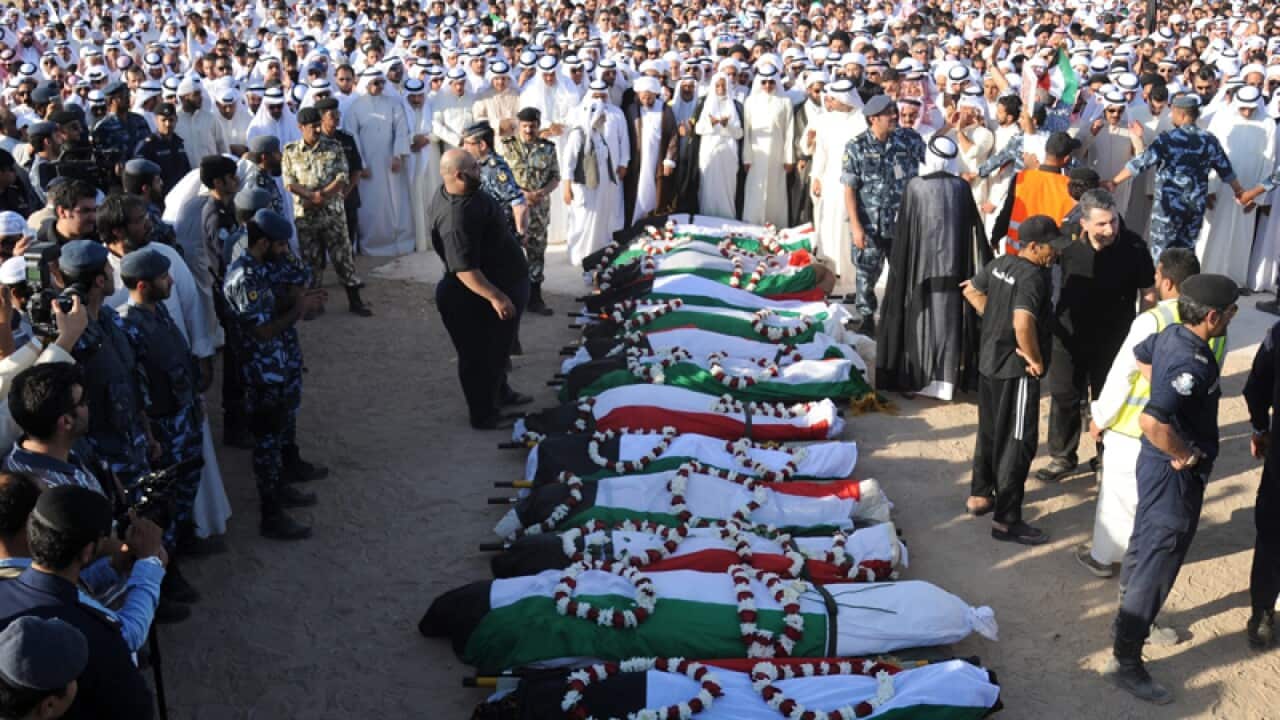
The breakthroughs in the bombing investigation came a day after thousands of Kuwaitis braved scorching summer heat on Saturday to attend the funerals of 18 victims.







