By Bronwyn Hinz, University of Melbourne; Chris Aulich, University of Canberra, and Sinclair Davidson, RMIT University
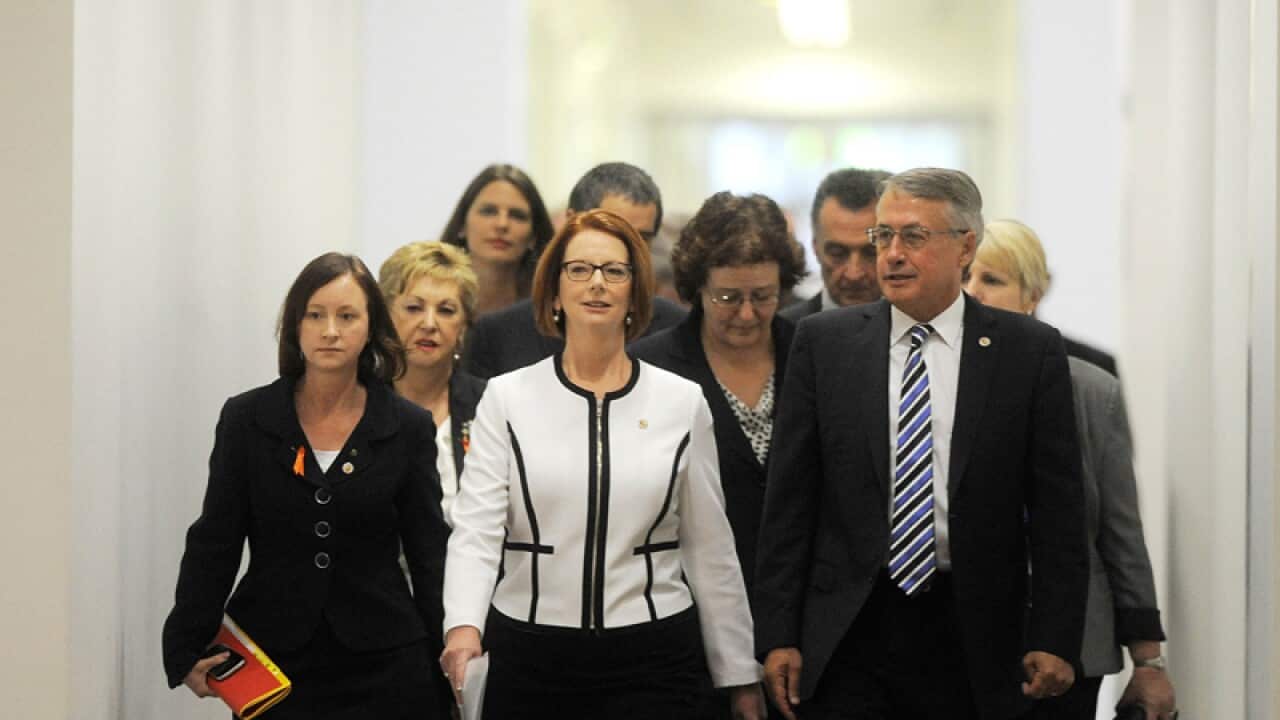
Prime minister Julia Gillard has called a ballot for the Labor party leadership at 4:30pm today, at the urging of minister and former leader Simon Crean.
Crean has called on Kevin Rudd to step up and nominate for the leadership, saying the current speculation cannot continue.
We'll bring you expert views on the outcome of the spill as it happens, until now, The Conversation's panel of experts give their view on the day so far.
News that makes sense
Your trusted source for staying up-to-date with the world around you. Get free daily news updates and analysis, straight to your inbox.
Chris Aulich, Professor, Australia and New Zealand School of Government's (ANZSOG) Institute for Governance
We don't know what will happen next, of course, it will all depend on the numbers… But the reality is the leadership spill had to come some time because [leadership speculation] really has not stopped since the last election.
I don't think Rudd and his supporters have really let go of the way in which Rudd was removed and the problem is it has been exacerbated especially by issues of judgement.
For example, why would you choose to pick a fight with the major newspapers this week when you haven't done the background work as they have done in Britain to make the issue one of significance to the population. It's come out of the blue to most people.
It really has underlined Julia Gillard's inability to understand proper process and her weakness in being able to gather around her the levels of support required both within the party, and certainly in the crossbenchers to get things through.
When it comes to the question of whether they can recover from this major turmoil, you look back to Latham for example. Latham followed after serious turmoil and he was able to turn the party around fairly quickly.
Tony Abbott, too, had exactly the same issue. We had an incredibly divided Liberal party and in a relatively short amount of time he was able to prepare them for the next election.
Someone said recently, “nothing sharpens the mind like a forthcoming election”. I suspect that's where Labor will find themselves.
If it is Gillard still, it will continue to be a problem for her. And if it were Rudd (and I can't think it would be anybody else) I think the Gillard supporters will have to get behind Rudd at least until the next election.
Self-preservation is going to drive Labor towards being more cohesive. But whether that will be enough? I don't know…

Bronwyn Hinz, public policy researcher University of Melbourne
The Rudd government and Gillard governments have extremely impressive records. In fact in 2012 we've had the second most pages of legislation passed in Commonwealth parliamentary history, and this is despite a supposedly unworkable hung parliament.
It's been the hardest week for Gillard since she assumed leadership in 2010, with the media reform package and anti-discrimination act unable to gain necessary parliamentary support, and Eddie Obeid and the NSW Right causing further destablisation. But in the end, it appears the spill really came down to polls. And as we know, polls are an imperfect and influential science, a mere glimpse into the electorate.
Both Rudd and Gillard are good communicators. Rudd was an excellent communicator with the public and Gillard was better within the parliament and caucus. Both skill sets are critically important, but they haven't successfully combined within a single leader, or a stable, ongoing leadership partnership.
Crean was right in saying the situation can't go on, because it's counting numbers and feverishly speculating on leadership prevents effective governance and diverts attention from the important matters before parliament, such as the apology to victims of forced adoption. That's what we should have talked about today.
Sinclair Davidson, School of Economics, Finance and Marketing College of Business, RMIT
Irrespective of what happens at 4.30 today, the Gillard government has collapsed. Julia Gillard doesn't have the support of a fair proportion of her party.
Ultimately this points to the legitimacy of her rule. While there might be some months to the next election no one can seriously imagine that any government can now do much to implement any serious policy.
To be fair, that may not be a bad thing – politicians with ideas cause trouble.
There have been some spectacular policy failures over the past few years. Fuelwatch, grocery watch, banning live exports, the various mining taxes, broken promises to cut corporate income tax, the list goes on. At the same time voters have been unimpressed with the government's claim that the stimulus steered us through the global financial crisis.
The electorate was confused by the carbon tax policy. Ms Gillard stared down the camera barrel and promised there would be no carbon tax under a government she led. We can quibble as to whether she meant there would be a price on carbon but in the form of tax – the electorate were unimpressed.
Government failings have been most evident in handling the economy. But we can't blame Ms Gillard for that. Wayne Swan has been Treasurer since November 2007. He has not been up to the challenge.
The Rudd-Gillard government inherited a budget surplus and spent it all. Now there has always been a good reason to spend. But there is no doubt that the government spent too much during the GFC and the budget has never recovered.
This has been a big spending government. John Howard was a big spender too, but his government had the revenue to spend.
This has also been a government that was reluctant to take advice. When economists warned that the stimulus spending was too much, they got vilified. Businessmen who argued against the mining tax got vilified. Newspapers that reported on government bungling got vilified.
This has been a government where policy ambition outstripped basic competence.
All this isn't Julia Gillard's fault. In 2007 Labor were under-prepared for government. This can be seen by the rapidly convened 2020 Summit – the government had run out of ideas within six months of winning office.
Against that background it is very hard to see what an alternate Labor prime minister can really do in the few months that remain before the election.
More to come.
Bronwyn Hinz used to work for Labor Senator Kim Carr and MP Maria Vamvakinou.
Sinclair Davidson has received funding from the Australian Research Council. He is a Senior Fellow at the Institute of Public Affairs.
Chris Aulich does not work for, consult to, own shares in or receive funding from any company or organisation that would benefit from this article, and has no relevant affiliations.








