
In Brief
- The government ruled out lifting compulsory super above 12 per cent as debate over retirement savings grows.
- Labor will crack down on lead generators accused of steering Australians into high-risk investments.
Labor will not increase how much superannuation employers must pay workers, instead focusing on reforms to stamp out "predatory" practices used to lure people to put retirement savings into risky investments.
The superannuation guarantee rate — the minimum percentage of a worker's earnings that employers must pay into a retirement fund — is 12 per cent, and there have been calls within Labor to raise the rate to 15 per cent.
While rebuffing the need to increase the guarantee rate, the government has doubled down on its defence of the superannuation system amid calls from One Nation to allow workers to withdraw funds before retirement to help pay off mortgages.
"There's no plans to lift the super guarantee," Assistant Treasurer Daniel Mulino, who unveiled the long-awaited consumer protection reforms on Wednesday, told ABC's Radio National.
He said raising the rate to 12 per cent was something Labor had long pushed for and that was now "putting people in a very strong position" for retirement.
News that makes sense
Your trusted source for staying up-to-date with the world around you. Get free daily news updates and analysis, straight to your inbox.
Mulino detailed the long-awaited crackdown on predatory practices in an address to the National Press Club on Wednesday, after the high-profile collapses of First Guardian and Shield Master Funds in 2024 and 2025 stripped an estimated 12,000 Australians of their retirement savings.
The reforms land in the middle of a wider fight over superannuation.
One Nation has pushed to loosen rules around early access, while the government ruled out any rise to the compulsory super guarantee on Wednesday morning.
What's changing?
The reforms target "lead generators" — operators who use social media, online ads and cold calls to funnel people's retirement into high-risk schemes.
Unlicensed real-time communication about superannuation will be banned, and licensees will be required to take reasonable steps to ensure lead generation activities comply with legal requirements.
The anti‑hawking regime will also be bolstered, with stronger consent requirements, a narrower exemption for financial advisers to existing clients, and harsher penalties for breaches.
Mulino said the reforms were designed to strengthen consumer protections and disrupt "predatory and inappropriate behaviour" that led to the collapse of the Shield and First Guardian funds.
"Lead generators reaching out to these people in unsolicited ways, undertaking highly manipulative interactions to convince them that their super products were not performing well or were inappropriate, and then manipulating them into inappropriate products for them," Mulino told ABC radio on Wednesday morning.
The government previously floated the measures in a consultation paper published in April.
The Financial Advice Association of Australia (FAAA) has previously called on Labor to crack down on the practices, which can steer consumers towards inappropriate financial products.
FAAA chief executive Sarah Abood said the collapse of Shield and First Guardian showed how devastating high-pressure sales tactics can be when unregulated.
"Around 12,000 Australians lost, in some cases, all their retirement savings after being targeted by sales processes that looked and felt like advice," Abood said.
"Consumers need stronger protections against predatory lead generation, while still being able to find the right adviser for them."
SBS' The Feed spoke to victims of the collapses in July 2025, including Melbourne woman Susy Zjak, 52, who lost her entire $574,000 super balance after being cold-called and steered into the First Guardian Master Fund.
"I felt dizzy. I just cried. I vomited. I actually thought I was going to have a heart attack. It was the worst nightmare of my life," Zjak said at the time. "This is 30 years of working, 30 years of hard working."
A new political battleground
The reforms come as superannuation threatens to become a fresh political battleground.
One Nation leader Pauline Hanson called this week for super rules to be relaxed and allow Australians to withdraw their super during the cost of living crisis, labelling the current system as broken.
Treasurer Jim Chalmers rejected the idea on Tuesday, warning it would "absolutely decimate the retirement incomes of millions of Australian workers" and that One Nation was undermining the superannuation system.
"One of the most important features of our superannuation system is ... this idea that, with compounding interest over time, Australian workers can access the decent retirement incomes that they need and deserve after a lifetime of work."
Australian Council of Trade Unions president Michele O'Neil backed that view on Wednesday morning, but said people shouldn't be forced to choose between surviving now and their future retirement.
"Workers shouldn't have to choose between housing and being able to have a retirement with some dignity and not retiring into poverty," O'Neil said.
"We have to recognise that it's a good thing that we've built up the opportunity for people to be able to retire with a bit of security — it shouldn't be an either-or.
"We need to keep super strong and growing for people. If money's taken out early, then they get less at the end. They don't get all that compounding effect, which is so important when you face retirement."
Currently, super can only be accessed in limited circumstances, such as stopping the foreclosure of a home, a terminal medical condition or severe financial hardship.
Tax office figures show 67,900 early super releases were approved in 2024/25, amounting to just over $1.4 billion.
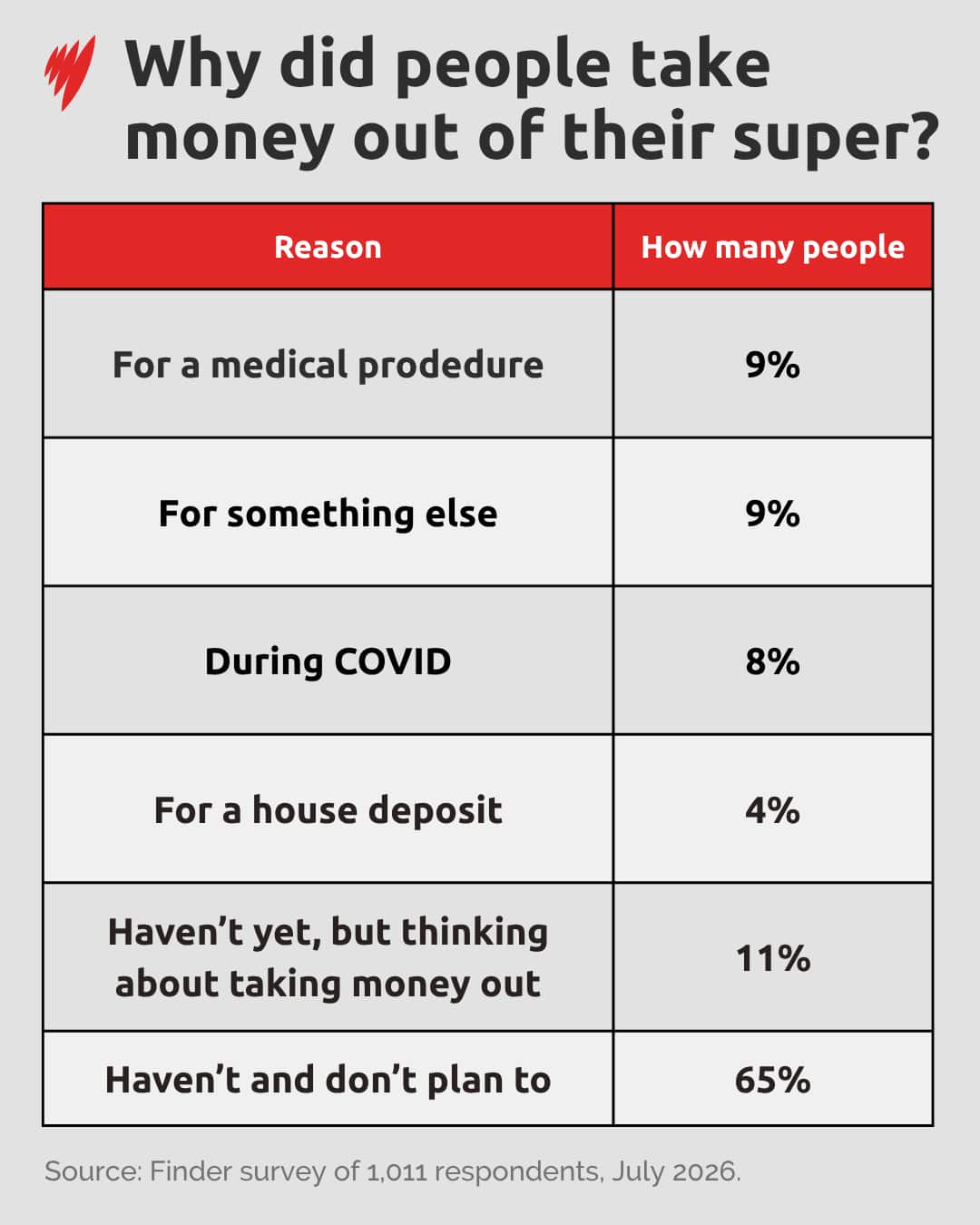
New research from comparison site Finder found 24 per cent of Australians have withdrawn money from their super before retirement, according to a survey of 1,011 people.
Medical expenses were the most common reason, cited by 9 per cent, with another 9 per cent withdrawing for "other reasons". Eight per cent did so during the COVID pandemic, and 4 per cent have used their super to help fund a house deposit.
Eleven per cent said they were considering a withdrawal, while 65 per cent said they had no plans to touch their super early.
Of those who had accessed their super early, 43 per cent said they regretted it.
— With additional reporting by the Australian Associated Press.
For the latest from SBS News, download our app and subscribe to our newsletter.







