
Local television dedicated morning bulletins to the attacks, which were carried out late on Thursday in a busy residential and commercial area that is a stronghold for Lebanese Shi'ite movement Hezbollah, and were claimed by Islamic State.
"Unacceptable", newspaper L'Orient Le Jour said in a one-word front-page headline. Another daily, al-Diyyar, showed gruesome pictures of the bodies of the bombers, including a bloody disembodied head.
The pro-Hezbollah al-Akhbar proclaimed there was "no room for retreat", after the group warned of a "long war" against its enemies.
UN Secretary General Ban Ki-moon condemned the attacks, urging Lebanon's security services and state institutions "not (to) allow this despicable act to destroy the relative calm that has prevailed in the country over the past year."
The explosions were the first attacks in more than a year to target a Hezbollah stronghold in Lebanon, as the Iran-backed group steps up its involvement in the war in neighbouring Syria.
News that makes sense
Your trusted source for staying up-to-date with the world around you. Get free daily news updates and analysis, straight to your inbox.
US condemns blasts
"The United States will stand firm with the Government of Lebanon as it works to bring those responsible for this attack to justice," the White House's National Security Council said in a statement.
At least 43 people were killed and more than 240 wounded on Thursday in two suicide bomb blasts claimed by Islamic State in a crowded residential district in Beirut's southern suburbs, a stronghold of the Shi'ite Muslim group Hezbollah.
The explosions were the first attacks in more than a year to target a Hezbollah stronghold inside Lebanon, and came at time when the group is stepping up its involvement in the Syrian civil war -- a fight which has brought Sunni Islamist threats and invective against the Iran-backed Shi'ite group.
Hezbollah has sent hundreds of fighters to support Syrian President Bashar al-Assad's forces in the four-year-old conflict over the border. Government forces backed by Hezbollah and Iranian troops have intensified their fight against mostly Sunni insurgents, including Islamic State, since Russia launched an air campaign in support of Assad on Sept. 30.
Syria's civil war is increasingly playing out as a proxy battle between regional rivals, including Iran and Saudi Arabia, which supports the rebels. The two foes also back opposing political forces in Lebanon, which suffered its own civil war from 1975 to 1990, and where a political crisis has been brought about by factional and sectarian rivalries.
The blasts occurred almost simultaneously late on Thursday and struck a Shi'ite community center and a nearby bakery in the commercial and residential area of Borj al-Barajneh, security sources said. A closely guarded Hezbollah-run hospital is also nearby.
Health Minister Wael Abu Faour said 43 people were killed and 240 people were wounded.
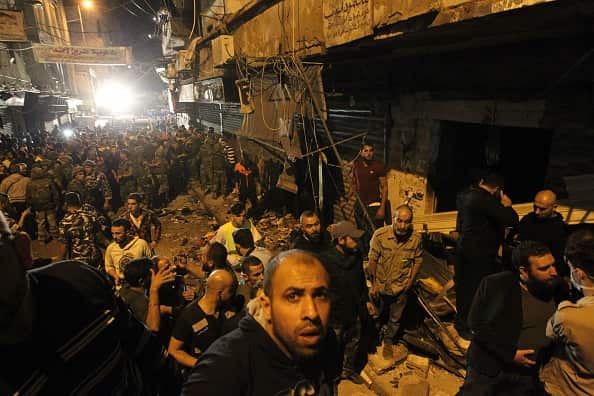
Islamic State said in a statement posted online by its supporters that its members blew up a bike loaded with explosives in Borj al-Barajneh and that when onlookers gathered, a suicide bomber blew himself up among them. The group said the attacks killed 40 people.
Hezbollah vowed to continue its fight against "terrorists", warning of a "long war" against its enemies.
Medics rushed to treat the wounded after the explosions, which damaged shop fronts and left the street stained with blood and littered with broken glass.
Interior Minister Nouhad Machnouk said a third suicide bomber had been killed by one of the explosions before he could detonated his own bomb. His body was found nearby.
It was a blow to Hezbollah's tight security measures in the area, which were strengthened following bombings last year. The army had also set up checkpoints around the southern suburb entrances.
'Unjustifiable attacks'
A series of bomb blasts struck Lebanon in 2013 and 2014, including attacks on Hezbollah strongholds. Most of them were claimed by Sunni militants in response to Hezbollah sending fighters to Syria to fight in support of Assad.
Hezbollah's involvement has brought many threats against it in Lebanon.
Security forces say they have foiled a number of attacks inside the country recently and dismantled terror cells. A security source said a man wearing a suicide vest was arrested in Tripoli on Thursday, and a bomb dismantled in the northern city.
The attacks drew a wave of condemnation across the country's political spectrum, including some of Hezbollah's opponents.
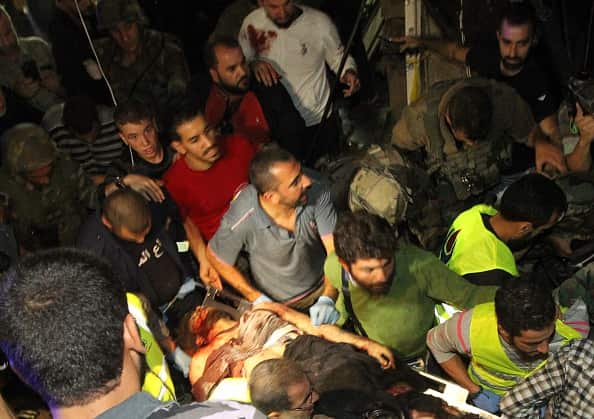
Lebanonese Prime Minister Tammam Salam condemned the attacks as "unjustifiable", and called for unity against "plans to create strife" in the country, urging officials to overcome their differences. France's foreign ministry also condemned the attacks.
The war in Syria, with which Lebanon shares a border of more than 300 km (190 miles), has ignited sectarian strife in the multi-confessional country, leading to bombings and fighting between supporters of the opposing sides in Syria.
Gun battles broke out in Tripoli last year in clashes that involved the army and Islamist militants, and regular infiltrations of Islamists from Syria into a Lebanese border town still draw army or Hezbollah fire.
The bombers also struck as Lebanese lawmakers held a legislative session for the first time in over a year. A political crisis has left the country without a president for 17 months, with the government failing to take even basic decisions.
Religious leaders warned last year that in the absence of a head of state, sectarian strife was threatening a country that was gripped for 15 years by its own civil war.







