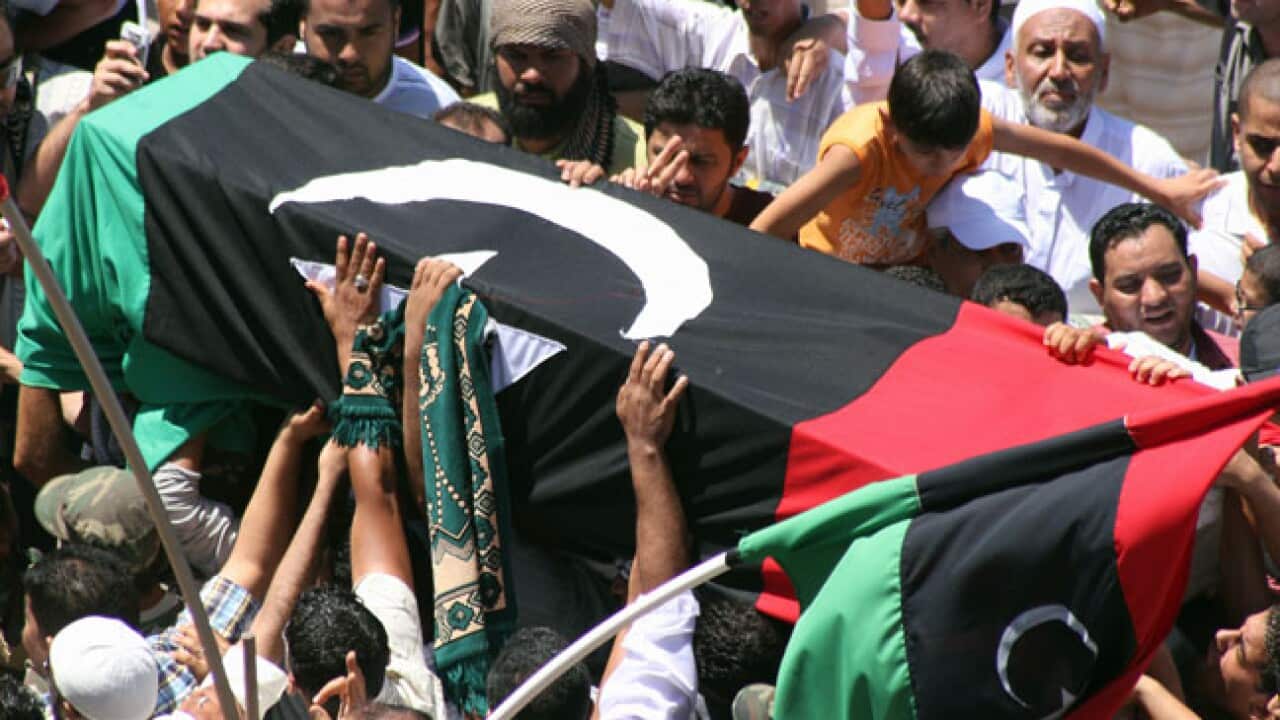
Tens of thousands of Libyans mourned slain rebel military chief General Abdel Fatah Yunis on Friday as insurgent fighters pounded forces loyal to Muammar Gaddafi in the west of the country.
"The blood of martyrs will not be spilled for nothing," the crowd, which attended the weekly Muslim prayers, chanted as Yunis's coffin was carried away under the nervous gaze of security forces.
Yunis was shot dead by a gang after he was summoned from the front by the National Transitional Council "for questioning over military issues," NTC chairman Mustafa Abdel Jalil said late on Thursday.
News that makes sense
Your trusted source for staying up-to-date with the world around you. Get free daily news updates and analysis, straight to your inbox.
"With all sadness, I inform you of the passing of Abdel Fatah Yunis, the commander-in-chief of our rebel forces," Abdel Jalil said in a statement to reporters in Benghazi, the rebels' eastern stronghold.
"The person who carried out the assassination was captured," a somber looking Abdel Jalil said without elaborating, moments before armed men stormed the hotel where he was speaking and accused the NTC of the assassination.
Yunis's death, and that of two officers with him, left rebels with a leadership crisis on the same day that they made fresh advances in the western Nafusa mountain range as part of a pre-Ramadan push to oust Gaddafi.
The United States urged the rebels to stand united and stay focused on ousting Gaddafi and blamed him for creating the conditions that led to the murder.
State Department spokesman Mark Toner said: "I think what's important is that they work both diligently and transparently to ensure the unity of the Libyan opposition.
"In this kind of fluid situation, it's important to keep, if you will, eyes on the prize, which is the democratic transition for the Libyan people," Toner said.
"Such tragedies speak to the situation that's been created by Gaddafi and his regime. It underscores why he needs to leave power and do so immediately."
In London, Britain's minister for the Middle East and North Africa, Alistair Burt, said he condemned the assassination and had delivered his condolences to Abdel Jalil.
"Exactly what happened remains unclear. I welcome chairman Abdel Jalil's statement yesterday that the killing will be thoroughly investigated, and he reiterated this to me during our conversation."
Later Friday, Ali Torhuni, who normally handles economic matters for the NTC, said they had had formed a committee to investigate the assassination and they would publish all their findings.
The assassination of Yunis, Libya's interior minister and Gaddafi number two before defecting in February, has fuelled a broad range of rumours, including that rebels killed him for treason.
Meanwhile, a senior opposition figure in Benghazi accused Gaddafi on Friday of playing a role in the killing.
Early reports from Tripoli that Yunis had been killed suggested Gaddafi wanted it in a bid to get rebels to withdraw from the strategic eastern oil town of Brega.
"All these are signs Gaddafi was behind it," the official told AFP, asking not to be named.
But a spokesman for Gaddafi said Al-Qaeda was behind the killing and insisted it showed the weakness of the rebels' grip on the east.
"By this act, Al-Qaeda wanted to mark out its presence and its influence in this region", Moussa Ibrahim told reporters in Tripoli.
"The other members of the National Transitional Council knew about it but could not react because they are terrified of Al-Qaeda," he said.
"The assassination of Abdel Fatah Yunis was a strong message from Al-Qaeda to the other members of the NTC," Ibrahim added.
Yunis was killed as he returned from the front line, which lies near Brega.
The scenario that the rebels may be fighting among themselves could pose awkward problems for the many Western powers who have recognised the NTC as the sole legitimate authority in Libya.
"The NTC hasn't been able to make any clear, credible statements about Yunis because they don't really know what's going on," Lynette Nusbacher, senior lecturer in war studies at Britain's Royal Military Academy Sandhurst, told AFP.
"Nobody wanted him alive except maybe his mother," she said, adding that the leadership crisis opened an opportunity for rebels to promote a better field commander to his position.
Rebels and loyalist forces have fought their way into a stalemate five months after the start of a popular uprising that quickly turned into a civil war.
The Libyan leader controls much of the west and his Tripoli stronghold, while the opposition holds the east from its bastion in Benghazi.
In Brussels, a NATO official told AFP Norway would fly its last combat mission in Libya on Saturday, two days before the official end of its role in the air war.
But a Norwegian military spokesman, Colonel Petter Lindqvist, refused to confirm that.
And Portugal became the latest country to recognise the NTC, the foreign ministry said.
dsg/jj/ch
DATELINE:BENGHAZI, Libya, July 29, 2011 (AFP) -
A Pakistani-American, Faisal Shahzad, was jailed for life last October for the Times Square attack.
Tehrik-E-Taliban Pakistan (TTP) leader Hakimullah Mehsud has been on the UN sanctions list since last October because of his links to Al-Qaeda and the Afghan Taliban.
His group claimed responsibility for a suicide attack on the World Food Program headquarters in Islamabad in October 2009, and for an attack in July 2010 which killed more than 50 people waiting to receive relief supplies in Mohmand Tribal Agency, Pakistan.
Other attacks include a double suicide bombing in Mohmand Agency in December 2010 which killed more than 40 people, and an attack on a Pakistan army compound in Mardan in February 2011, which killed 31.
In May, Pakistan Taliban operatives stormed a Karachi naval base and killed at least 10 security officers. The Pakistan Taliban said Friday they were holding a Swiss couple kidnapped a month ago while on holiday in the remote province of Baluchistan.
Britain's UN ambassador Mark Lyall Grant said the addition of the Pakistan Taliban to the UN terrorism list "sends a powerful signal of the international community's solidarity and resolve in the fight against the TTP and international terrorism."
The UN Security Council decided last month to take the Afghan Taliban off the Al-Qaeda sanctions list to differentiate the two and encourage Afghan reconciliation efforts.
"We have made a conscious choice not to seek the wholesale listing of the Afghan Taliban at this time. This is because we want to support the Afghan reconciliation process," Lyall Grant said.
"But the Afghan Taliban should heed this message. The window will not be open forever. If the Taliban continue actively to work against the political process, continue attacks on civilians in Afghanistan and Pakistan and UN Security Council-backed international forces, then we will seek the listing of key Taliban leaders, notably on the military side," the British ambassador added.
The Caucasus-based Emarat Kavkaz, which says it wants to set up an Emirate across the Russian Caucusus and neighboring countries, was added to the terror list because of its alleged links to Al-Qaeda.
It is accused of responsibility for attacks on Russian security forces. The group's leader, Doku Umarov, this week claimed responsibility for the killing of a Russian colonel, Yuri Budanov, who was convicted of strangling a teenaged girl.







