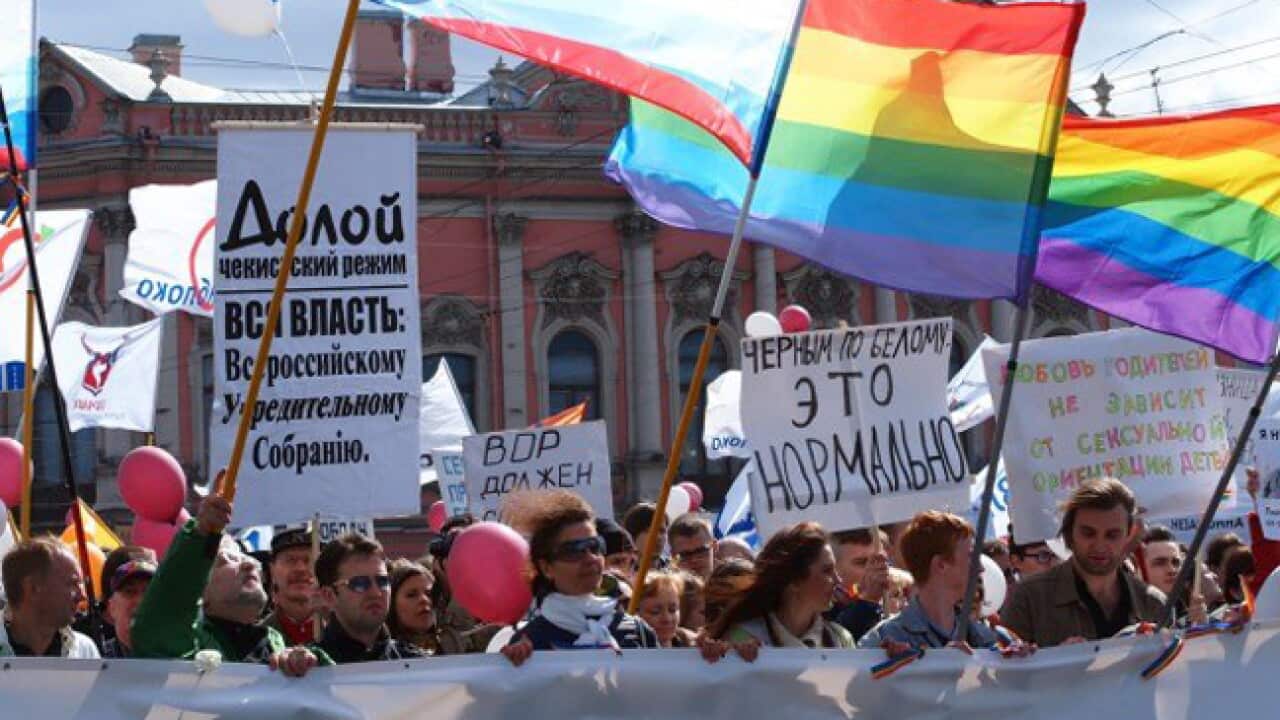
As the world marks the International Day Against Homophobia, Russia's gay and lesbian community is living in fear of arrest under a set of repressive new State laws that look set to be adopted federally.
Gay rights activist Igor Kochetkov thought he was doing the right thing when he got official approval for his planned May Day march into downtown St Petersburg.
State authorities had inspected his anti-homophobia banners. They scrutinised the confronting messages “we didn't vote for discrimination”, “gay rights are human rights” and “they came for gays today, they'll come for you tomorrow”.
Nobody warned him off and his protest got the green light to proceed. It appeared he had navigated a repressive new anti-gay law that bans so-called "homosexual propaganda" as a threat to minors.
But when he and another one hundred activists from his LGBT (Lesbian, Gay, Bisexual and Transgender) Network raised their rainbow flags and banners in unison along Nevsky Prospekt, the police moved in.
News that makes sense
Your trusted source for staying up-to-date with the world around you. Get free daily news updates and analysis, straight to your inbox.
“It is clear to us that to be gay in Russia means you are an enemy of society,” the LGBT Network Chairman told SBS through a translator.
Seventeen demonstrators, including Kochetkov, were bundled into police vans and left there for three hours before state officials instructed police on how to charge them.
“It is impossible to know what the authorities are thinking. We had a permit. These arrests were illegal,” Kochetkov said.
“They were very aggressive and treated us like dogs.”
PROTECTING MINORS
Before the march began City Hall Official Nikolai Strumentov and two police officers approached the activists to ask that they put away their flags and posters.
Mr Strumentov told the St Petersburg Times that demonstrators had “violated the ban on the promotion of sodomy, lesbianism, bisexuality and transgenderism.”
He made it clear the arrests were made under the new homosexual propaganda law, designed by Russian President Vladimir Putin's United Russia Party.
St Petersburg Governor Georgy Poltavchenko signed the bill into law in March, in spite of the State Legislature's own legal advisors criticising the bill as too vague.
It has also come under fire for linking homosexuality to pedophilia.
Governor Poltavchenko maintains, however, that the new legislation is good policy and is designed “to the benefit of public morality.”
COURTING TROUBLE
But Kochetkov says authorities are clearly struggling to interpret the law. He says both police and the courts are seemingly at a loss on how to administer justice.
“Police make arrests on grounds of homosexual propaganda, and then lose the records or there's a lack of information and then they charge you with something else,” he said.
All 17 arrested activists were charged with violating the rules of holding a public meeting and failure to obey police orders, a crime that can carry a 15-day jail term.
On May 4th Russia's best known gay rights activist Nikolay Alexeyev was found guilty for spreading homosexual propaganda to minors after his one-man protest at St Petersburg's City
Hall, where he held up a sign reading "Homosexuality is not perverted".
LEGAL CHALLENGE
At the state level Igor Kochetkov and the LGBT network are mounting a legal challenge to have the St Petersburg law repealed.
But Juris Lavrikovs from The International Lesbian and Gay Association suggests that being organised as a movement might be the LGBT and Igor Kochetkov's real crime.
“The existence of an organised grass roots movement is a relatively new phenomenon in Russia and these laws are a reaction to that, they want to stop it with arrests and heavy fines,” Lavrikovs told SBS.
In St Petersburg, violating the homosexual propaganda law carries a fine of up to 5,000 roubles ($A162) for citizens, 50,000 ($A1,624) for officials and a staggering 500,000 ($A16,246) for legal entities, such as gay rights organisations.
“These groups don't have money and if they have to pay such hefty fines, they would cease to exist,” Lavrikovs said.
WORRYING TREND
Homosexuality was decriminalised in Russia in 1993, but anti-gay sentiments remain strong.
A number of discriminatory laws have been adopted in Russia's Ryazan, Arkhangelsk and Kostroma regions but no one in the civil rights movement thought such draconian legislation could pass in relatively liberal St. Petersburg.
Now, with Russia's second largest city onboard, the worrying trend looks set to be adopted nationally.
“Some government officials understand the absurdity of such laws but it is hard to predict the outcome federally,” Kochetkov explained.
Lawmakers are due to debate similar bills in the Moscow Duma in June, paving the way for a federal ban on promoting same sex rights, despite opposition from Russia's Human Rights Ombudsman.
European campaigners say other countries have been watching Russian legal reform very closely and are poised to follow Russia's lead.
“It is also happening in Moldova and Ukraine. Ukraine has just recommended adopting very similar repressive laws that with institutionalize discrimination,” Juris Lavrikovs said.
THE ROLE OF THE CHURCH
The Russian Orthodox Church was heavily suppressed in Soviet times, but now appears to be enjoying a growing influence on public policy in Russia.
Father Dmitry Pershin, head of the Church's youth council has made the powerful institution's position clear.
He has urged federal lawmakers to adopt a nationwide bill outlawing what he called the promotion of homosexuality among minors “without delay”.
It is part of the Russian Orthodox Church's campaign to restore traditional family values in Russia, according to lobbyists.
“It's a worrying sign because the government is welcoming them with open arms, encouraging a very close relationship and they're vocal about stopping LGBT networks,” Lavrikovs said.
TIME TO LEAVE
Olga Lenkova of Vykhod (Coming Out), the largest grassroots homosexual organisation in Russia, predicts increased number of asylum applications due to the new laws.
She told Radio Free Europe that community members are concerned that the initial arrests are "just the beginning." She says the prospect of fleeing Russia is "now in the minds of many."
LGBT activist Anastasia Smirnova acknowledges the Network has received a growing number of requests for advice on how to seek asylum abroad but she is quick to point out that leaving isn't the answer.
“It is not the response we are looking for, they should stay here and fight.”







