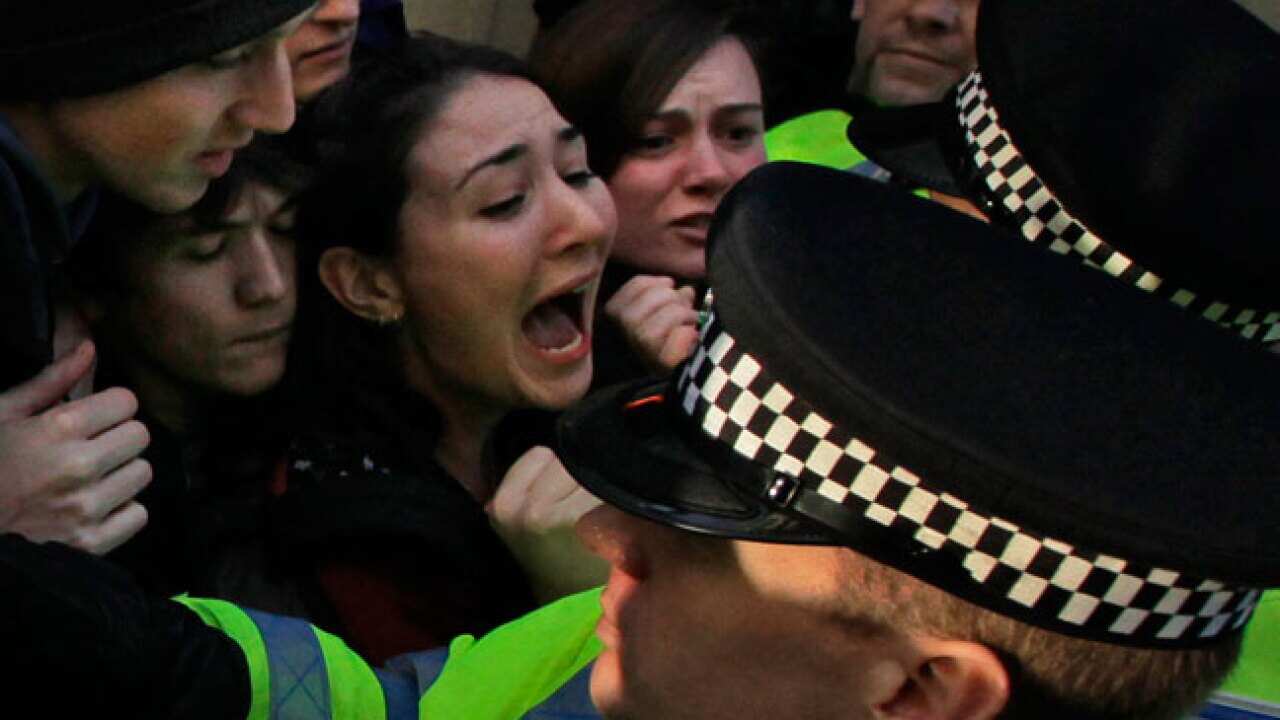
Thousands of students marched through London Wednesday against cuts in university funding as a massive police operation prevented a repeat of the violence at similar protests a year ago.
Organisers said 10,000 people joined the march through the heart of London's financial district in protest against a tripling in higher education fees by the coalition government of Prime Minister David Cameron.
About 4,000 police were deployed, Scotland Yard said, adding that it did not dispute the number of protesters given by the organisers despite earlier giving a lower figure.
News that makes sense
Your trusted source for staying up-to-date with the world around you. Get free daily news updates and analysis, straight to your inbox.
Police made 24 arrests, mainly for public order offences but the rally remained largely peaceful despite a few sticks and bottles being lobbed at lines of riot police.
The only real moment of tension came when officers forcibly cleared a group of demonstrators who briefly pitched tents in London's historic Trafalgar Square, leaving one protester with a bloody head injury.
Police had warned ahead of the rally that they had authorised the use of rubber bullets in case of "extreme circumstances", but besides deploying riot and mounted police they did not take any major steps.
"It went extremely well. We're very happy with the turnout, which is good given the amount of intimidation there was before," Michael Chessum, of the National Campaign against Fees and Cuts, told AFP.
"We wanted to send out a clear statement to the government that this is a sustainable movement, it isn't over, and I think that is what we have done pretty successfully today."
The heavy police presence was in response to the violence that marred a series of four student protests last year against the tuition fees hike, which the government says is needed as part of austerity measures.
At the first rally on November 10, 2010, protesters smashed up the offices of Cameron's Conservative party, while a month later they attacked a car carrying Prince Charles and his wife Camilla.
Riot police in fluorescent jackets lined the route of Wednesday's protest from the University of London to the City of London financial district, blocking off all side roads, while police helicopters buzzed overhead.
They handed out booklets to protesters advising them what to do if there is disorder, for example to stand aside and let officers work, demonstrators said.
They also stopped the demonstrators joining a protest camp at St Paul's Cathedral, where anti-capitalism activists inspired by the "Occupy Wall Street" movement have been camping out since mid-October.
A group of protesters had earlier broken off from the main rally to set up around 25 tents in historic Trafalgar Square at the foot of Nelson's Column, which commemorates one of Britain's greatest naval victories.
Police later moved in, hauling protesters out of the green and blue tents which officers then folded up.
"This is what democracy looks like," screamed one protester with a trickle of blood running down his forehead, as police led him away in handcuffs.
Another protester, Glyn Jukes, told AFP the demonstrators were allied to the "Occupy London Stock Exchange" movement in St Paul's.
"We've chosen this very public place at the centre of London to serve as a beacon for the general strike on the 30th to help communicate with people," Jukes said.
British trade unions are planning a major walkout over pension reforms on November 30, which the student movement says it will join.
Fears of violence had also been raised after London was rocked by riots and looting for four nights in August, which the government blamed on criminality, but which many analysts linked to high levels of deprivation in some areas.







