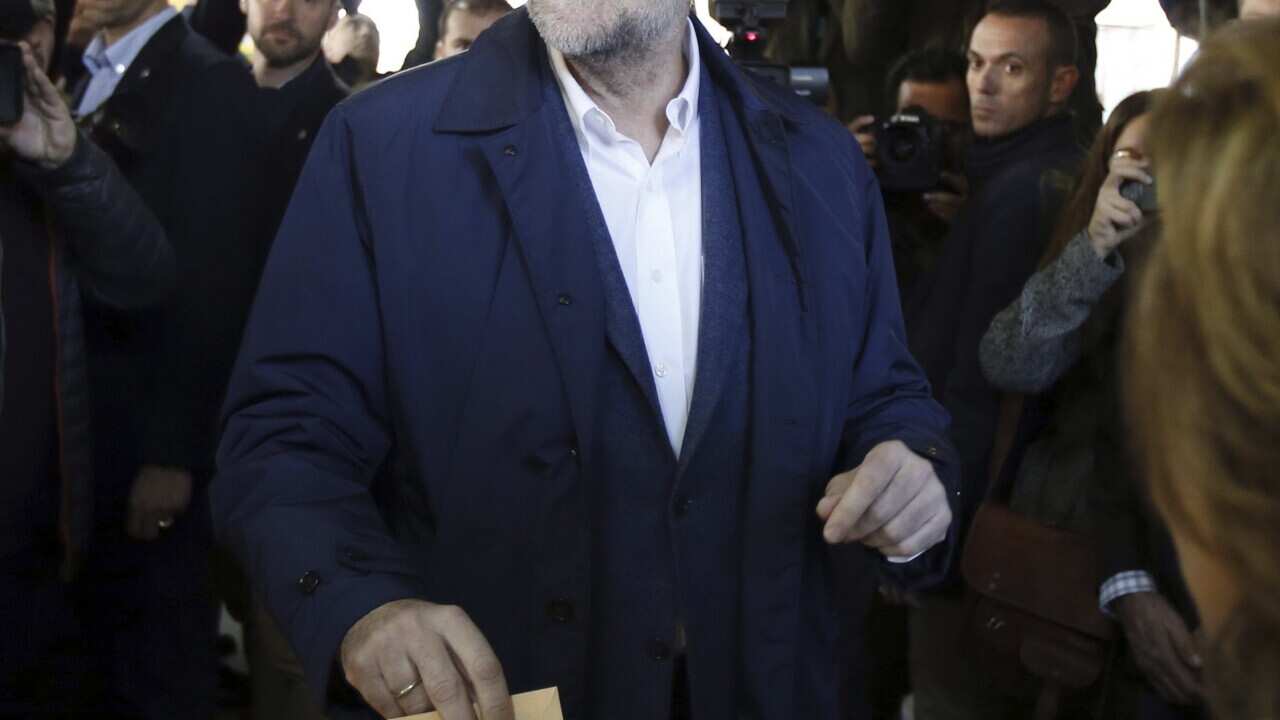
Spain's major parties, taking stock after the most fragmented national election result in the country's history, embarked on Monday on potentially long and arduous talks to form a coalition government.
With neither Prime Minister Mariano Rajoy's conservatives nor left-wing parties winning a clear mandate to govern, the country faces weeks of uncertainty that has cast doubt on the durability of its flagship economic reforms and unnerved financial markets.
Despite garnering the most votes, the centre-right People's Party (PP) had its worst result ever in a parliamentary election as Spaniards angered by high-level corruption cases and soaring unemployment turned away from the party in droves.
The outcome was reminiscent of a similar situation in neighbouring Portugal, where the incumbent conservatives won an October election but a socialist government backed by far left parties was sworn in.
The inconclusive vote heralded a new era of pact-making, shattering a two-party system that has dominated Spain since the 1970s, with an unexpected surge from upstart anti-austerity party Podemos - the latest of several strong showings by populist parties in European elections - giving it a potential role as kingmaker.
News that makes sense
Your trusted source for staying up-to-date with the world around you. Get free daily news updates and analysis, straight to your inbox.
"We're starting a period that will not be easy," Rajoy told cheering PP supporters at party headquarters in central Madrid. "It will be necessary to reach pacts and agreements and I will try to do this."
However, the likelihood of a PP-led coalition faded with Podemos' third place, outpacing fellow newcomer Ciudadanos whose market-friendly policies had been seen as a natural fit for the PP.
A tie-up between the PP and Ciudadanos would yield 163 seats, far short of the 176 needed for a majority administration.
Ciudadanos leader Albert Rivera on Monday urged the main opposition Socialists, which finished second in the ballot, to support a minority PP government on a law-by-way basis.
"Spain can't allow itself to become Greece. Spain can't become a chaotic country," he told broadcaster Telecinco.
But the Socialists reiterated they would not back Rajoy, although they did not fully rule out supporting another PP candidate, in what would be a de facto grand coalition.
"The Socialist party is going to play a very responsible role in this process," senior party member Cesar Luena told Cadena Ser radio.
Overall, Podemos' strong showing tipped the balance to the left of the political spectrum with five left-wing parties led by the Socialists and Podemos together winning 172 seats.
Such a left-wing alliance will be hard to form, however, as groups differ on economic policy and the degree of autonomy that should be awarded to the wealthy northeastern region Catalonia, home to an entrenched independence movement.
"This result confirms Spain has entered an era of political fragmentation," said Teneo Intelligence analyst Antonio Barroso. "The key question is whether there will be a coalition of parties against Rajoy."
That uncertainty spilled over into financial markets, with Spanish shares lagging their European counterparts and benchmark bond yields rising.
The Spanish constitution does not set a specific deadline to form a government after the election. Analysts say negotiations could go for weeks - and maybe trigger another election.







