The finding - if backed by a hoped-for unmanned robot mission - is exciting, for water is one of the key ingredients for life.
Its white icy shell brightly reflecting the distant Sun, Europa is the second closest satellite of Jupiter, the biggest planet of the Solar System.
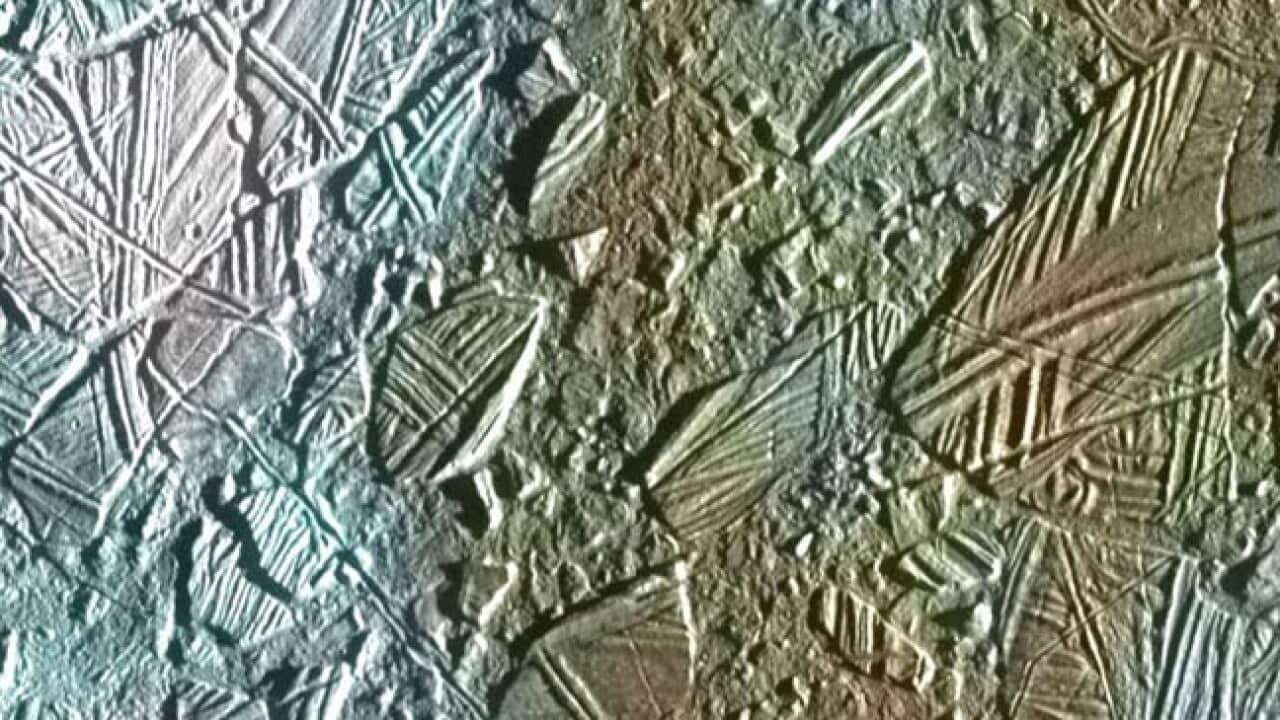
Pictures of it sent back by the Galileo spacecraft during its 1995-2003 exploration point to a tortured surface of cracks and jumbled ice.
News that makes sense
Your trusted source for staying up-to-date with the world around you. Get free daily news updates and analysis, straight to your inbox.
Seeking to understand how such weird topography evolved in a place with such dim sunlight, scientists believe that the answer lies in similar processes on Earth.
Beneath floating ice shelves and under glaciers that overlay volcanoes, interaction between ice and plumes of warm water gives rise to a phenomenon called chaos terrain, they say.
Their model suggests that Europa's ice shell is about 10 kilometres thick and within it are giant pockets of water, lying at depths as shallow as three kilometres.
Warm water from these sub-surface lakes wells up in plumes, causing the ice to become brittle, crack and then collapse.
The ice turnover would be a plus for the prospects for life, as it would transfer energy and nutrients between the sub-glacial lake and the surface.
"One opinion in the scientific community has been, 'If the ice shell is thick, that's bad for biology - that it might mean the surface isn't communicating with the underlying ocean'," said Britney Schmidt, a geophysicist at the University of Texas at Austin, who led the research.
"Now we see evidence that even though the ice shell is thick, it can mix vigorously. That could make Europa and its ocean more habitable."
The study, published in the British journal Nature, adds to a file of knowledge about ice moons of giant gassy planets.
The Saturnian moon Enceladus is likewise believed to harbour a salty sea between its rocky core and icy crust.
Theorists suggest the tiny moon is geologically active thanks to a phenomenon called tidal heating.
It suffers a ripping gravitational pull from its giant mother, and from the nearby satellites of Dione and Janus.
As a result, according to their hypothesis, its guts are stretched and squeezed, causing friction that warms the sub-surface ocean.
In the case of Europa, the tidal flexing would be exerted by Jupiter and Io, the innermost Jovian satellite.
A mission to explore the strange worldlet is on the short- list of candidates for future planetary explorations by NASA, the university said.







