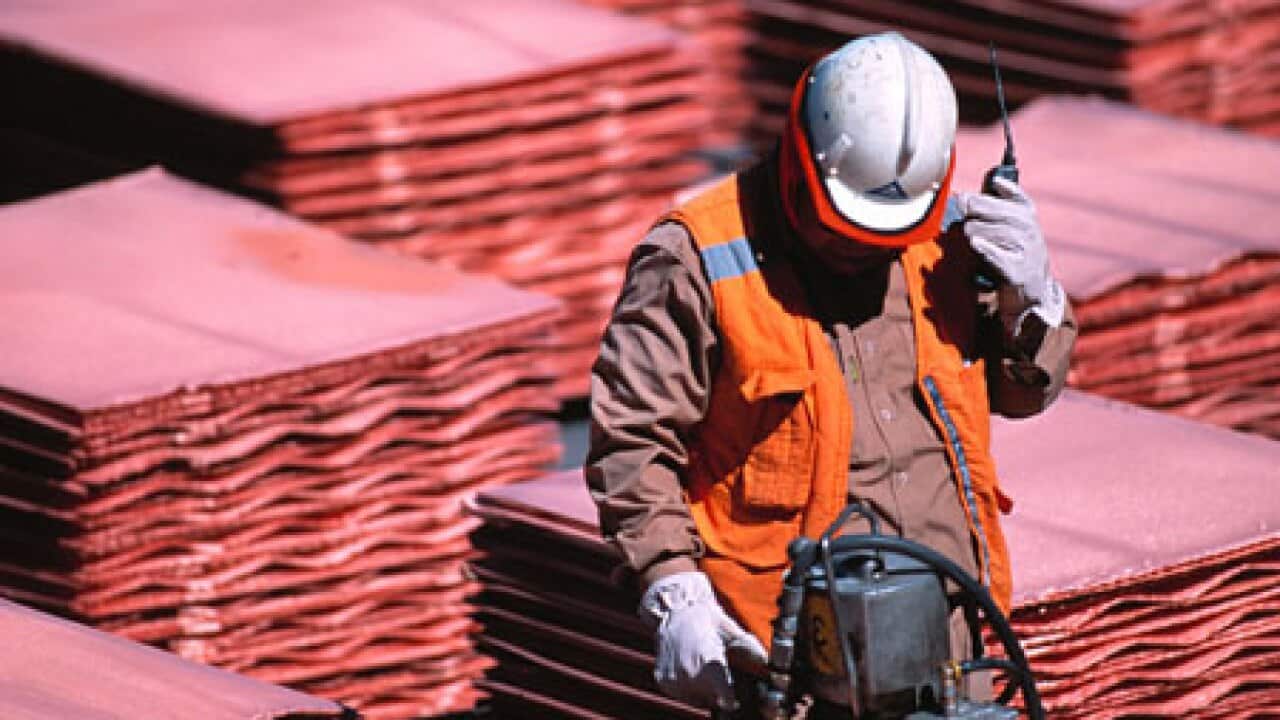
Why recycle metals?
With concern over theories such as peak minerals, constraints on mining such as carbon emissions and higher costs, and an increase in consumer goods requiring rare metals, recycling metals is becoming an increasingly attractive way of fulfilling society's needs.
Many countries recycle a range of metals, from the copper used in our pipes and cabling, to the rare trace metals used in our computers and mobile phones.
News that makes sense
Your trusted source for staying up-to-date with the world around you. Get free daily news updates and analysis, straight to your inbox.
The international picture
Younger generations in Australia won't remember a time when the humble aluminum can wasn't supposed to be thrown in the recycling bin. Scrap metal collection too has long been a viable trade.
So when metal recycling is spoken about here in Australia, aluminum and steel are usually the metals in question.
But other countries are going much further than Australia, and it's largely down to legislation.
They recycle more metals because it might make more economic sense to them, but also because foreign governments are simply insisting on it; there's a consumer awareness coupled with a politcal will.
As it stands, the EU, Japan and Korea all have legislation in place for the recycling of metals.
In the EU, legislation is looking at 'end of life' considerations - requiring cars in 2015 to be 90 per cent recyclable, a daunting task. The dismantling and recycling of consumer products is also increasingly a job for manufacturers, not consumers, across various sectors.
In the US, similar legislation is also in place for recycling, although there are different targets for recycling rates.
Kumar Rahdakrishnan of the E-recyling division of Sims Metal Management - despite being Australian, the biggest E-recyclers in the world through their overseas operations - is critical of the federal government when its record is put up against other developed countries.
"With the European Union's WEEE directive (Waste Electrical and Electronic Equipment (WEEE) they set a collection target of four kilograms per person, and within a few years pretty much every country of the original member countries exceeded the target, and some are collecting up to 18 kilogrammes per person per year", he said.
"If you look at all the OECD countries, Australia is in the minority of those that does not have any legislation to recycle electronic waste. Everybody knows that electronic waste is the fastest growing waste stream in the world, but the federal government has not done anything so far."
The Environment Protection and Heritage Council plans for the federal government to develop and introduce product stewardship requirements for manufacturers on products such as TV sets and computers.
And while Rahdakrishnan has some appraisal for the plans, he is, unsurprisingly, still of the view that the government 'has not done enough work on it yet.'
Despite the inertia, what is clear is that metals can be recycled over and over. Estimates suggest that 80 per cent of the copper ever mined is still in use today. And it is this inherent recyclability which has led some industry analysts to call cities, with their abundant supplies of scrap just waiting to be collected, the 'mines of the future.'
High tech concerns
Where hi-tech industries are concerned, it also makes sense for countries which are heavy producers to be capturing the metals they need, particularly where international supply constraints loom.
"Some industries have understood this - Japan needs indium because they are selling Sony flat panels so they're making sure they have the infrastructure in place to get that metal back to Sony - that's how it's going to work", says Professor Markus Reuter, Chief Executive Technologist at Ausmelt.
"If you just think that metals come out of a hole in the ground, then you've lost that opportunity - then metals can become rare. If China wants to be the dominating force in rare earth they'll get all the E-waste back into the country and they'll have people plucking out the metals, recovering it, putting back into products which we're then buying again - that is not sustainabale'
Recycling and 'end of life' consideration- why Australia lags behind
Australia may dig many metals from the earth and ship the raw material overseas, but the downstream industries that go with that - including the processing that directly follow, is often carried out overseas. This in itself has academics worried about a 'resource curse'.
Dr Mary Stewart, a sustainability expert at climate-consultants Energetics, says it's just not a current focus in Australia.
"I think there's a bit drive on the part of consumers to increase our recycling effort, however there's a critical mass required to make the recycling of metals economically viable - we actually don't have enough people to support big recycling efforts. ...it's not a technical focus for us - I think a lot of our recycling is going to go offshore where it's economically viable to recycle in other countries.'
Partiularly for rare metals, countries that require metals for manufacturing are more concerned at 'closing the loop'.
It's more economically viable in a tech-intensive economy.
China is the world's leading exporter of rare metals - and this extraction and processing has also lead to an increased interest in recycling. 'It was more adventurous, more visionary in setting up an infrastructure that can recover these metals", Reuter said.
Australia currently offers tax breaks and concessions to companies digging metals out of the ground, but measures to recover those metals are lacking.
At Sims E-recycling, Rahdakrishnan even says that it is corporates who bring in 60 per cent of the metal. The other 40 per cent is brought in by willing councils, but there is no legislation to encourage them to collect more.
According to Damien Giurco at the University of Technology's Institute for Sustainable Futures, it's something Australia should be considering - before we miss the boat.
"Countries like Japan, Taiwan, China and others are coming to capture the value from resources such as phones and computers that we are throwing away - avoiding a landflll problem for sure, but also capturing the value to supply the metals that a more sustainable society will need."
Reuter is cautious "You can over legislate - you shouldn't over-legislate or you kill things off...but legislation should be part of the equation...the EU, Japan and Korea have good legislation in place, but Australia has not taken it on board yet."
E-Waste
In an increasingly consumer-orientated society, E-Waste is an interesting case in point. While the media fawns over the ipad, there's an increasing belief that a society which supports constant updating of gadgets heavy on rare metals is just not sustainable.
ABS statistics from 2006 showed that Australians were estimated to have purchased over 2.4 million new computers.
But in 2009, The Environment Protection and Heritage Council found in 2009 that only 7 per cent of computers were being recycled.
The same year, The Australian Mobile Telecommunications Association estimated in 2009 that between 14 million and 16 million mobile phones and batteries were lying around in drawers, unused.
With mobiles gaining more attention in recent years, much of the debate around recycling has focused on poisonous elements leaking into water supplies from landfill sites, there is a growing concern that rare metals such as tantalum will run out if we're not careful.
"All these resources are finite.. there will be issues with them unless you have a recycling infrastructure in place that recovers them", Damien Giurco said.
In the end, he says, it will be consumer attitudes that drive change.
"We don't want to only see recycling systems put in place, and then we can throw away and forget because we're racing to get a new mobile phone every six months - we also need to think about what we need."







