British politicians have queued up to complement the Iraq Inquiry's questioning of former British Tony Blair, but others have slammed the lack of focus of an alltogether 'establishment' set up which allowed the former PM to dodge a real questioning.
At the inquiry on Friday, Blair, a former lawyer, robustly and passionately expressed his lack of regret for toppling the man he referred to throughout as 'Saddam' – former Iraqi dictator Saddam Hussein.
"I think that he was a monster, I believe he threatened not just the regime but the world ... Even if you look back now it was better to deal with this threat, to remove him from office, and Ido genuinely believe that the world is safer as a result."
News that makes sense
Your trusted source for staying up-to-date with the world around you. Get free daily news updates and analysis, straight to your inbox.
British Opposition leader, Conservative David Cameron told the BBC "I think the whole point of having a full-scale, proper inquiry with proper public sessions, proper discovery of papers - all of which, by the way, the Conservative Party called for - is to get to the truth about these issues."
The opposition Conservative Party also supported the war, and many have pointed out that the politcial will for 'justice' is therefore distinctly lacking.
Foreign Secretary David Miliband of Blair's Labour Party said that "for the first time you've got a proper explanation."
But others, in particular those who opposed the invasion, were far from impressed at the proceedings.
The Guardian's legal affairs correspondent Afua Hirsh said: "The sheer length, lack of focus, and scope for manoeuvre in the Chilcot panel's questions were revealed at the Iraq inquiry today, as a nervous and tense Tony Blair nevertheless managed to remain more or less within his comfort zone."
Iraqi novelist and a prisoner in Saddam Hussein's Iraq told the Guardian:
"It was excruciating watching Tony Blair's testimony at the Iraq inquiry. Blair was the same smooth talker as he was throughout his career, repeating his "absolutely clear" visions, how options are quite simple, and "when you're right, it is the right thing to do...
"But how often do war criminals admit their crimes? He was in a warm, well-lit hall, conversing with gentle folk in an academic conversation that could have lasted forever. Undergraduates would have asked more probing questions."
Tony Blair biographer Anthony Seldon added: "After six hours of probing by the well-briefed Chilcot inquiry, we have learned next to nothing from Blair that we did not know about the war in Iraq."
Click here for a 'Twitter verdict' showing preponderance of negative over positive tweets.
Chairman Sir John Chilcot reminded everyone on the day what the inquiry was not - a trial - and the inquiry has faced criticism for not having enough scope or legal heavweights on board.
Chris Mullen MP, of the Labour Party, voted against the invasion and told the BBC following the inquiry:
"My biggest regret is that - and it's his biggest mistake - is that he linked us umbilically to the worst American president in my lifetime."
Mr Blair's expressed reasons for invading have wavered over the years, but possession of 'WMD', or weapons of mass destruction, were always cited as a prime reason.
The WMD were never found.
Critics have consistently accused the PM and his government of manipulation of the facts in order to pursue a preordained plan for war, but Blair distanced himself from any wrongdoing.
"When you are the prime minister and the Joint Intelligence Committee is giving you this information, you have got to rely on the people doing it, with the experience and with the commitment and integrity as they do ... Of course now, with the benefit of hindsight, we look back on the situation differently", Mr Blair said.
He said he wanted to stand alongside the Americans and send a signal to regimes who were engaged in WMD after the September 11 attacks that they had to stop.
He was asked whether he had pledged Britain's support for war during an April 2002 meeting with Bush at the president's ranch in Crawford, Texas - 11 months before the British parliament voted for military action.
Blair denied this, saying he had told Bush "we are going to be with you in confronting and dealing with this threat" of Iraqi WMD.
He added: "How we did that was an open question, and even at that stage I was raising the issue of going to the UN."
Blair admitted he and Bush had discussed the military option but only if the UN route failed, adding: "The position was not a covert position, it was an open position.
In the end, the 'coalition of the willing', which included Prime Minister John Howard, invaded without a UN mandate.
In relation to the so-called 'dodgy dossier', with the notorious claim that Iraq could attack the UK within 45 minutes, he defended his statement that he believed Iraq possessed WMD.
"I didn't focus on it a great deal at the time" (what kind of weapons the 45 minutes deployment referred to).
'The coalition forces weren't the ones doing the killing'
The former PM said he believed that there was a proper plan for Iraq once Saddam Hussein's forces were defeated, and when asked about the enormous death toll resulting from the war, again dodged responsibility.
"The coalition forces weren't the ones doing the killing. The ones doing the killing were the terrorists, the sectarians."
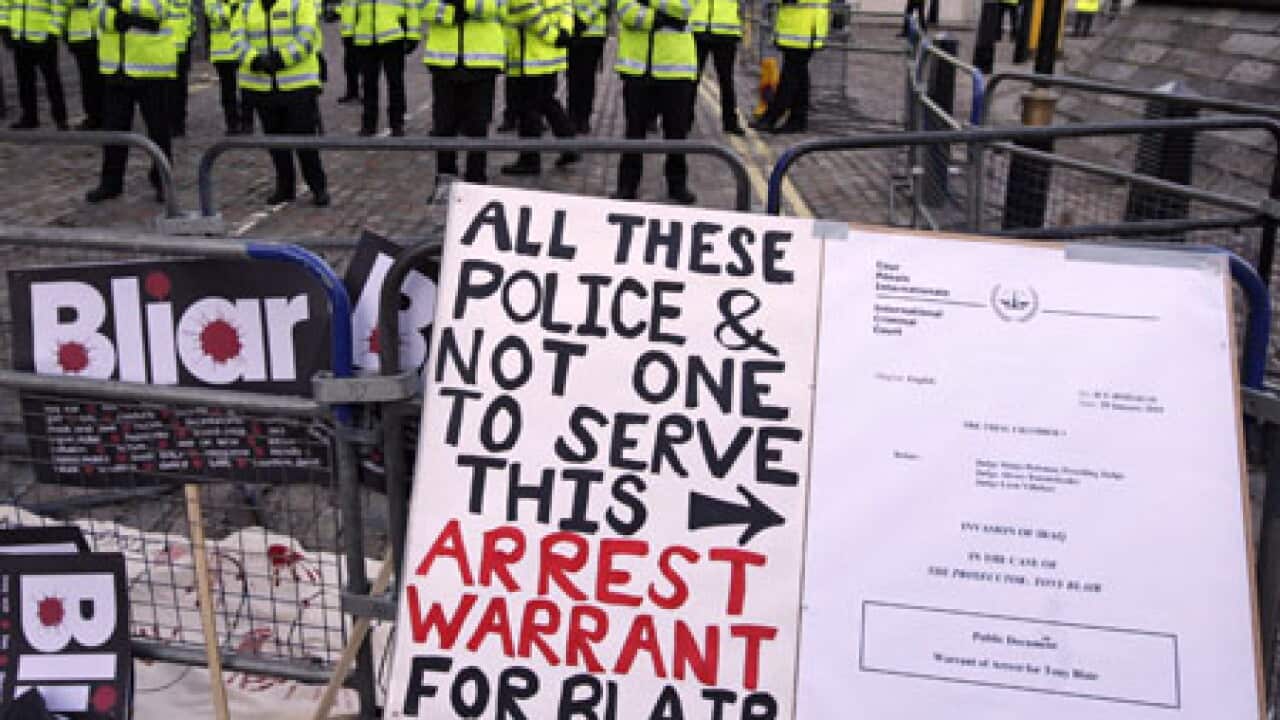
Hundreds of anti-war protesters outside the conference centre where the inquiry is taking place waved placards saying "Bliar" and chanted "Tony Blair war criminal".
Valerie O'Neill, whose son Kris, 27, was killed by a roadside bomb in Basra in April 2007, was angered by Blair's evidence and accused him failing to admit errors over the war.
"I think he's an autocratic dictator. He wouldn't have taken any notice of anyone other than himself," she said.
"He doesn't admit he's made a mistake."







