The US Geological Survey says the temblor had a magnitude of 6.2 and struck at 10.26am (12.26pm AEST) on Sunday. It was centred about 179 km east of Tokyo, at a depth of 24.5 km.
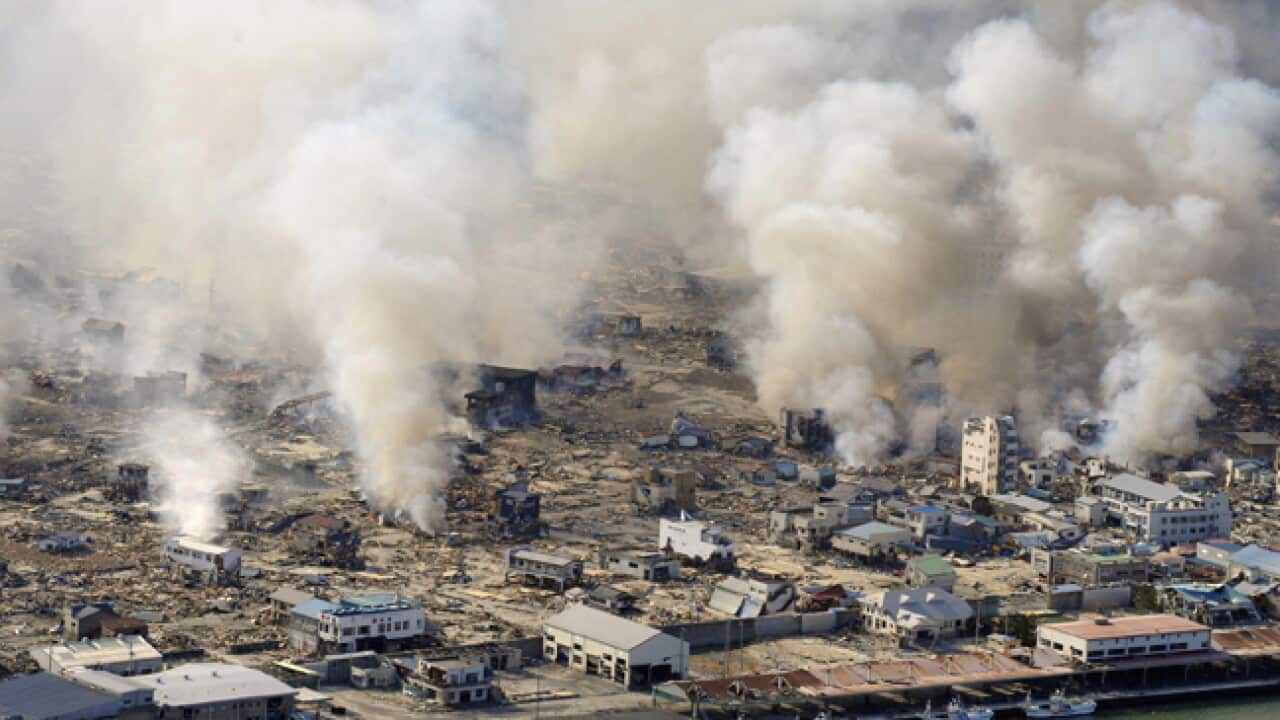
The 8.9-magnitude earthquake, the largest on record in Japan, struck Japan's northeast coast at 2.46pm on Friday (4.46pm AEDT) triggering a 10-metre tsunami that washed over hundreds of kilometres of coastline including the city of Sendai, causing widespread destruction.
A 6.8-magnitude aftershock hit the Niigata prefecture northwest of Tokyo, causing landslides and avalanches and destroying some wooden houses, less than 24 hours later, on Saturday.
News that makes sense
Your trusted source for staying up-to-date with the world around you. Get free daily news updates and analysis, straight to your inbox.
Japan has been rattled by more than 150 aftershocks since Friday's massive quake.
The death toll
The National Police Agency says 688 people have been confirmed dead and 642 are missing, with 1,570 injured. Police in Sendai in the country's northeast, separately say 200 to 300 bodies been found on the shore.
"We have received a preliminary report that more than 200 bodies were found in the city of Higashimatsushima," a National Police Agency spokesman said, adding that local police are starting to collect the bodies.
In the small port town of Minamisanriku alone some 10,000 people were unaccounted for - more than half the population of the town, which was practically erased, public broadcaster NHK reported.
The police chief in Miyagi prefecture - where Minamisanriku is situated - said the death toll was certain to exceed 10,000 in his district.
Nuclear reactor damaged
An explosion at the ageing Fukushima No 1 atomic plant blew apart the building housing one of its reactors on Saturday.
The atomic emergency widened Sunday as the cooling systems vital for preventing overheating failed at a second reactor, and the government warned there was a risk it too could be hit with a blast.
The International Atomic Energy Agency said about 200,000 people had so far been evacuated from the area around the two Fukushima plants that house a total of 10 reactors.
Japan's nuclear safety agency rated the incident at four on the international scale of zero to seven. The 1979 Three Mile Island accident in the United States was rated five, while the 1986 Chernobyl disaster was a seven.
Impact outside Japan
Tsunami waves hit the North American shores of Hawaii, California, Oregon, Washington and Mexico.
Tsunami warnings were issued for Australia, New Zealand, the Philippines and Indonesia but have been lifted.
Boats have been damaged by waves at Crescent City, California, and a 25-year old man was confirmed dead after he was swept out to sea while taking pictures of the tsunami.
Australians in Japan
About 191 Australians are registered as living in the quake- and tsunami-hit region and 2,331 registered in Japan. DFAT reported on Sunday morning that 1,271 Australians were confirmed as safe, including five in Sendai.
Worldwide response
US aircraft carrier USS Ronald Reagan arrived off the coast of Japan early on Sunday to provide logistical support for Japanese forces.
Japan has asked it to refuel its helicopters and help transport its troops to affected areas, the US Pacific Fleet said on its Facebook page.
A 144-member rescue team of the US Agency for International Development was also due at Misawa, northern Japan to join inland operations, the Japanese foreign ministry said.
They included 12 dogs trained to detect victims trapped under rubble and about 150 tonnes of rescue equipment, USAID said.
Japanese officials have asked other nations to provide sniffer dogs to help search for trapped survivors.
Australia, South Korea and Singapore on Saturday all pledged to send dogs and search and rescue teams, as they also offered their condolences to Tokyo.
Two experts from the US Nuclear Regulatory Commission were headed for Japan, the commission announced Saturday.
After the European Union vowed to get aid to Japan Friday, many member states were quick to make their contribution.
From Britain, a 59-strong search and rescue team was headed for Japan Sunday, with two rescue dogs, a medical support unit -- and 11 tonnes of specialist rescue equipment including heavy lifting and cutting gear.
France said it was sending two civil security teams to help with rescue efforts.
And a 66-strong Japanese team which has spent more than two weeks searching the rubble left by last month's 6.3-magnitude quake in Christchurch in New Zealand was due back home to confront the unfolding tragedy.
The United Nations said Japan had also accepted help from Germany, Mexico, New Zealand, Singapore and South Korea, with rescue teams from another 39 countries on standby.
A team from the United Nations Disaster and Assessment body (UNDAC) was also on the way.
Messages of sympathy
In a message to the Japanese prime minister the Dalai Lama, who has a huge following among Japanese Buddhists, expressed his "sadness" at the catastrophe and praised Japan's high level of disaster preparedness for saving lives.
And Britain's Queen Elizabeth II sent her "heartfelt sympathy" in a message to Japan's Emperor Akihito.







