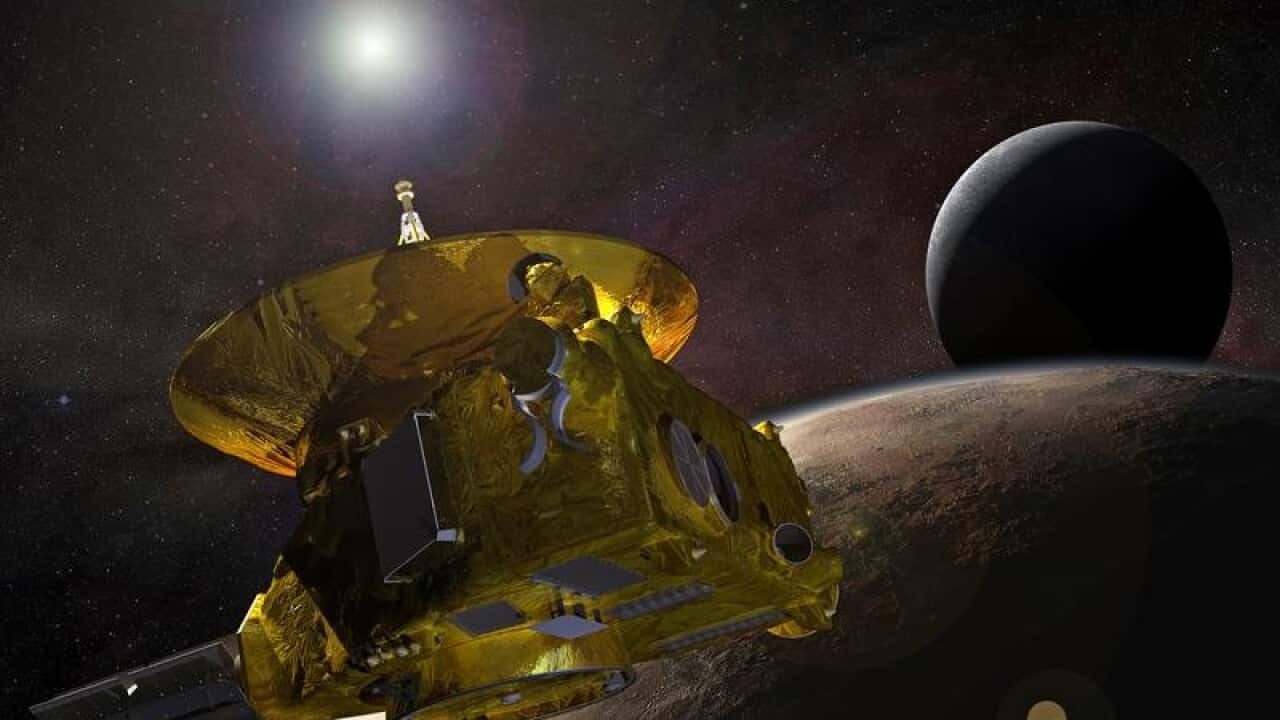
A NASA explorer is believed to have reached the solar system's outermost region, flying close to a space rock 30km long and billions of kilometres from Earth.
The body is farther from Earth than any other that has had such a close encounter with a NASA probe, scientists believe.
The New Horizons probe was slated to reach the "third zone" in the uncharted heart of the Kuiper Belt early Tuesday.
Scientists will not have confirmation of its successful arrival until the probe communicates its whereabouts through NASA's Deep Space Network later in the day.
Once it enters the peripheral layer of the belt, containing icy bodies and leftover fragments from the solar system's creation, the probe will get its first glance of Ultima Thule, a cool mass shaped like a giant peanut.
News that makes sense
Your trusted source for staying up-to-date with the world around you. Get free daily news updates and analysis, straight to your inbox.
Scientists had not discovered Ultima Thule when the probe was launched, according to NASA, making the mission unique in that respect.
In 2014, astronomers found Thule using the Hubble Space Telescope and selected it for New Horizon's extended mission in 2015.
"Anything's possible out there in this very unknown region," John Spencer, deputy project scientist for New Horizons, told reporters on Monday at the Johns Hopkins Applied Physics Laboratory in Maryland.
Launched in January 2006, New Horizons embarked on a seven billion-kilometre journey toward the solar system's frigid edge to study the dwarf planet Pluto and its five moons.
During a 2015 fly-by, the probe found Pluto to be slightly larger than previously thought. In March, it revealed that methane-rich dunes were on the icy dwarf planet's surface.
After trekking almost two billion kilometres beyond Pluto into the Kuiper Belt, New Horizons will now seek clues about the formation of the solar system and its planets.
As the probe flies 3500 km above Thule's surface, scientists hope it will detect the chemical composition of its atmosphere and terrain in what NASA says will be the closest observation of a body so remote.







