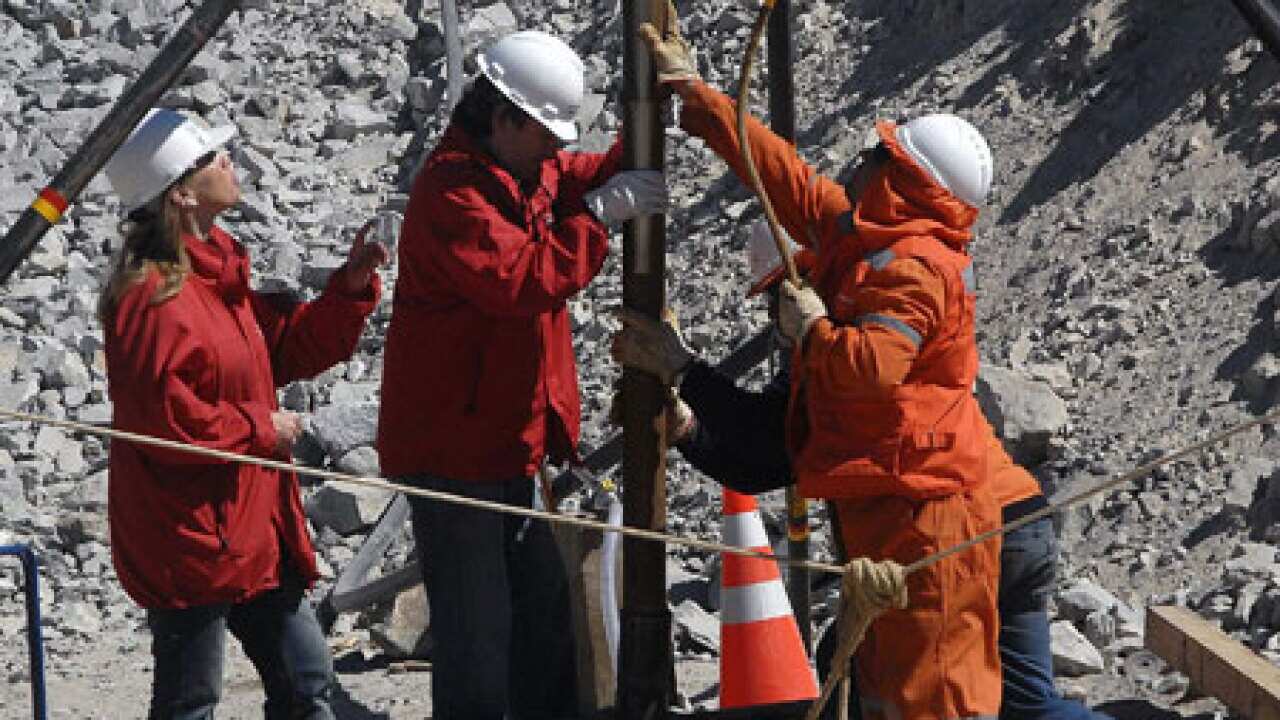
NASA experts have advised Chilean officials to be frank with 33 miners trapped deep underground about how long their rescue will take, as a giant drill slowly burrows toward the desperate men.
Meanwhile, the owners of the Chilean mine begged for "forgiveness for the anguish" caused by the collapse of the San Jose gold and copper mine August 5, which sealed in the miners 700 meters (2,300 feet) under the earth.
"This is a terrible situation, and we hope that it will soon come to a happy end," Alejandro Bohn, co-chief of the San Esteban mining group, told a parliamentary committee looking into the 26-day-old drama.
News that makes sense
Your trusted source for staying up-to-date with the world around you. Get free daily news updates and analysis, straight to your inbox.
They denied any negligence on their part in implementing safety regulations at the San Jose mine, near Copiapo, and said all the mine's inspection documents were in order prior to the August 5 cave-in.
Rescuers say it will take three to four months for a 30-ton hydraulic drill to chew through the rock to where the miners were holding out.
They have been told they are in for a long wait before they can be pulled out, but have not been given any date by Chilean officials concerned about their mental state.
The NASA experts, experienced in getting astronauts through extended periods of isolation, told Chilean Health Minister Jaime Manalich and Mining Minister Laurence Golborne and other officials to avoid conveying "false hopes" to the trapped men.
Honesty was key, NASA's deputy chief medical officer James Duncan, explained to reporters in Santiago.
The miners' experience and expectation that rescue would take a long time had to be taken into account, he said, drawing parallels with the training and professionalism of astronauts.
The NASA team was to travel to the scene of the mine drama on Wednesday.
One of the engineers overseeing the rescue at the mine, Jorge Sanhueza, told AFP late Tuesday that the drill had burrowed down just five meters so far, because the initial phase required "high precision" to get the trajectory right.
The machine, an Australian-made Strata 950, had a maximum excavation rate of 15-20 meters (50-65 feet) a day. After first boring a 33-centimeter (13-inch) pilot hole, it was to double the width of the shaft so the men can be pulled up through it, one by one.
Chilean President Sebastian Pinera said the operation was well underway and his government "has done and will continue to do everything humanly possible to rescue them alive."
He added that another bore was on its way to expand one of three fist-sized holes already drilled to drop supplies the men, in case the Strata 950 encountered problems.
Authorities have started vaccinating the miners against tetanus, diphtheria, flu and pneumonia to prevent outbreaks of disease.
A medical report Tuesday said five miners were still having difficulties digesting after the 17-day period before rescuers made contact with them, during which food supplies severely rationed.
Psychologically, the report added, "there are a few cases of sleeping problems."
The men have also moved to a drier spot about 300 meters deeper inside the mine because some were developing fungal infections and body sores in the hot, dank area.
The miners, who were found alive August 22, have located four sources of water, two of which have been deemed fit for human consumption.
They have been able to shave and get a change of clothes. Smokers have been denied cigarettes, but given nicotine patches to help them cope with withdrawal symptoms.
A new video of the trapped miners was shown Tuesday on National Television showing them rested and in good spirits.
Unlike the first video shown last week of a mud-caked, sweaty, unshaven and shirtless group of men, in Tuesday's video the miners all wore red t-shirts, were clean shaven, smiled and waved at the camera, one of them holding a Chilean flag.
"They're telling jokes. They point to their boss' Luis Urzua's desk that's nothing more than the hood of one of the pickup trucks down there strewn with papers," Elvira Valdiva, the wife of one of the miners told AFP.
The drilling of the rescue shaft was taking place at a site restricted to media, which have been broadcasting the drama to the world.
The process, which began late Monday, was painstaking and delicate, with precautions being taken to try to make sure it did not trigger another collapse in the unstable mine.







