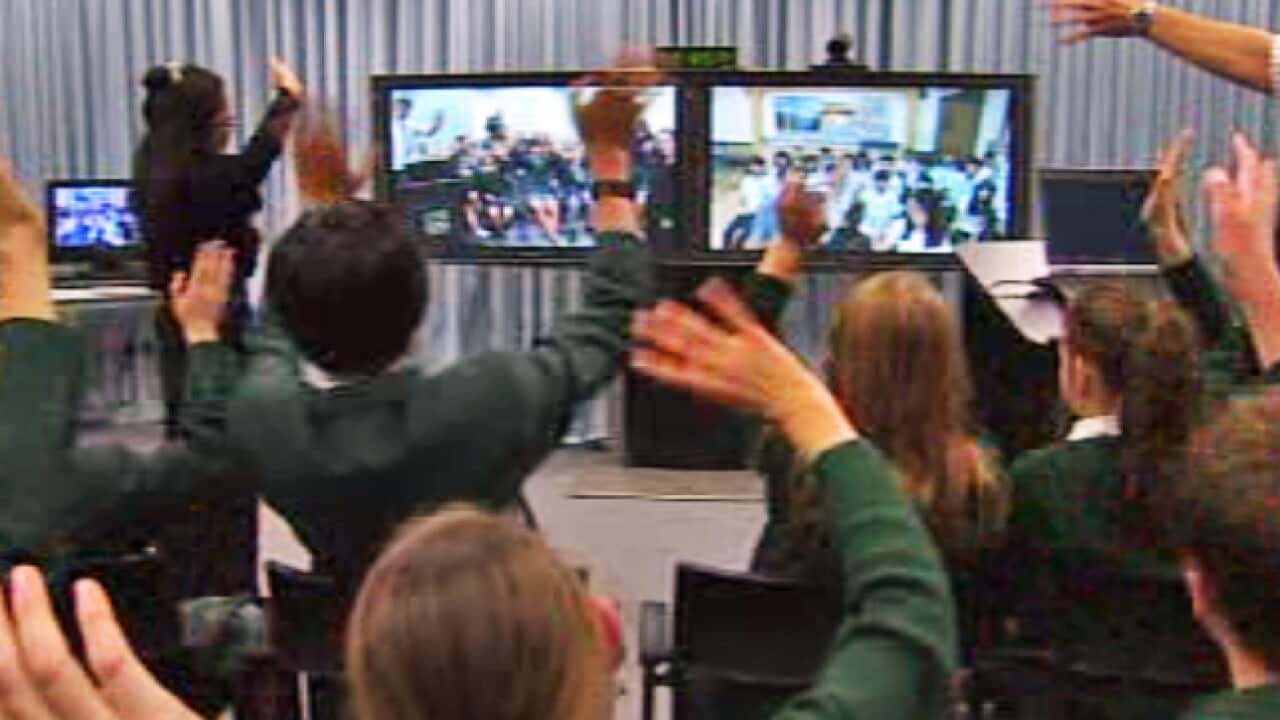
A group of year seven students from Armidale's Duval High School are getting a leg up in the so-called Asian century.
They're using the power of high speed broadband to learn Korean.
'It's pretty nerve-wracking at the start’, says Jess. ‘But then you get used to it.’
‘We get a lot of laughs. We always say words wrong!’, classmate Turner chimes in.
Other students, like Isabella Andronicus, says it’s a good way of making friends overseas.
News that makes sense
Your trusted source for staying up-to-date with the world around you. Get free daily news updates and analysis, straight to your inbox.
‘Since we've been talking to them for a while, they've become my friends and it's easier to talk to them.’
The National Broadband Network has opened up the Asia-ConneXions program to regional schools, many of which struggle to attract language teachers.
'It's fantastic for breaking down the barriers of geography and the tyranny of distance’, the University of New England’s Rob Irving says. ‘People don't have the expense of travel.'
Julia Gillard witnessed the program from behind the screen when she visited a Catholic School in Seoul last year.
New Prime Minister Tony Abbott has stated that he wants a ‘more Jakarta than Geneva’ focus when it comes to foreign affairs.
The Coalition wants 40 per cent of Year 12 students studying a foreign language within a decade, and has set aside $10 million to develop online language lessons in preschools.
But with a review underway, the fate of the NBN in places like Armidale -where connections already exist - remains unclear.
Asia ConneXions classes used to be conducted via Skype, but teachers were let down, explains Dr Myung-Sook Auh, Asia ConneXions Program Director.
‘When we had failures in audio qualities and video qualities it meant student time was wasted.’
Dr Oh says the NBN has made the project faster and more reliable, and the program now extends to 33 schools in NSW, with a planned expansion in Victoria and Tasmania.
Only 12 per cent of students studying an Asian language, and it’s thought that programs like this could boost that figure.
“We need as many Australian students as possible who are learning Asian languages”, says Kurt Mullane of the Asia Education Foundation.
“So that Australia as a nation is equipped to make the best the possibilities that the Asian century offers”







