There's concern that the long-awaited National Disability Insurance Scheme could struggle to address Indigenous demand.
IN PICTURES: Karen Ashford's visit to the APY lands
South Australian MP Kelly Vincent, from Dignity for Disability - the nation's only disability political party, has headed to the remote Anangu Pitjantjatjara Yankunytjatjara Lands to see the challenges faced by disabled Aboriginal people in some of the toughest environments in the country.
(Transcript from World News Australia Radio)
News that makes sense
Your trusted source for staying up-to-date with the world around you. Get free daily news updates and analysis, straight to your inbox.
The corrugated roads criss-crossing South Australia's far northwest were a bone-jarring introduction to the bush for a politician more accustomed to cruising the corridors of power.
Over a week, Kelly Vincent was determined to experience for herself the realities of life on the Lands for those with disabilities.
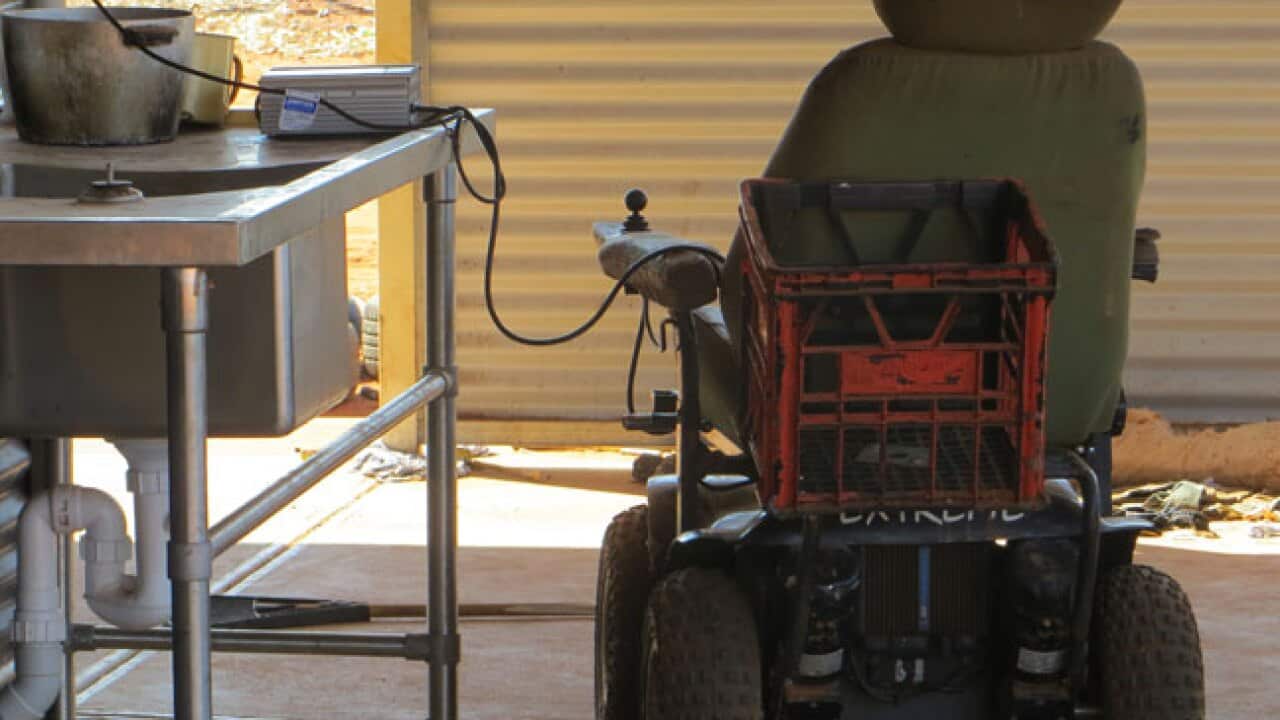
Kerbs and steps made access to shops and clinics impossible without assistance, and paths of deep red dirt were hard to push through, even in her specially imported all-terrain wheelchair.
In the space of a few days, a tack and a thorn played havoc with her tyres.
Political adviser David Gustafsson was called upon to play mechanic.
"We have a spare tube here we'll change it when we get back, no point in doing it on the side of the road - three corner jack."
Maintenance and spare parts are a big issue for locals.
At Fregon, a broken electric wheelchair means Roger has resorted to scooting around on his bottom, as he doesn't have the strength to use a replacement manual wheelchair.
Kelly Vincent is concerned about the cost and availability of spare parts.
"So is the manual wheelchair just for you to use while the electric one is broken? How long did it take them to give you that one when your first one broke? Long time? Mm-hmm..."
Roger has an acquired brain injury as a result of substance abuse, and communication is difficult.
Just over 100 kilometres away in Amata, Noel George also has physical and mental injuries, the legacy of a car accident.
"Now, I'm feeling better, finished (with his wheelchair), now can't work him (his arm),it won't go for this here or what, laughter."
Noel George is referring to his crippled arm, which he says won't behave itself.
Over many months he has learned to walk again, and wants to know whether Kelly Vincent will ever manage the same.
"She get up and walk again, or ? No, but that's okay because I'm happy like this. Some people want to walk and some people don't. That's okay."
Disabilities - whether from birth, accidents or substance abuse - are more common in Indigenous communities than elsewhere, but Kelly Vincent says it's difficult to know the true extent of the challenge it presents.
"The extent of disability itself, in terms of the prevalence, is greater because it's roughly twice that of the white Australian population, so it's at about 37 per cent where white Australia is at about 20, and of course the figures are conservative because of the difficulty getting really accurate information about these things."
The scale of the need, compounded by distance, has Kelly Vincent concerned about the capacity of the National Disability Insurance Scheme, the NDIS, to meet demand.
At the Family Wellbeing centre in Amata, she discovered staff going beyond the call of duty to ensure people get the basics such as a bed, regular showers and food in their belly.
"One of the things about the staff here, normally everyone's happy to forget their job and person specifications and do what needs to be done."
Marilyn Strawbridge is the APY Lands Community Programs coordinator.
She says flexibility and adapting to local culture can prove the difference between success and failure when it comes to disability services.
Ms Strawbridge says sometimes her team has to bend the rules to deliver the goods.
"There is a stigma even to driving around in our vehicle we use to deliver the meals, there is a stigma attached to that and definitely that stigma is around disability and we really do try not to use it for that reason, especially for young men, because for them they're proud and they don't want to be seen to be different."
But will the NDIS be that flexible?
The trial is due to begin in a little over six months, yet there's been no discussion on the Lands about how it is supposed to work, with state government employees asking Kelly Vincent if she could tell them what was going to happen.
Ms Vincent's worried that consultation delayed will be consultation denied - and the scheme could be rejected by communities who feel it's been imposed without considering their needs.
"I'm worried for what will happen now, when the scheme is rolled out, if consultation isn't done quick smart and I just don't see how it can be done properly, especially culturally appropriately, quick smart, and it just infuriates me that again these people who are the ones who've been most left behind but then again I guess unfortunately in indigenous communities that's nothing new, is it?"
Another big problem is money management.
It's accepted wisdom that fresh food is important in preventing or managing disability.
But food prices are high and disabled people are often under pressure to give money to family members, known as humbugging.
Marisa Munti is an artist at Amata.
There's an expectation that her disability income will be shared by family, leaving her little to live on.
"Nah, I'm sick of it, they come and knock on my door, every pay day. Leave me alone I might tell the person I'm going to Alice Springs and stay there. Every time they come around, my sister she's smoking marijuana. She knows my pay day and she will knock on the door. Vincent: Would you ever say no to them? No."
There are hopes that a newly-introduced income management scheme may help ease humbugging.
The coordinator of the Ngaanytjatjara Pitjatjantjara Yunkunytjatjara
Womens Council, Andrea Mason, says the option of quarantining half of all welfare payments for spending on essentials may prevent money being siphoned off for gambling, drinking or drugs.
"Our members have been very consistent in wanting income management particularly to be a support to those who are vulnerable, particularly around those who because of their status or frailty or disability in community where they are a target by other members of the family."
But there is also the possibility that the NDIS, in giving extra resources to the disabled, could make them even bigger targets for predatory behaviour.
Marilyn Strawbridge says the system is already being manipulated.
"I wish I could stop the humbug that happens to them, the taking the minute it's pay day. Even if the income is managed and they go to the store and get their food, that can be taken from them anyway. Or their cigarettes. So I guess what we try to do if we come across that then we have our two bobs' worth, but we can't be with them 24 hours a day."
It's not just managing the cost of living that's a problem; the cost of medical treatment is enormous.
There are several medical clinics and an aged care facility on the Lands, but they're not set up for ongoing disability-specific support.
At the Pukatja Aged Care Centre, most of the residents have various degrees of age-related disability, most requiring walking frames or wheelchairs.
Residential Care Manager Tracy Turner says she can see the need for disability services, but says it's a different kind of demand than the centre is equipped for.
"A lot of the disability clients that are coming of age have lots of behavioural problems which wouldn't mix with the old people so they'd have to think carefully about. I think across the whole lands I think there'd be a real need for it because at the moment they have to go to Alice Springs."
Nganampa Health is the medical provider for the APY Lands.
Kelly Vincent received a briefing from Nganampa's Umuwa coordinator David Busuttil.
"So we have about 2,300 current patients and about 700 patients we count as visitors. We have 6 major clinics, some smaller clinics in the homelands, I guess that gives you a bit of an overview of our services."
Mr Busuttil says because disability doesn't always fall under the realm of medical treatment, it's difficult to know the extent of the challenge.
But he says what is very clear is the enormous cost posed by distance, with the nearest services at least five hours away in Alice Springs.
"If a disabled person needs to travel to Alice Springs for a medical appointment often we have to bring a troop carrier out with a trailer attached so someone physically drives from Alice Springs to the community to collect them, takes them in to the appointment and then physically drives back. So that alone is a $3,000 cost so it's just that much more expensive for people with disabilities to live out here and any type of scheme needs to take those type of challenges into account."
The alternative - being forced to leave country for an institution - is too awful for many Anangu to contemplate, even if it means going without the support Kelly Vincent thinks they're entitled to.
"There are still things that we could be doing to make them able to stay out here on the lands in their homes, but also just make them better. Because there shouldn't have to be such a great sacrifice just to live in your home (breaks down and cries) sorry."
Kelly Vincent says she will use this experience to lobby the state government.
A spokeswoman for Disabilities Minister Ian Hunter says it would be premature to begin consultations until agreement has been reached with the Commonwealth on details of the scheme.
She thinks that should happen in December.







