
Jupiter's tempestuous, gassy atmosphere stretches some 3,000 kilometres (1,860 miles) deep and comprises a hundredth of the planet's mass, studies based on observations by NASA's Juno spacecraft revealed Wednesday.
The measurements shed the first light on what goes on beneath the surface of the largest planet in the Solar System, which from a distance resembles a colourful, striped glass marble.
"Galileo viewed the stripes on Jupiter more than 400 years ago. Until now, we only had a superficial understanding of them," said Yohai Kaspi from the Weizmann Institute of Science in Israel, an author of one of four studies published in Nature.
News that makes sense
Your trusted source for staying up-to-date with the world around you. Get free daily news updates and analysis, straight to your inbox.
Up to a depth of about 3,000 km, Juno's data showed, Jupiter comprises a psychedelic swirl of cloud bands and jet streams blown by powerful winds, in opposite directions and at different speeds.
But underneath, the planet's liquid core of hydrogen and helium rotates uniformly, behaving almost like a solid body, researchers found.
"The result is a surprise because this indicates that the atmosphere of Jupiter is massive and extends much deeper than we previously expected," Kaspi told AFP.
Earth's atmosphere, by comparison, holds less than a millionth of the planet's total mass.
"It's an almost 50-year puzzle in planetary science that is solved," said another study author, Tristan Guillot from the Universite Cote d'Azur in France.
Understanding our past
"We didn't know whether a gaseous planet like Jupiter rotates with zones and belts all the way to the centre, or whether on the contrary the atmospheric patterns are skin-deep."
The findings were the result of unparallelled measurements of Jupiter's gravity field by Juno, in orbit around the closest gas giant to Earth since July 2016.
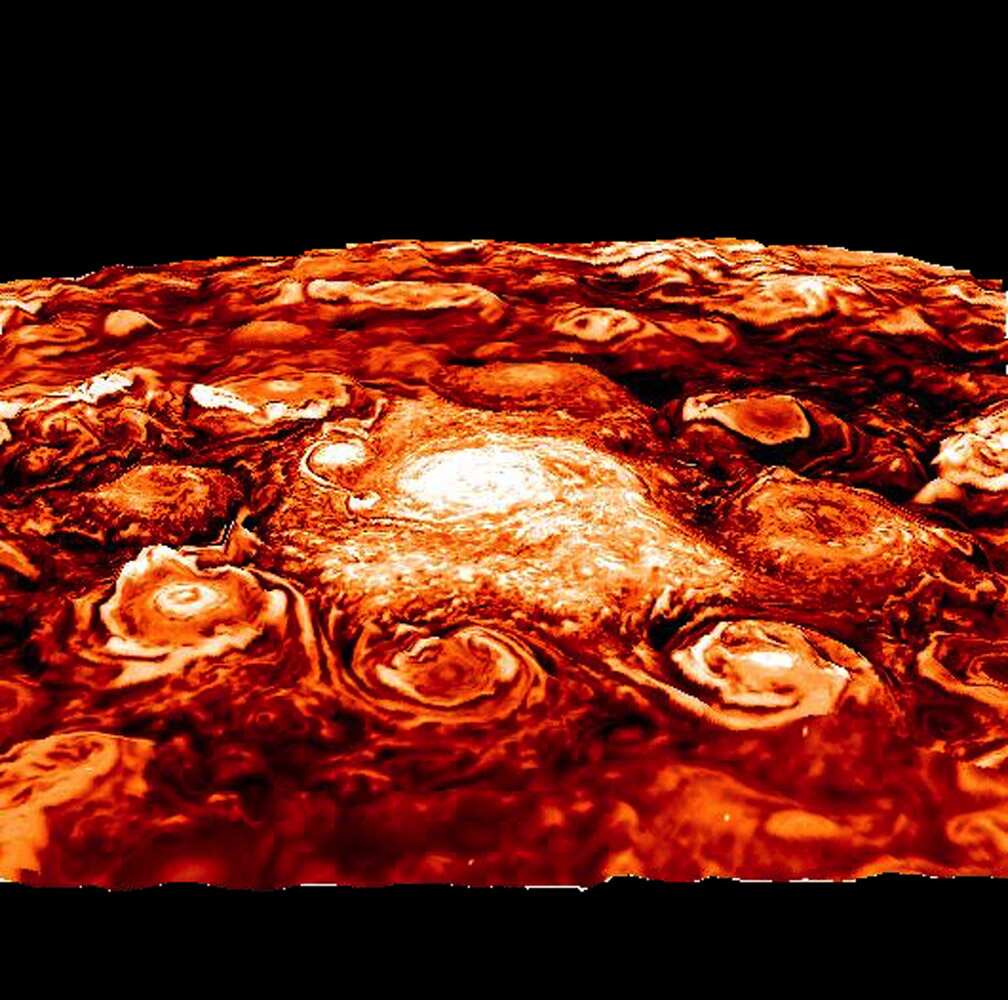
Other observations included a rash of massive cyclones at the planet's poles, the likes of which have not been observed on any other Solar System planet.
It is not known how the cyclones are formed, or how they persist without merging into one.
"The first and most important question that Juno aims to answer is how our Solar System was formed and consequently (to) understand more about its evolution," another study author, Alberto Adriani from Italy's National Institute for Astrophysics, told AFP.
"Any piece of knowledge we can add in understanding Jupiter, which is very probably the first planet formed (around the Sun), is a step towards that direction."







