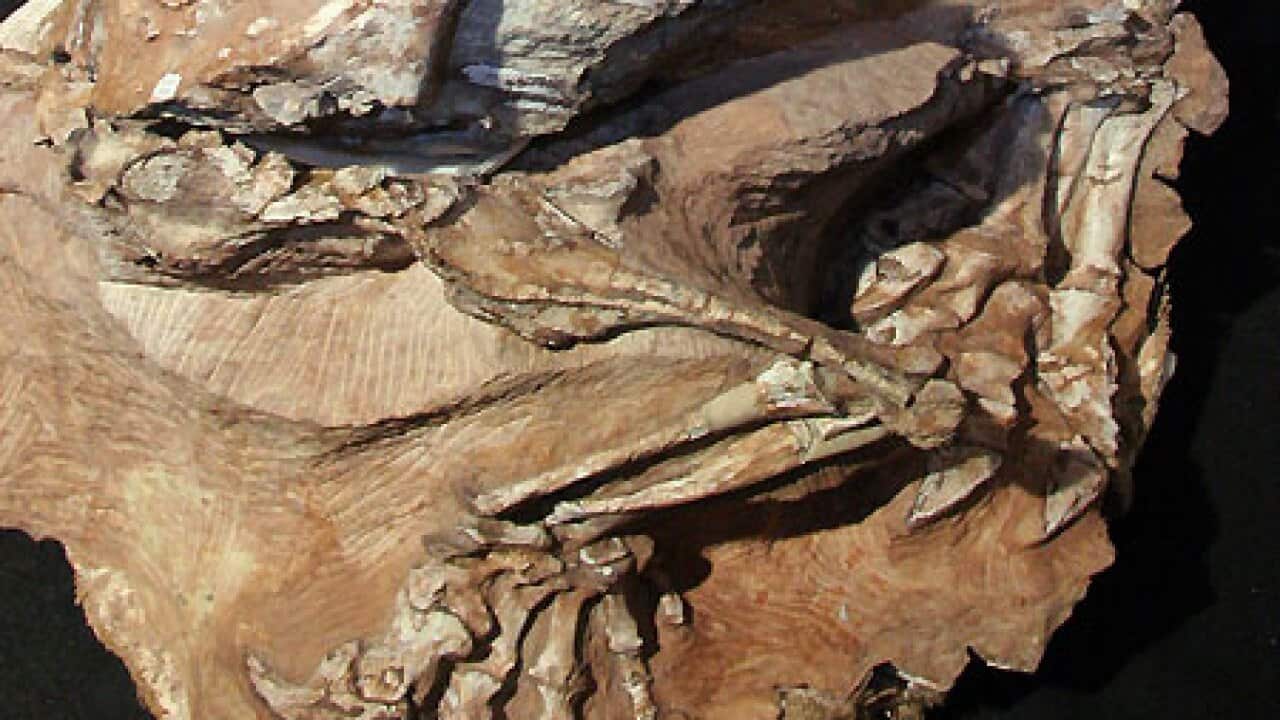
The partial remains of the plant-eating creature, named Seitaad ruessi, were found in the red rocks of the Navajo Sandstone region of the western US state of Utah.
The bones were found just below stone and adobe dwellings of the ancient Anasazi people in a site known as the Eagles Nest.
News that makes sense
Your trusted source for staying up-to-date with the world around you. Get free daily news updates and analysis, straight to your inbox.
Seitaad is an ancestor of the giant long-necked, long-tailed dinosaurs such as Diplodocus, Apatosaurus, and Brachiosaurus that roamed Earth in the late Jurassic period.
Scientists reported the discovery in the March 24 edition of PLoS ONE, the online open-access journal produced by the Public Library of Science.
The study was conducted by paleontologist Joseph Sertich, a Stony Brook University doctoral student, and Mark Loewen of the Utah Museum of Natural History.
"Although Seitaad was preserved in a sand dune, this ancient desert must have included wetter areas with enough plants to support these smaller dinosaurs and other animals," Sertich said.
Named after fabled 'desert monster'
"Just like in deserts today, life would have been difficult in Utah's ancient 'sand sea.'"
The remains were discovered in 2004 and excavated the following year.
Seitaad ruessi is a sauropodomorph, a type of dinosaur common during the Early Jurassic period, when all of the continents were still joined together in the supercontinent of Pangaea.
The discovery "confirms the widespread success of sauropodomorph dinosaurs during the Early Jurassic Period," the scientists said.
Researchers believe the animal "was buried in a suddenly collapsing sand dune that engulfed the remains and stood them on their head," according to the statement.
"The missing parts of the skeleton were lost to erosion over the past thousand years, but were almost certainly visible when Native Americans lived on the cliff just above the skeleton."
The name Seitaad is derived from a Navajo word referring to the legend of a sand-desert monster, while the second part honors US explorer Everett Ruess, who vanished in the southern Utah desert in 1934 at age 20.
When it was alive, the Seitaad ruessi likely weighed between 32 and 40 kilos (70 and 90 pounds) and could walk on four legs or stand up and walk on its rear legs.







