By Sunanda Creagh, The Conversation
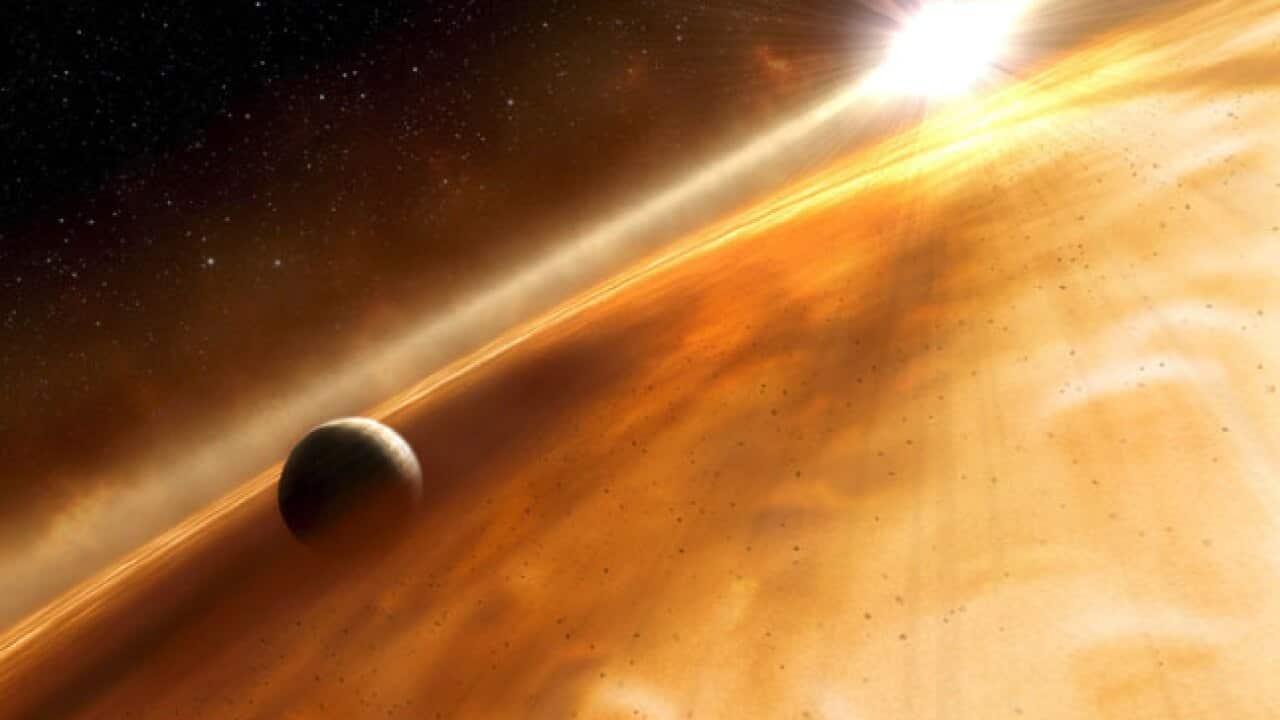
A new study of data from NASA's Hubble telescope shows that the distant star Fomalhaut b really is a massive exoplanet and squashes claims made last year that it was just a dust cloud, researchers said.
Fomalhaut b was first photographed by NASA in 2008 orbiting a very bright star called Fomalhaut around 25 light years from Earth. It celebrated at the time as the first ever directly imaged exoplanet.
Last year, however, a University of Toronto astronomer cast doubt on claims Fomalhaut b was an exoplanet, saying data showing it had drifted off course may mean it was little more than a measly dust cloud.
But a new study released this week has breathed life back into Fomalhaut b, saying a closer look at Hubble images taken between 2004 and 2006 suggest it is an exoplanet after all.
News that makes sense
Your trusted source for staying up-to-date with the world around you. Get free daily news updates and analysis, straight to your inbox.
“Although our results seriously challenge the original discovery paper, they do so in a way that actually makes the object's interpretation much cleaner and leaves intact the core conclusion, that Fomalhaut b is indeed a massive planet,” University of Toronto astronomer, Thayne Currie, who led the study, said in a statement.
The new research will be published in The Astrophysical Journal Letters.
Professor Chris Tinney, head of the Exoplanetary Science group in the University of NSW's the Department of Astrophysics, said the finding was significant.
“This was one of the first exoplanets to be directly imaged and, as such, the question of whether it's real or not is quite critical,” he said.
Dr Jonti Horner, an astronomer from the University of NSW, said that “one of the key reasons Fomalhaut b gets people so excited is that it's something we can really get a feel for – the great majority of exoplanets known to date orbit stars that are too faint to see with the naked eye.”
“The arguments made by the authors of the new study make a lot of sense, and actually address a couple of problems in both the initial discovery work and the latest work that suggested this isn't a planet. The idea that we're seeing a planet embedded in a dusty shroud is an intruiging one – the obvious question to ask is 'How did it get that shroud?',” he said.








