In brief
- Australians will be treated to a rare total solar eclipse in 2028.
- The sky over Sydney will turn dark as the moon passes between the earth and sun.
As millions turned out to see the total solar eclipse over Europe, some Australians may be wondering when it will be our turn to enjoy such a spectacle.
If you're among them, there's some good news: Australia's next total solar eclipse is on the horizon, and it will bring a rare celestial spectacle to parts of the country.
What is a total solar eclipse?
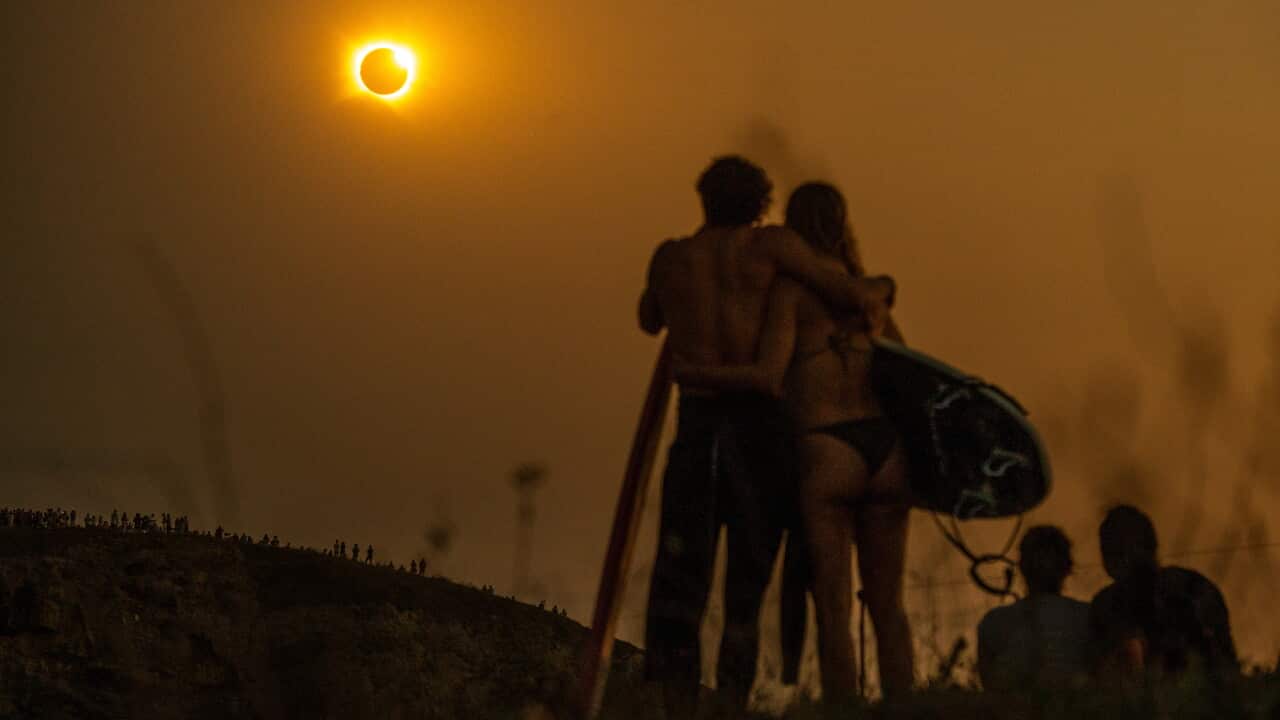
A total solar eclipse is when the moon's orbit passes between the Earth and the sun. For a few moments, the three planetary bodies align. The moon almost perfectly blocks the sun from view, plunging the planet below into a brief darkness.
That's quite different to the partial solar eclipse. In a partial solar eclipse, the orbits of the Earth, moon, and sun align, but the moon only obscures part of the sun.
News that makes sense
Your trusted source for staying up-to-date with the world around you. Get free daily news updates and analysis, straight to your inbox.
It's rare for total solar eclipses to happen anywhere. It's rarer still for them to happen in Australia. There have been just five total solar eclipses visible from Australia in the last 50 years — two close together in 1974 and 1976, then long gaps between eclipses in 2002, 2013 and 2023.
Even then, the word "visible" has done some heavy lifting. Most total eclipses only graze the Australian continent, passing over a northern or southern tip. The 2023 total eclipse, for instance, passed just off the North West Cape region of Western Australia and then transited northeast over Indonesia and Papua New Guinea.
But in 2028, things will be very different.
Where will the 2028 total solar eclipse be visible in Australia?
The 2028 total solar eclipse, also referred to as the Great Australasian Eclipse in some quarters, will start on Saturday 22 July 2028. As the name suggests, the moon will completely obscure the sun for those on the ground.
It will pass south-west across the Australian continent from the Kimberley in northern Western Australia. The eclipse path will then move across the Northern Territory, south-western Queensland and rural NSW, and finally arrive directly over Sydney.
Why is the 2028 eclipse so significant?
For those in the Kimberley, the total eclipse will begin at around 11am AWST. In Sydney, the total eclipse will start at 2pm AEST. It will last for around four minutes as the moon passes in front of the sun.
To put the rarity of an eclipse path of this kind into context, 2028 will be the first time Sydney has experienced a total solar eclipse since 1857. According to NASA, it won't happen again for another 800 years — 3 June 2858.
When the 2028 eclipse passes over Dunedin in New Zealand later that afternoon, it will be the first to do so since 1163.
Will Melbourne, Brisbane and other Australian cities see the eclipse?
But what about Australian cities other than Sydney? Will you be able to see the eclipse?
Viewers in Melbourne, Brisbane, Adelaide, Perth, Darwin, Hobart, and Canberra will all be able to see the partial eclipse. The moon will block part of the sun, but the sky will not turn completely dark as it does during a total eclipse.
For the latest from SBS News, download our app and subscribe to our newsletter.







