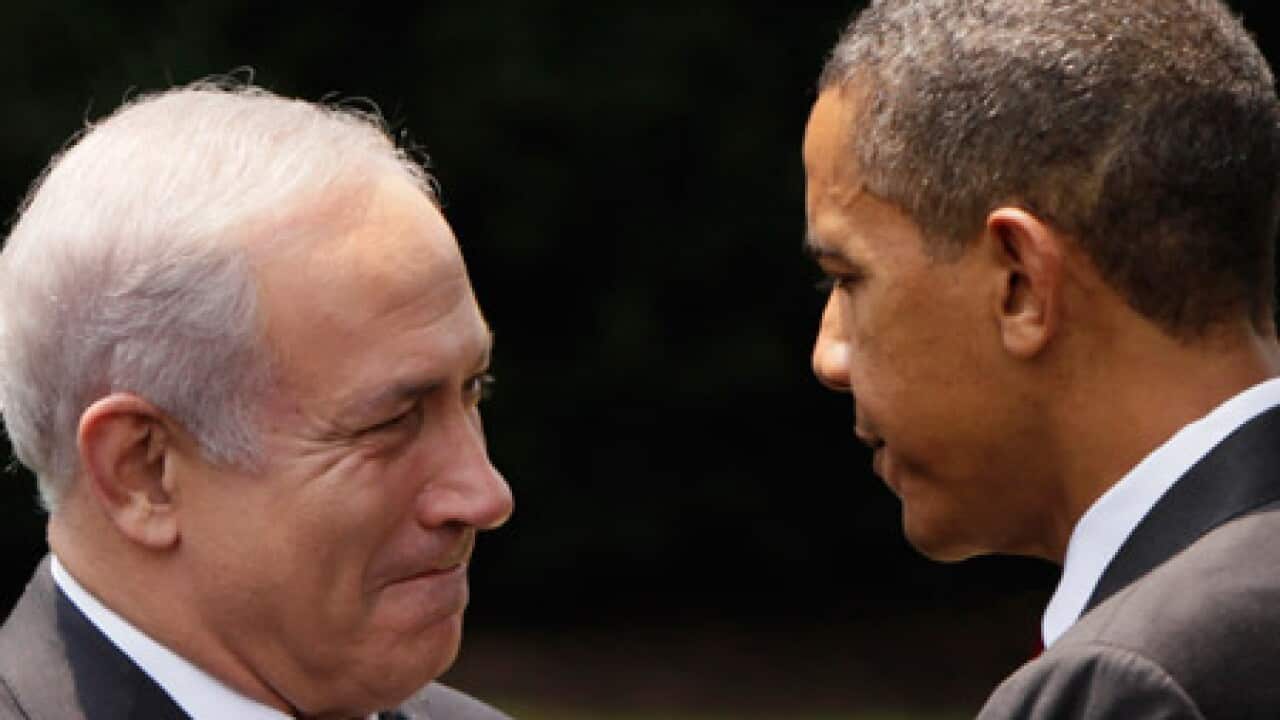
Israeli Prime Minister Benjamin Netanyahu's brief visit to Washington seems to have left him with everything he could have wanted from US President Barack Obama, and then some.
In 80 minutes of one-on-one talks in the White House on Tuesday, Netanyahu won praise for his recent easing of Israel's embargo on the Gaza Strip and reaffirmation of the strong ties between his country and the United States.
In marked contrast to the chilly atmosphere during his his last visit, this time he was greeted at the White House door by Obama. The two sat close together as they spoke to reporters in the Oval Office and they staged a long and vigorous handshake for the cameras.
News that makes sense
Your trusted source for staying up-to-date with the world around you. Get free daily news updates and analysis, straight to your inbox.
Netanyahu got a US pledge to try to deflect motions against Israel at a September session of the International Atomic Energy Agency and an assurance that a proposed 2012 conference on establishing a Middle East free of nuclear weapons would not be allowed to single out Israel.
At a conference in New York last month, participants called on Israel to sign the Non-Proliferation Treaty and open its facilities to inspection, but made no mention of Iran's controversial nuclear program.
Israel is widely reported to have around 200 warheads but refuses to confirm or deny its capability, a policy of which is said to date back to a secret agreement reached in the 1960s between Israeli premier Golda Meir and US president Richard Nixon.
Published accounts say that Nixon agreed to turn a blind eye to Israel's nuclear arsenal as long as it did not test a nuclear missile or publicly admit to having one.
It could be that understanding that Obama was alluding to when he sat next to Netanyahu in front of reporters on Tuesday.
"We discussed issues that arose out of the nuclear non-proliferation conference and I reiterated to the prime minister that there is no change in US policy when it comes to this issue," Obama said.
"We strongly believe that given its size, its history, the region it's in and the threats that are leveled against it that Israel has unique security requirements."
There was one area where it had been thought that Obama might try to pressure his visitor; the approaching end of a 10-month Israeli freeze on Jewish settlement building in the occupied West Bank.
Successive US administrations have described settlements as an obstacle to peace between Israel and the Palestinians and Obama would have loved to see the moratorium extended beyond its September end.
But it seems that the president accepted that Netanyahu, who heads a coalition government dependent on hawks, would be unable to deliver an extension.
Instead Obama said that Israel and the Palestinians should move, before the moratorium runs out, from their current US-mediated talks to direct negotiations on the issues at the heart of their dispute.
A senior US official said that as it had become clear that Israel would let the freeze expire, the United States hoped to use the deadline to motivate progress on launching talks, rendering the freeze issue obsolete.
"It's a way to add some leverage to this situation," the official said on condition of anonymity.
"My hope is that once direct talks have begun, well before the moratorium has expired, that that will create a climate in which everybody feels a greater investment in success," Obama said.
Netanyahu says he is ready to meet Palestinian president Mahmud Abbas at any time, but the Palestinians have yet to commit to direct talks, accusing Israel of undermining the atmosphere with continuing settlement activity.
Tuesday's White House meeting, just a few hours after Netanyahu flew in from Israel, was all about laying to rest past impressions of a chilly relationship.
In March, Netanyahu was denied even a photo-op with Obama as a row raged over settlement expansion. This time, reporters were invited to watch the US leader see the premier to his limousine and wave him goodbye as marines in dress uniform stood to attention.
Sweetening the tone still further, US First Lady Michelle Obama invited Netanyahu's wife Sara for afternoon tea.
An Israeli official said the two women spoke about their children and their husbands and played with the Obama family dog when he wandered into the room in which they were sitting.
After spending Tuesday night in Blair House, the presidential guest residence next to the White House, Netanyahu flies to New York on Wednesday for meetings with United Nations Secretary-General Ban ki-Moon, former president Bill Clinton and American Jewish leaders.







