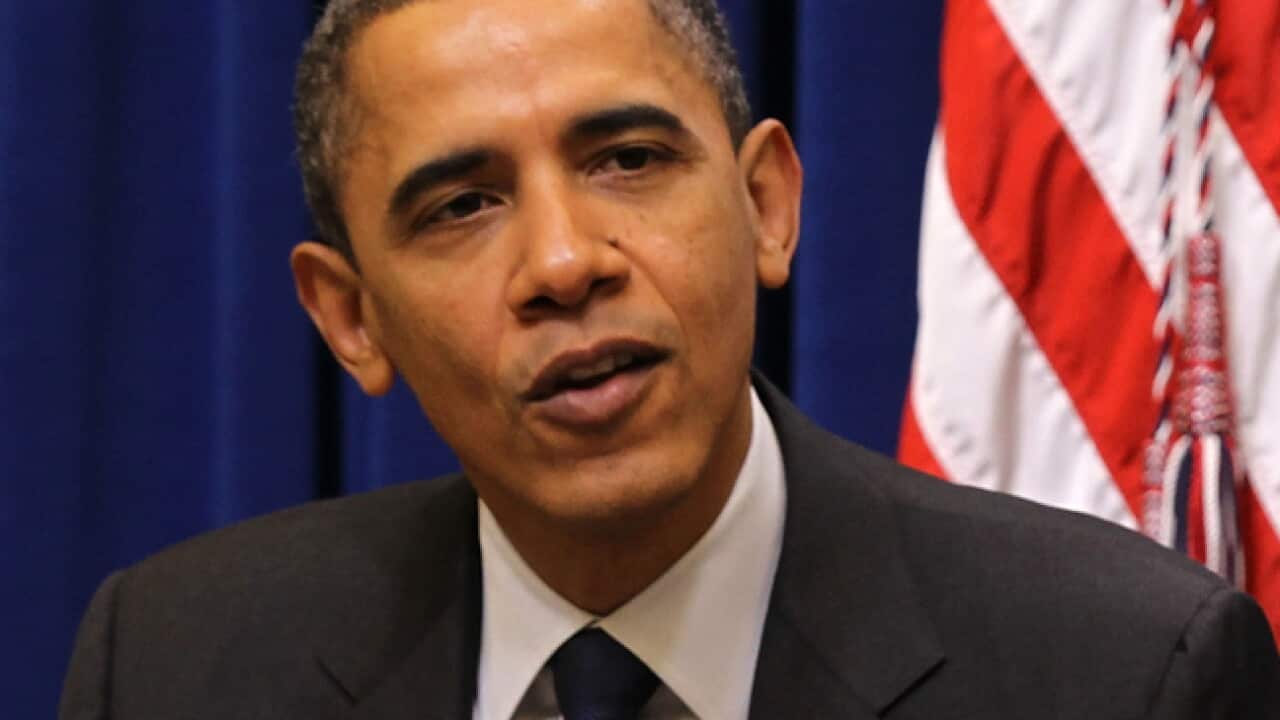
US President Barack Obama has fiercely defended US involvement in Libya, saying that when America's interests and values are at stake "we have a responsibility to act."
Obama was giving a prime-time address aimed at winning the support of a war-weary public for the military intervention against Muammar Gaddafi, who is attacking rebels trying to oust him after four decades in power.
"I can report we have stopped Gaddafi's deadly advance," Obama said.
"History is not on Gaddafi's side," he added.
News that makes sense
Your trusted source for staying up-to-date with the world around you. Get free daily news updates and analysis, straight to your inbox.
Seeking to answer critics at home who have questioned US intervention in Libya, Obama agreed America should not be "expected to police the world," adding that mistakes made in Iraq must be avoided.
"Mindful of the risks and costs of military action, we are naturally reluctant to use force to solve the world's many challenges," Obama said in a nationally broadcast address.
"But when our interests and values are at stake, we have a responsibility to act. That is what happened in Libya over the course of these last six weeks."
He said the United States had had a direct plea for help from the Libyan people, and was faced with "the prospect of violence on a horrific scale."
"To brush aside America's responsibility as a leader and -- more profoundly -- our responsibilities to our fellow human beings under such circumstances would have been a betrayal of who we are," Obama said.
"Some nations may be able to turn a blind eye to atrocities in other countries. The United States of America is different. And as president, I refused to wait for the images of slaughter and mass graves before taking action."
Public support low
US public support for the conflict is lukewarm: a March 22 Gallup poll showed that 47 percent of Americans surveyed approve of action against Libya, less than for most US military campaigns over the past four decades.
After inheriting wars in Afghanistan and Iraq, the Nobel Peace Prize-winning president finds himself embroiled in yet another conflict, this time one of his own choosing.
Obama has been criticized since military action began nine days ago for not getting his message across.
Lawmakers, including many from Obama's own Democratic Party, are angry Congress was not consulted before troops were deployed and have raised concerns the Libya mission is ill-defined and the exit strategy unclear.
Egypt and Tunisia
Defense Secretary Robert Gates and Secretary of State Hillary Clinton have argued that the US had to intervene quickly in Libya for humanitarian reasons and also made a broader case that inaction would have had disastrous knock-on effects for the region.
"It was not a vital national interest to the United States, but it was an interest," said Gates, pointing to the possibility of a mass exodus of refugees that could have overwhelmed Tunisia and Egypt.
"So you had a potentially significantly destabilizing event taking place in Libya that put at risk potentially the revolutions in both Tunisia and Egypt.
"Egypt is central to the future of the Middle East," Gates added.
"Imagine we were sitting here and Benghazi had been overrun, a city of 700,000 people, and tens of thousands of people had been slaughtered, hundreds of thousands had fled... either with nowhere to go or overwhelming Egypt while it's in its own difficult transition," Clinton said.
"The cries would be, 'why did the United States not do anything? How could you stand by when, you know, France, and the United Kingdom, and other Europeans, and the Arab League, and your Arab partners were saying, 'You've got to do something?'"
The pair also downplayed fears of a protracted conflict, highlighting the limited scope both of the mission and of US military involvement as the Pentagon tries to off-load tasks to European and Arab allies.
NATO takes command
Obama's position was made easier Sunday when NATO ambassadors agreed in Brussels to take command of all Libyan operations, but the United States was still clearly bearing the brunt of the military burden.
Rebel forces on the ground were gaining momentum as they wrested back control of key towns and pressed on westwards towards Tripoli, reaching Gaddafi's hometown of Sirte, which was pounded overnight by coalition jets.
The United States and its allies are hopeful that Gaddafi's regime will eventually crack. They dread a long drawn-out conflict that could test the political will of their patchwork coalition.
Clinton said the allies would be encouraging defections through a UN special envoy, former Jordanian foreign minister Abdul Ilah Khatib, who would visit Tripoli and ask Gaddafi: "'Do you really want to be a pariah? Do you really want to end up in the international criminal court?"







