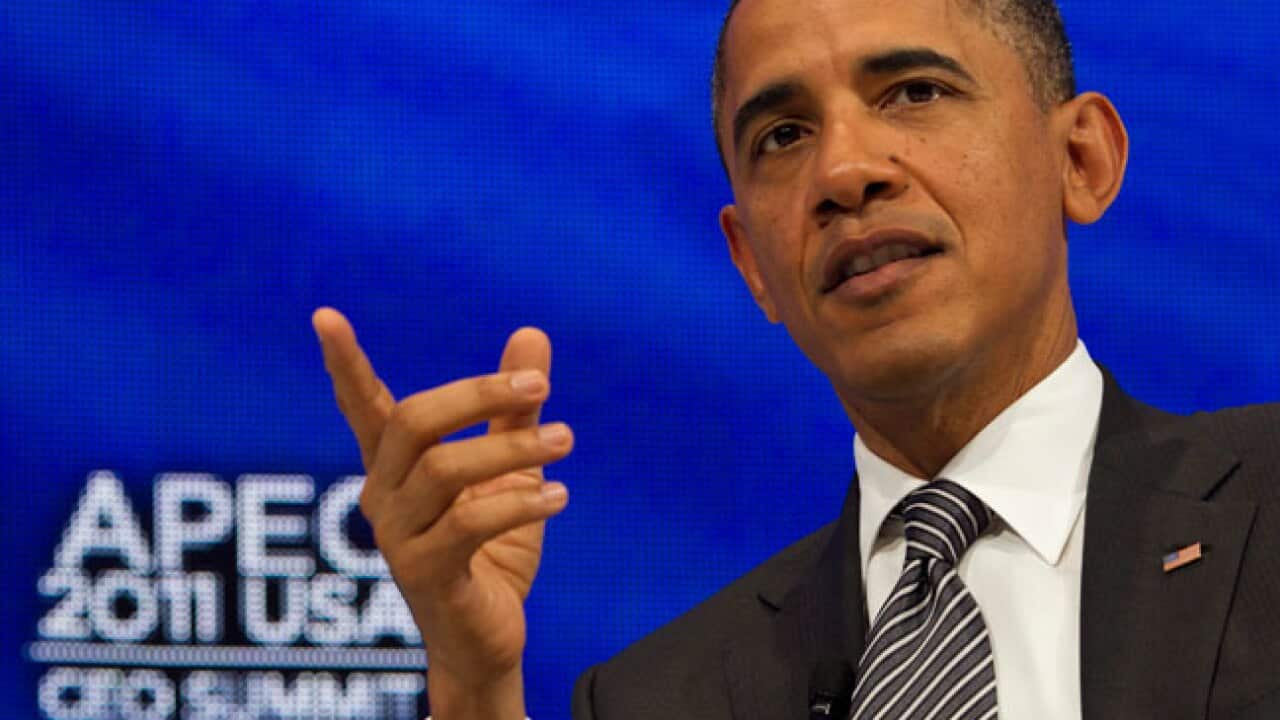
US President Barack Obama laid out his vision Sunday of a 'seamless' trans-Pacific trade zone that could re-energize global growth, boosted by Japan and now Canada's entry into talks.
Opening a regional summit in his native Hawaii, Obama said harnessing the huge trade potential of the dynamic region was vital as he wooed countries from across the Pacific Rim into the US-led Trans-Pacific Partnership (TPP).
The details of the agreement remain vague and opposition has already built in several countries but it could become the biggest free trade zone in the world, dwarfing even the European Union.
"Today we have got a chance to make progress towards our ultimate goal which is a seamless regional economy," Obama told the Asia-Pacific Economic Cooperation (APEC) forum, which accounts for more than half the world's GDP.
"I want to emphasize that the Asia-Pacific region is absolutely critical to America's economic growth," Obama said.
News that makes sense
Your trusted source for staying up-to-date with the world around you. Get free daily news updates and analysis, straight to your inbox.
"We consider it a top priority. And we consider it a top priority because we're not going to be able to put our folks back to work and grow our economy and expand opportunity unless the Asia-Pacific region is also successful."
The TPP was signed in 2005 as an obscure agreement among Brunei, Chile, New Zealand and Singapore. Obama has turned it into the cornerstone of US free trade drive, with Australia, Japan, Malaysia, Peru, the United States and Vietnam now also in the talks.
Two days after Japan committed to joining the negotiations, Canadian Prime Minister Stephen Harper followed suit, telling reporters in Hawaii: "We are expressing our formal intention to join the Trans-Pacific Partnership."
The notable absentee is China, the world's second largest economy, and tensions over economic policy threatened to bubble over as Obama and Chinese President Hu Jintao held talks in Hawaii on the sidelines of APEC.
The United States has not explicitly ruled out China's entrance into the TPP, but Secretary of State Hillary Clinton has linked the "21st century" trade agreement to fundamental values including openness and labor standards.
Obama, seeking re-election next year as many heartland Americans think they lost their jobs to lower-wage China, told Hu on Saturday that Americans were "impatient" for a change in Beijing's economic policy.
Washington says that China keeps its yuan currency artificially low to boost its exports and complains that Beijing is lax on intellectual property standards, penalizing US innovation.
A US official said that Obama and Hu would hold a second, informal meeting on Sunday before Obama ends the weekend gathering in palm-fringed Hawaii with a press conference.
Despite swirling optimism about the TPP, Obama has acknowledged major obstacles must be overcome before a deal can be reached. Experts are skeptical that a US timeframe for concluding a concrete pact in 2012 is realistic.
The Trans-Pacific Partnership would strike down tariffs and trade barriers and inject momentum to liberalization hopes bogged down by inconclusive talks on the Doha trade round.
Some farm groups in Japan and the United States have both voiced alarm that they would be swamped by global competition.
Obama and First Lady Michelle, in a stylish strapless dress topped with a pink sash, hosted a Hawaiian reception on Saturday evening on Waikiki Beach, in a rare informal opportunity for top world leaders.
But even with smothering security along the beach, one demonstrator managed to get through -- a popular Hawaiian recording artist who was enlisted to perform but, in a subtle protest, sang in support of the "Occupy" movement.
Makana, who goes by one name, told AFP that he pulled open his jacket to reveal a T-shirt that read "Occupy with Aloha," using the Hawaiian word whose various meanings include love and peace.
He then sang his new song "We Are The Many," playing it repeatedly for 40 minutes.







