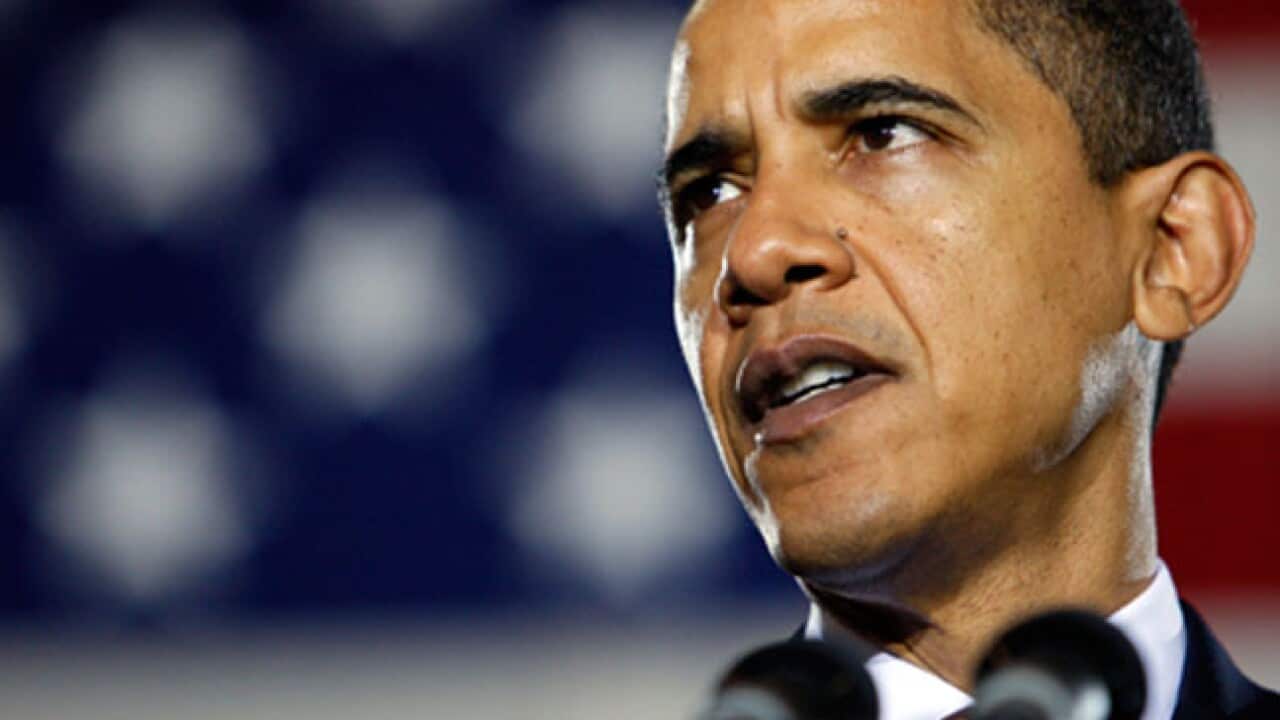
US President Barack Obama unveiled a $4 trillion deficit reduction drive and savaged Republican plans that he said would reward the rich and fracture America's social compact.
Obama laid out his vision in a speech at George Washington University, aiming to prepare the ground for short-term budget fights and define his stand on an issue crucial to the US economy and his 2012 reelection chances.
He proposed cutting spending with a "scalpel and not a machete" on health care costs, the military and some bedrock social programs, and decried the vision of budget-cutting Republicans as "deeply pessimistic."
Tax increases for affluent Americans
News that makes sense
Your trusted source for staying up-to-date with the world around you. Get free daily news updates and analysis, straight to your inbox.
In addition to cuts in discretionary spending, Obama would finance his deficit drive with tax increases for affluent Americans. But he warned he would not allow investments in education, broadband and clean energy to be starved.
"The debate about budgets and deficits is about more than just numbers on a page, more than just cutting and spending," Obama said.
"It's about the kind of future we want, it's about the kind of country we believe in."
Obama unveiled a plan to achieve $4 trillion in deficit reduction over 12 years or less, saying he was borrowing recommendations from a bipartisan fiscal commission which reported last year.
Officials said the approach would shave deficits as a share of the US economy to 2.5 percent of GDP in 2015 and put them on a path to reach close to 2.0 percent by the end of this decade.
Currently, the US budget deficit is forecast to reach $1.6 trillion this year and cumulative public debt stands at $14.27 trillion.
The president said every sector of government spending should be "on the table," giving notice that social programs cherished by Democrats would not be immune and proposed a fundamental strategic review to mine for waste in military spending.
Portraying himself as a voice of reason and a conciliator amid Washington's fevered political debate, Obama called on Democrats and Republicans to come together to secure a prosperous future for their country.
But he savaged a rival budget and deficit reduction plan put forward by Republican congressman Paul Ryan, which aims to cut 4.4 trillion dollars from the deficit over a decade.
Obama argued Ryan's plan mandated sweeping cuts on health care programs for the poor and the elderly while rewarding the richest Americans with tax cuts.
"The fact is, their vision is less about reducing the deficit than it is about changing the basic social compact in America," Obama said.
"There's nothing courageous about asking for a sacrifice from those who can least afford it and don't have any clout on Capitol Hill," Obama said, criticizing Republican cuts in clean energy, education and transportation.
The president was forced to agree to an extension of the cuts late last year in a compromise with Republicans that avoided tax hikes on the middle-class.
After the meeting, the president's top Republican adversary, House speaker John Boehner, rolled out his party's bottom line on taxes.
"I think the president heard us loud and clear. If we're going to resolve our differences and do something meaningful, raising taxes will not be part of that," he said.
Key details of the plan and how it stacks up against those of his political rivals:
- Obama's plan would cut $4 trillion from the deficit over 12 years through a mixture spending cuts (roughly 75 percent) and closing tax loopholes and tax breaks for the very wealthy (roughly 25 percent).
- Republican plans would see a similar level of deficit reduction in a slightly shorter period, with savings coming exclusively from $6 trillion in spending cuts -- which would also pay for the cost of further tax breaks.
- Obama's planned cuts to non-defense spending would trim the deficit by $770 billion by 2023. Meanwhile, keeping increases in defense spending below the rate of inflation would trim a further $400 billion in the same period.
- Reforms to Medicaid, which offers government medical help to the poor, and Medicare, which offers help for seniors, would save $480 billion by 2023. The reforms include using the government's vast purchasing power to get lower prices for treatment and cut excessive medicine costs.
- Obama would also reform the personal and corporate tax regimes, paying for lower basic rates by closing loopholes that cost the government tens of billions of dollars.
- Even if the four trillion dollars in savings are realized it would not necessarily spell balanced finances. The White House estimates deficits would still be worth about two percent of GDP at the end of the decade. According to Harm Bandholz of UniCredit Bank the deficit will be around 10 percent this year and 8.5 percent for 2012.
- But if the broader debt to GDP ratio does not stabilize by 2014 then Obama is proposing a "fail-safe" that would trigger across the board spending cuts to limit deficits to no more than 2.8 percent.







