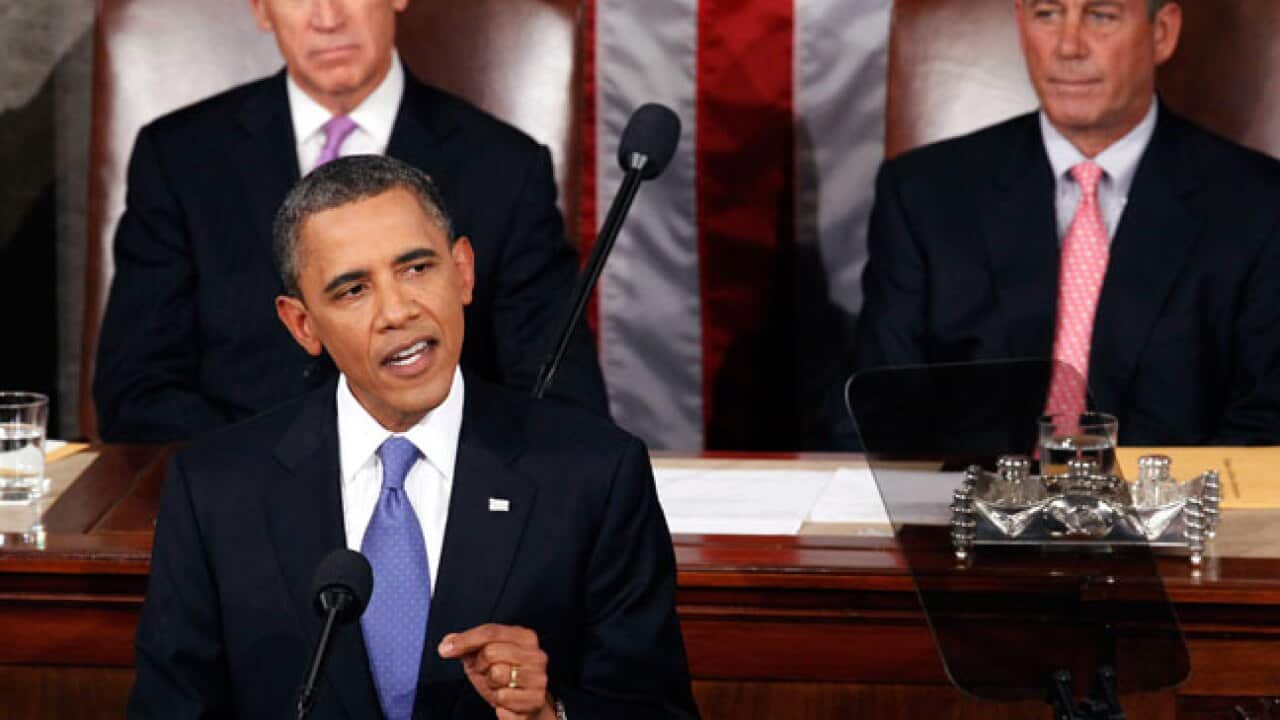
US President Barack Obama has unveiled a $447 billion jobs plan which he said would 'jolt' the stalled economy at an 'urgent' time for a nation facing a deep economic and political crisis.
Mr Obama challenged Republicans to halt a "political circus" and immediately pass a bigger than expected $447 billion jobs plan he said would jolt the "stalled" economy.
Obama, seeking to restore public trust in his economic management and take aim at 9.1 per cent unemployment which has derailed the recovery and threatens his reelection bid, unveiled the plan at a joint address to Congress.
"The people of this country work hard to meet their responsibilities, the question tonight is whether we'll meet ours," Obama said.
News that makes sense
Your trusted source for staying up-to-date with the world around you. Get free daily news updates and analysis, straight to your inbox.
"The question is whether, in the face of an ongoing national crisis, we can stop the political circus and actually do something to help the economy."
PLAN WILL 'PUT PEOPLE BACK TO WORK'
Obama said the initiative, called the American Jobs Act, would put people back to work and more money in the pockets of those who are working.
"It will create more jobs for construction workers, more jobs for teachers, more jobs for veterans, and more jobs for the long-term unemployed," he said.
"It will provide a tax break for companies who hire new workers, and it will cut payroll taxes in half for every working American and every small business.
"It will provide a jolt to an economy that has stalled, and give companies confidence that if they invest and hire, there will be customers for their products and services. You should pass this jobs plan right away."
PAYROLL TAX CUT
The centrepiece of the plan is a deeper than expected $240 billion payroll tax cut for employers and employees meant to keep money in the pockets of those most in need, and most likely to spend extra cash to spur demand.
Hopes for renewed economic demand also got a boost on Thursday when Federal Reserve Chairman Ben Bernanke said the central bank was ready to employ various tools to provide an additional monetary stimulus.
But prospects for Obama's plan are uncertain, given blanket Republican opposition to new spending not balanced by steep budget cuts and a deeply polarised political climate already agitated by the coming election.
DEFICIT REDUCTIONS WILL PAY FOR PLAN
The plan will be paid for in future years, through deficit reductions, a factor that could spark opposition from some Republicans who may demand cuts in government programs to balance the new spending.
However, senior US officials said the package had to be paid for in future years to ensure that it had a stimulatory impact.
The plan's $447 billion price tag contains $175 billion to cut employee payroll taxes in half, to 3.1 per cent in 2012.
The taxes fund the Social Security retirement and Medicare health plan for senior citizens, and officials said the cuts were a way to get money directly into the pockets of those who need it most and those most likely to spend it.
Obama also proposed cutting the payroll tax in half for 98 per cent of businesses on payroll up to $5 million in a bid to induce hiring of new workers.
Firms can get a complete payroll tax holiday if they add workers or increase the wages of current employees up to $50 million in payroll.
One administration official said that using payroll taxes to spur demand was an "elegant" way to ensure that people "have more money in your cheque, more money in your pocket."
$50 BILLION FOR INFRASTRUCTURE
Obama also proposed a $50 billion program to invest in highways, railroad and airport modernisations, which officials said would put hundreds of thousands of construction workers back to work.
He called on Congress to provide $10 billion to capitalise a national infrastructure bank to leverage private and public capital to invest in a broad range of projects.
He also proposed a $35 billion program to prevent layoffs of 280,000 teachers and to keep police officers and firefighters on the job, in a bid to stem local and state government layoffs that are inflating unemployment figures.
Obama will likely ask a congressional supercommittee which met for the first time on and is mandated to cut spending by $1.5 trillion to seek further budget cuts to offset the new spending.
'SPEECH TO RESET POLITICAL BATTLEGROUND'
The White House believes the speech will allow Obama to reset the political battleground and senses that Republicans are feeling political heat from their own unpopularity after a showdown over raising US government borrowing in July.
He has also warned that if the plan is blocked, he will seek to hold Republicans to account at the polls and accuse them of putting a desire to eject him from the White House above a patriotic duty to revive the economy.
KEY POINTS OF OBAMA'S JOBS PLAN
Here are key points of President Barack Obama's new $447 billion plan to generate more jobs for Americans and stimulate the economy.
- Employer payroll tax holidays: cuts in half businesses owners' share of payroll taxes, giving them more incentive to hire. Payroll taxes will be eliminated entirely for new workers. Cost: $65 billion.
- Employee payroll tax breaks: extends through 2012 a cut in social security and other deductions from workers' paychecks, giving households more money to spend. Cost: $175 billion.
- Investment incentives: businesses will be allowed to deduct 100 percent of their investments in new plants and equipment in one year. Cost: $5 billion.
- Hiring soldiers and others: businesses will get tax credits for hiring unemployed military veterans, important as forces in Iraq and Afghanistan are drawn down, and for hiring the long-term unemployed. Cost: at least $8 billion.
- Protecting public sector jobs: cash-pinched local authorities will get $35 billion to rehire or avoid laying off teachers, police and firefighters.
- Infrastructure investment: a $50 billion effort to modernize transport infrastructure, and $10 billion for new public-private National Infrastructure Bank to fund long-term projects. Another $30 billion is for improving schools, and $15 billion for rehabilitating vacant and foreclosed homes and businesses.
- Unemployment benefits: extending dole payments for millions of jobless, while allowing them to take part-time jobs and go through retraining programs. Cost: $49 billion. A path ways back to work fund. Cost: $5 billion.







