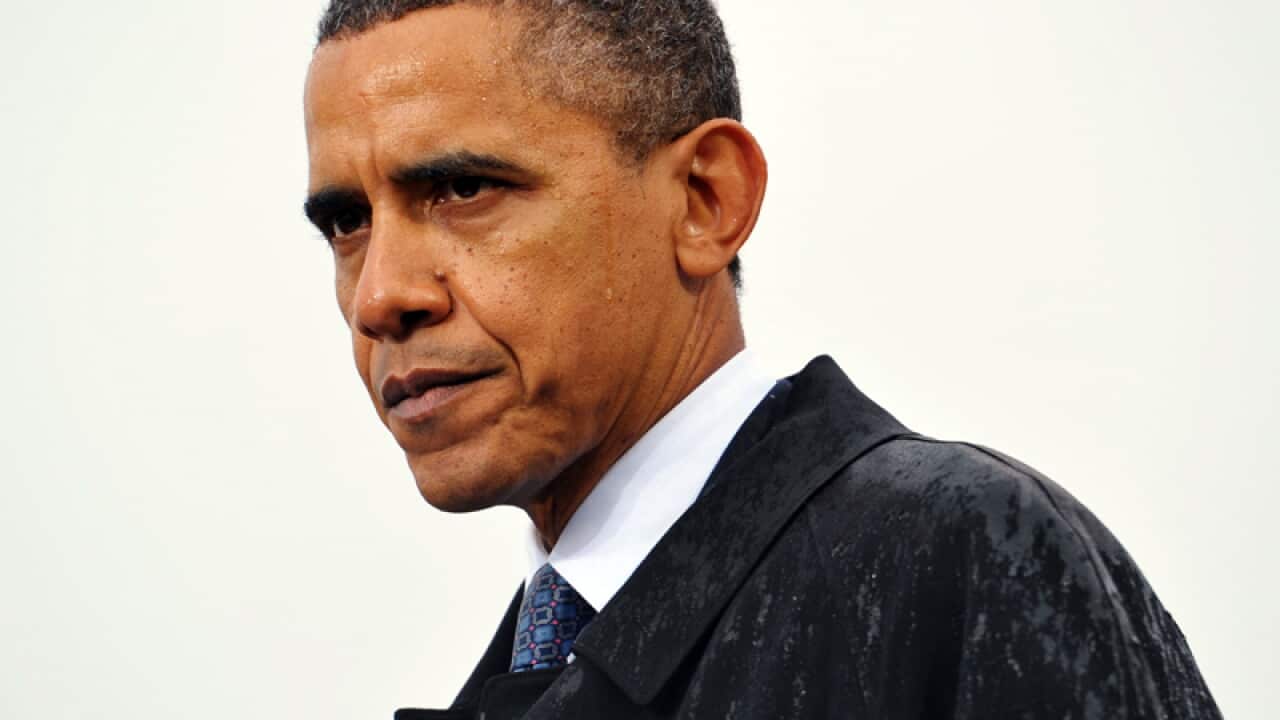
"Today, I want to make it absolutely clear to Assad and those under his command, the world is watching. The use of chemical weapons is and would be totally unacceptable," Obama said.
The US warned Monday that Syria had begun mixing deadly sarin gas, and said it was more and more concerned a desperate President Bashar al-Assad could use chemical arms on his own people.
News that makes sense
Your trusted source for staying up-to-date with the world around you. Get free daily news updates and analysis, straight to your inbox.
But the Damascus government, hitting back at increasingly explicit and alarming warnings from Washington, pledged never to take such a step, which the Obama administration warns would cross a "red line" and result in US action.
Prompted by deteriorating security in Syria, the United Nations meanwhile suspended operations there and said it would pull out non-essential staff, while the European Union reduced its activities in Damascus to a minimum.
A US official told AFP that Syria had begun mixing chemicals that could be used to make sarin, a deadly nerve agent, while CNN reported Damascus could be mulling the use of the gas in a limited artillery attack on advancing rebels.
The intelligence appeared to explain a series of fresh warnings issued by Washington that the use of chemical weapons by the Assad government would cross a "red line" and invite unspecified US action.
The White House has been loath to make a direct intervention in Syria but clearly indicated Monday that the use of chemical weapons could change the equation.
"We are concerned that an increasingly beleaguered regime, having found its escalation of violence through conventional means inadequate, might be considering the use of chemical weapons against the Syrian people," White House spokesman Jay Carney said.
Washington worries that battlefield advances by rebels could prompt Assad to use chemical arms, or that such stocks could become insecure or find their way into the hands of groups hostile to the United States and allies.
"The Assad regime must know that the world is watching and that they will be held accountable by the United States and the international community if they use chemical weapons or fail to meet their obligations to secure them," Carney said.
In televised remarks, an unnamed Syrian foreign ministry official said Syria would "never, under any circumstances, use chemical weapons against its own people, if such weapons exist."
The New York Times reported that as well as public warnings to Assad, US and European officials had sent private warnings to Damascus through Russia.
Secretary of State Hillary Clinton, during a trip to Prague, declined to "telegraph" what Washington would do if Syria crossed its "red line" and used chemical weapons.
But she said: ""suffice it to say that we're certainly planning to take action if that eventuality were to occur."
A 150-strong US task force, including special forces soldiers, has been stationed in Jordan for several months, and could be called into action if Syria loses controls of its chemical weapons amid battlefield chaos.
In Syria itself, there were new developments in a vicious conflict that has taken 41,000 lives since erupting in March 2011.
In an exclusive interview with AFP, Arab League chief Nabil al-Arabi said Assad's regime was in danger of collapse "anytime" as the opposition made political and military headway.
"Facts on the ground indicate very clearly now that the Syrian opposition is gaining, politically and militarily. Every day they are gaining something," Arabi said.
In another blow to the Assad regime, foreign ministry spokesman Jihad Makdisi, a prominent advocate of the president, was reported to have quit and headed for London from Beirut.
UN spokesman Martin Nesirky said the world body would pull non-essential international staff from Syria with "immediate effect."
The EU said it was also reducing activities in Damascus to a minimum.
An air strike Monday killed at least 12 people -- eight rebels and four civilians -- and wounded more than 30 in the rebel-held town of Ras al-Ain on the border with Turkey, the Syrian Observatory for Human Rights said.
The monitoring group, which relies on a network of activists and medics in civilian and military hospitals, said 86 people -- including 32 civilians, 32 rebels and 22 troops -- were killed Monday as Syrian troops battered rebel positions in and around Damascus.
On the diplomatic front, Russian President Vladimir Putin warned Turkey that the NATO deployment of Patriot missiles along its border with Syria could exacerbate tensions after meeting Turkish Prime Minister Recep Tayyip Erdogan.
Russia objects to Turkey's NATO request for the deployment of Patriot missiles as Assad's regime clings to power and suppresses a rebellion.
Moscow has warned that such a deployment could spark broader a conflict pulling in the Western military alliance.
"As they say, if a gun is hung on the wall at the start of a play, then at the end of the play it will definitely fire," Putin said.
"Why should we need extra shooting at the border? We are urging restraint."
Moscow is a staunch ally of Damascus, routinely blocking resolutions against Assad's regime at the UN Security Council, while Ankara's relationship with its neighbor collapsed over the conflict.







