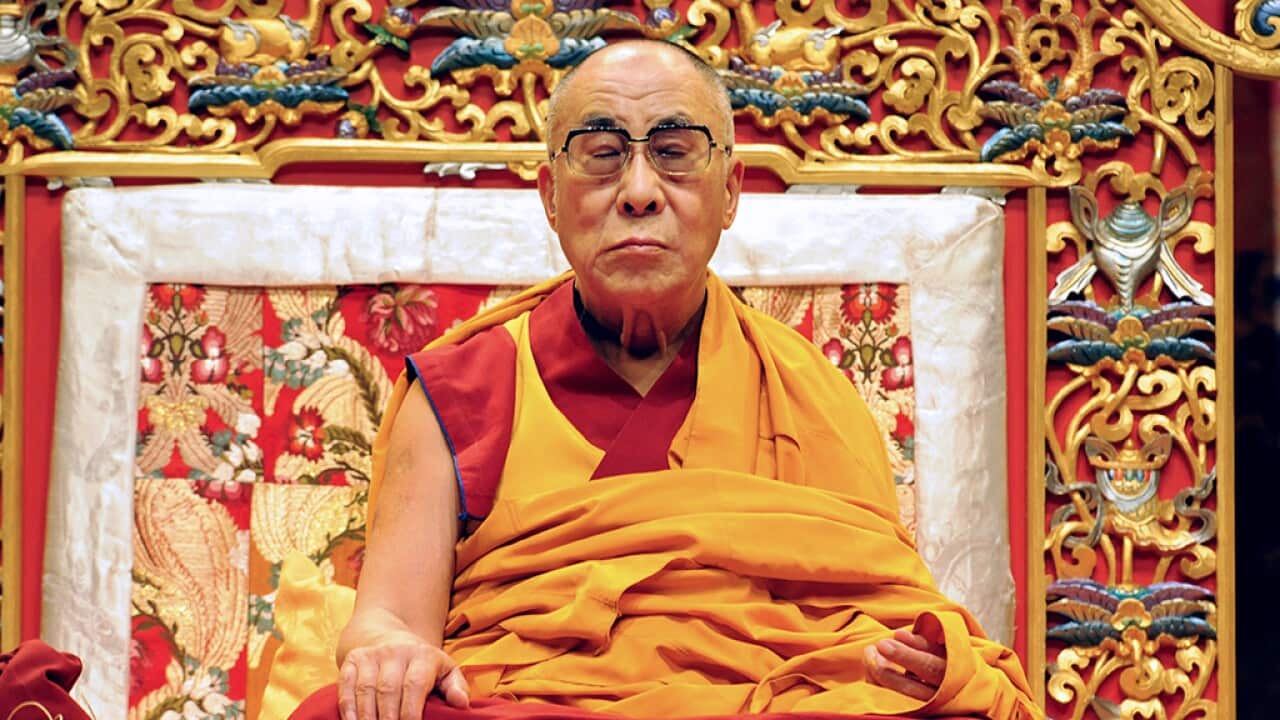
Every morning before meetings began at the 2014 World Economic Forum at Davos, attendees had a chance to meditate with Matthieu Ricard, a Buddhist monk famous for being “the happiest man in the world.” We know this, because Ricard’s brain had been analyzed for a project at the University of Wisconsin; 256 sensors had been attached to his head, confirming that his brain was indeed the happiest brain the researchers had ever run across. At Davos, Ricard brought that happiness with him. His job (which he performed, of course, happily) was to help economic policymakers be happier.
It may seem odd that those charged with the world’s productivity went to an expert in happiness. But according to William Davies’ new book, The Happiness Industry, such a focus on happiness is entirely natural. Economics, Davies argues, is built on happiness—not because all economists are happy, but because economics has always used happiness as a touchstone, a tool, and a goal. In Davies’ view, though, all that happiness research, hasn’t led to greater happiness. Instead, it’s resulted in an evacuation of morality and politics—which ultimately leaves people profoundly unhappy.
All that happiness research hasn’t led to greater happiness. Instead, it’s resulted in an evacuation of morality and politics.
The happiness industry, as Davies defines it, includes our current glut of so-called business gurus as well as the Buddhist at Davos. However its primary proponents are in the medical and economic sectors. Psychologists pushing anti-depressants, doctors who try to measure stress, and economists and marketers who try to gauge and fulfill consumer desires, are all part of a system working to make you ever happier.
But this obsession with finding ways to make us happy is not a new effort; it’s historical roots go back centuries. Davies traces happiness economics back to Jeremy Bentham and the beginnings of utilitarian philosophy in the 18th century. Bentham wanted a way to rationalize, quantify, and measure public policy successes and failures. Happiness seemed to be a way to do that. The goal of government, of economists, and of psychologists, therefore, is to maximize the happiness of society, or utility.
News that makes sense
Your trusted source for staying up-to-date with the world around you. Get free daily news updates and analysis, straight to your inbox.
And it wasn’t just Bentham—indeed, long before scientists strapped electrodes to Matthieu Ricard’s head, people have been dreaming of ways to measure human happiness. Some of these efforts have focused on trying to measure biological signs. Others have focused on money, which economists have “granted an exceptional psychological status,” according to Davies.
"You’re happy when we say you are"
Money and electrodes may seem like disparate strategies for what is already such a broad question. But they share an important thing in common: They allow someone to measure another’s happiness without actually asking if that person or persons are happy. “Is it possible to study and understand human beings…without letting them speak for themselves?” Davies asks. The answer for economists, psychologists, and social scientists clearly is, “yes.”
Enter behaviorism, as developed by psychologist John B. Watson, which was based on the idea that humans were essentially rats. If you want to understand a human/rat, you experiment on it; you don’t ask its opinion. In fact, asking humans their opinion is now seen as invalidatingan experiment.
For purposes of science, you can’t tell people why you’re studying them; experiments are designed to keep human subjects in the dark. Only when you’re ignorant, only when you’re a rat, can scientists find out what really makes you happy. The ideology of happiness sees individuals as objects of study rather than agents.
The great irony of course is that there’s a good deal of evidence suggesting people don’t like being treated like rats. Unhappiness and mental distress are exacerbated, Davies says, by the default treatment of workers as bodies, to be manipulated rather than treated as sentient beings. The ideology of happiness, which sees individuals as objects of study rather than agents, therefore itself contributes to making people unhappy.
Davies points to the apparent growth of mental health problems in America and Britain; the World Health Organization says that mental health may be the world’s largest cause of disability and death by 2020.
Creating a more moral society, together
The real problem for Davies, though, is not individual happiness, but the assumption that happiness, and questions of value, only concern the individual. Surely there’s something obscene about a group of extremely wealthy movers and shakers at Davos spending time meditating on their own inner states.
Instead, Davies argues, we need to chuck the assumption that happiness can be found by manipulating brains, and instead recognize that ethical “happiness” has to involve social relationships.
“Dialogue which is purely there to make employees feel valued is useless and repeats the same error yet again,” Davies points out. “The goal is not to make employees feel valued, but to rearrange power relations such that they are valued, a state of affairs that will most likely influence how they feel as a side effect.”
Rather than trying to make people happy, we need to try to make a more moral society. And what does a more moral society mean? That’s hard to say. But one step towards it, perhaps, might be to ask people who will have to live in it.
This article was originally published on Quartz. Click here to view the original. © All rights reserved. Distributed by Tribune Content Agency.