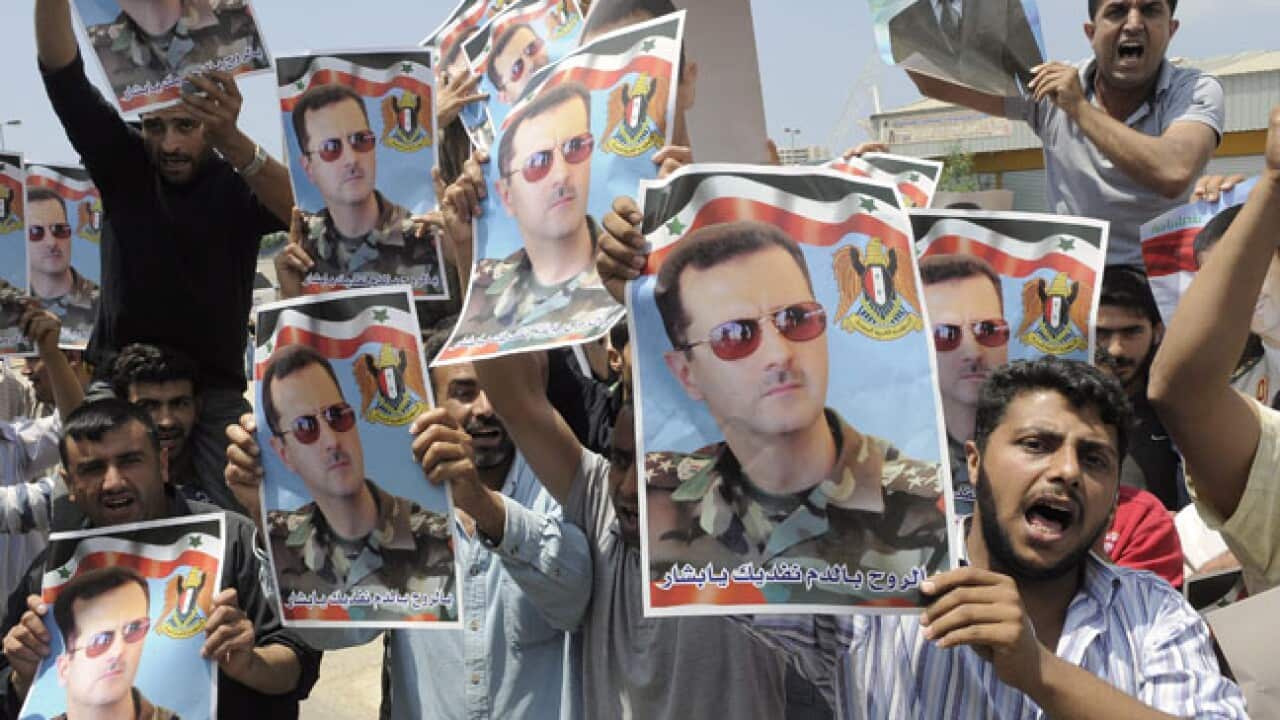
'Outraged' European ministers have agreed to beef up sanctions on President Bashar al-Assad as they cast doubt on his latest offers of change, some demanding he "reform or step aside".
Amid continuing bloodshed in Syria's crackdown on protesters, European Union foreign ministers also angrily demanded action at the United Nations and slammed Russia's resistance to any such move.
The bloc's 27 ministers stepped into one-day talks to review global hotspots expressing hopes that Assad's third speech in three months of protests would offer an end to violence that rights groups say has cost over 1,300 lives.
News that makes sense
Your trusted source for staying up-to-date with the world around you. Get free daily news updates and analysis, straight to your inbox.
But Assad's offer to dialogue once the "chaos" was over, failed to convince.
'POINT OF NO RETURN'
The Syrian leader had reached "a point of no return," said France's foreign minister Alain Juppe.
"Some believe there's still time for him to change his ways and commit to a (reform) process," he said. "For my part, I doubt it. I think that the point of no return has been reached."
British Foreign Secretary William Hague dubbed the speech "unconvincing", EU foreign policy chief Catherine Ashton was "disappointed", and Germany's Guido Westerwelle labelled him "incorrigible".
"He seems not to have understand the signs of the times," Westerwelle added.
The Syrian leader said dialogue could lead to a new constitution and even the end of his Baath party's monopoly on power, but stated that he refused to reform Syria under "chaos."
'THE REVOLUTION MUST GO ON'
His remarks immediately drew condemnation from pro-democracy activists who vowed that the "revolution" -- now in its fourth month -- must go on.
As the talks kicked off, Britain's Hague said he hoped Turkey would use its influence on Damascus to tell the regime that "they are losing legitimacy, that Assad should reform or step aside".
He added that he hoped Turkey "will be very clear and very bold about that".
Reacting to Assad's speech later, Hague said on twitter: "Little new on how reforms will be implemented & when, or how he will end violence."
EU PREPARING TO EXPAND SANCTIONS
The ministers later agreed a resolution that the EU was "actively" preparing to "expand its restrictive measures by additional designations with a view to achieving a fundamental change of policy by the Syrian leadership without delay."
It also stated that Assad's "credibility and leadership depend on the implementation of the reforms he himself announced".
The EU was looking at adding more than a dozen people and businesses to a blacklist of 23 people targeted by an asset freeze and travel ban which already includes Assad and key allies.
SANCTIONS MUST COME FROM UN: BILDT
But Sweden's outspoken foreign affairs chief Carl Bildt said European sanctions were a second-best choice to a global condemnation that must come from the United Nations.
And Germany's Westerwelle, whose government had split with its EU partners by refusing to vote with them at the UN on Libya, said there could be no comparison between the two situations.
With the situation in Syria going "from bad to worse", Bildt said it was vital for the UN Security Council "to express the outrage of the world".
"We have sanctions and we'll probably reinforce them but as long we have the silence of the Security Council we are in a difficult situation," he said.
Several European nations -- notably Britain, France, Germany and Portugal -- have joined Washington in pushing for a UN resolution condemning the crackdown but were stonewalled by permanent Security Council members China and Russia.
Westerwelle said Moscow's UN position "goes in the wrong direction".
Western military intervention in Libya must not be used as a pretext, he said. "This does not justify failing to act together on an international level against Syria."
"You don't give up on helping one country because you have in another," he said.
"It is essential for the international community to act together and agree on widening sanctions," he said. "Pressure must be exercised on Assad's regime. His political isolation must be upheld."







