She said she was cold and hungry.
I thought she was joking - but she wasn't.
Leaving Rustenburg's Royal Bafokeng stadium late on Saturday night after Australia's match with Ghana, long after fans and most other people working at the game had gone, required passing through the same X-Ray machines we'd come through hours earlier in the afternoon.
The machines had long been turned off but three women who had checked our bags many hours ago now sat on plastic chairs forlornly fighting off the biting cold wrapped in cardboard and blankets.
“Goodnight, how are you?” we asked, not really expecting an engaged reply.
News that makes sense
Your trusted source for staying up-to-date with the world around you. Get free daily news updates and analysis, straight to your inbox.
“We are cold – and we are hungry!” replied one of the women.
On a day of complaints – Harry Kewell's red card the most argued – we were suddenly transported outside FIFA's bubble and into the real South Africa.
“Really?” I asked, a little embarrassed, thinking this might be dry Rustenburg humour. But she was serious.
You don't joke about these things here. Having worked a 12-hour day, unlike in Durban where stadium workers wanted extra pay, in Rustenburg these women just wanted some warmth and food.
Meals for journalists at the stadium cost 75 Rand, almost a half days wages for these women. I meekly offered an apple, mandarin, and some chocolate, found at the bottom of my bag.
“Oh, thank you, thank you!” she said.
"Thank you. I love you! I really do! I love you!” Some marriages have been founded on less.
Driving through Johannesburg 48 hours later near the city's downtown, it was remarked that this really was the city of the future. But maybe not in the way many South Africans intended.
Each evening, as dusk envelops Johannesburg, fires light up across the cold city.
These are not veldt fires that, like in Australia's bush, burn off dead and dry scrub. These fires blaze on street corners, in suburban roads, and in city parks as people without houses behind razor wire fences try to keep warm in the South African winter.
The smoke wheezes across the city, getting in your lungs and hair, adding to the pollution a megalopolis this size already heaves up every day.
Near downtown, boutique hip hotels sit next to vacant bombsite blocks. Urban renewal has come to some streets but only for part of the block.
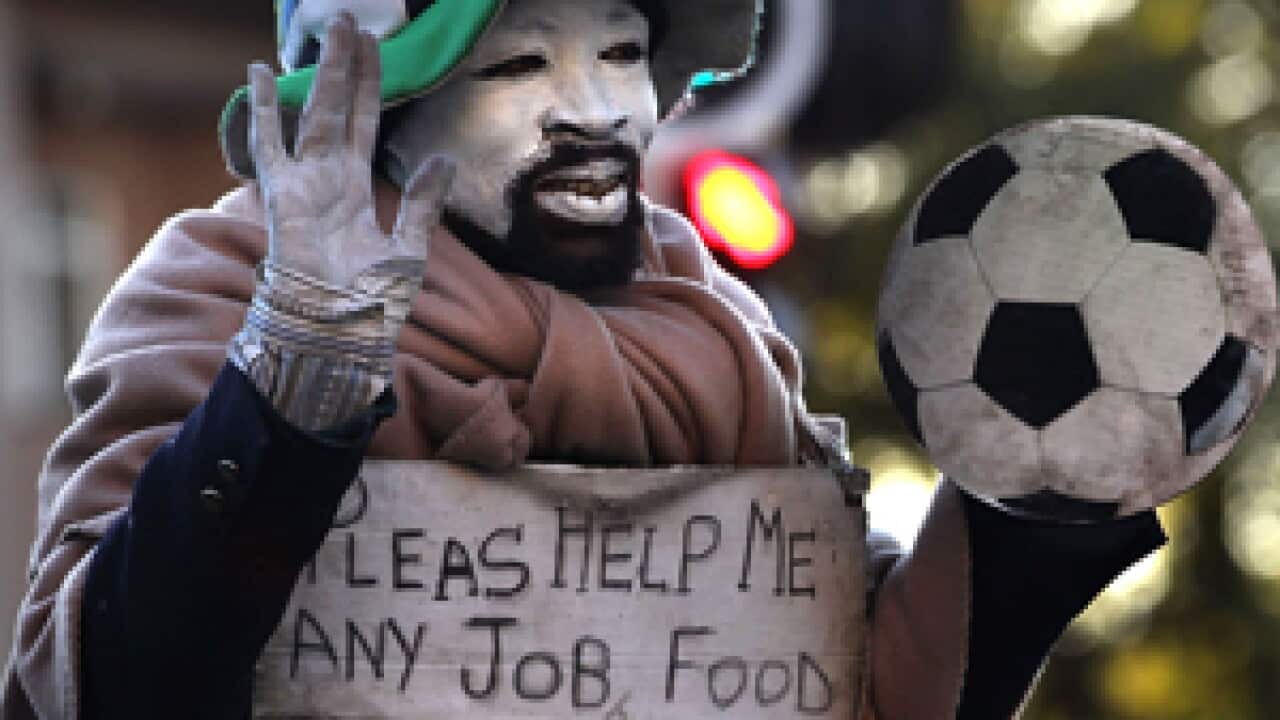
At traffic lights, vendors hawk World Cup merchandise, vuvuzelas, newspapers, and makarapas (the mining helmet that has become a fan fashion accessory) but there are also beggars claiming to be sick or starving, desperate for money.
There is money in South Africa, though. Those with it live in houses behind fences and barbed wire in neighbourhoods patrolled by companies promising an “armed response” to whatever intrusion may befall them.
BMWs, Mercedes, and Porsches drive Johannesburg's streets, swerving to avoid the hawkers, but they often don't stop at red traffic lights (or “robots”, as they are uniquely called in South Africa).
You see those same cars burning up the Platinum Highway north of Johannesburg, so-called because the road runs through the country's lucrative metal mines.
So, Johannesburg is a city of the future.
Trouble is, it might not be as on the up as we'd like to think – or hope. Instead, it may be a window into the Mad Max future of other cities around the world.
Rich, poor, hungry, fat. It's a thin line but rarely crossed.







