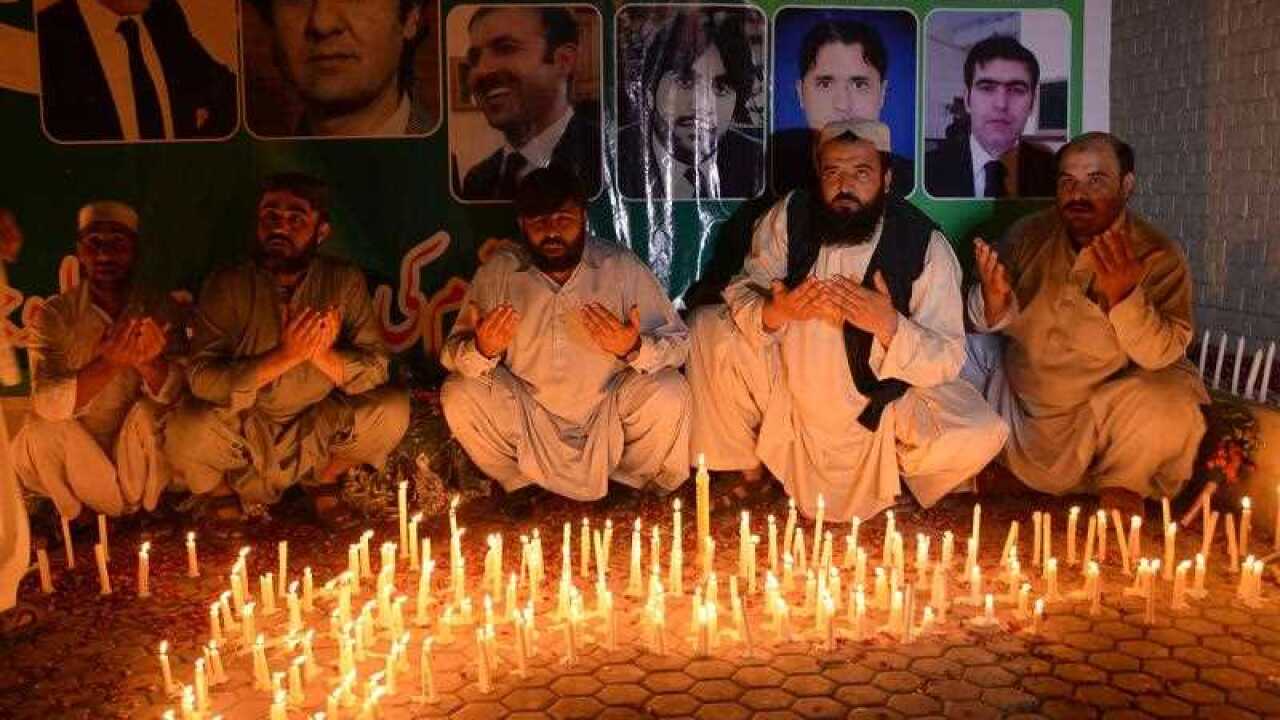
Pakistan has begun burying 74 people, most of them lawyers, killed in a attack on a hospital in the southwestern city of Quetta, as lawyers staged a nationwide strike and heaped pressure on the government to do more against militants.
Medical staff said up to 60 of those killed in Monday's bombing at a government hospital were lawyers who had gathered to mourn the assassination earlier that day of the president of the Baluchistan Bar Association, Bilal Anwar Kasi.
On Tuesday morning, four of over one hundred people wounded, including two more lawyers, died in hospital, taking the toll to 74, said Abdul Rehman, the medical superintendent at the Civil Hospital, Quetta, the capital of Baluchistan province.
Shops, businesses, schools and universities in the city and beyond remained closed as the government announced three days of mourning.
It was the deadliest militant attack in Pakistan this year and the latest in a string of strikes on lawyers, seen by some militants as an extension of the state and so legitimate targets.
News that makes sense
Your trusted source for staying up-to-date with the world around you. Get free daily news updates and analysis, straight to your inbox.
At the Civil Hospital in Quetta, windows were shattered and blood still stained the walls and floor a day after the attack.
Shreds of ripped black cloth from slain lawyers' suits littered the ground.
Rehman said that last year the hospital had requested paramilitary soldiers be stationed there for security.
At one lawyer's funeral on the outskirts of Quetta, the cleric leading prayers chanted: "May all the terrorists who carried out this heinous attack meet true justice."
At a protest outside the Supreme Court in the capital Islamabad, Ashtar Ausaf Ali, Pakistan's attorney general, called the attackers "weak and pathetic".
Supreme Court Bar President Ali Zafar called for the government to do more to protect lawyers.
The bombing in Quetta was initially claimed by Jamaat-ur-Ahrar, a faction of the Pakistani Taliban that is fighting to overthrow the government and impose strict Islamic law.
Later, however, Islamic State said one of its fighters carried out the attack, in what would mark an escalation in the ability of the group, or its regional offshoots, to strike in Pakistan.
Some Pakistani analysts were sceptical.
"The ISIS claim seems very unconvincing," said Imtiaz Gul, director of the Center for Research and Security Studies in Islamabad.
"The claim of responsibility by Jamaat-ur-Ahrar is more credible," said Muhammad Amir Rana, head of the Pakistan Institute for Peace Studies.
He noted that Jamaat had sworn loyalty to Islamic State's Middle East leadership in 2014, but later switched back to the Taliban.
It remains unclear what ties, if any, Jamaat has to Islamic State, whose leadership is a rival to both the Taliban and al-Qaeda over claims to represent the true Islamist Caliphate.
Only last week, Jamaat was added to the United States' list of global terrorists, triggering sanctions.
Baluchistan, which borders Afghanistan, is home to many militant groups, most notably sectarian outfits who have launched a campaign of suicide bombings and assassinations of ethnic Hazaras - Persian-speaking Shi'ites who mostly emigrated from Afghanistan and are a small minority of the Shi'ite population in Sunni-majority Pakistan.
Zahoor Afridi, the police officer leading the investigation, added: "Their (Islamic State) presence in Baluchistan is limited mostly to sympathisers, not to executioners."







