

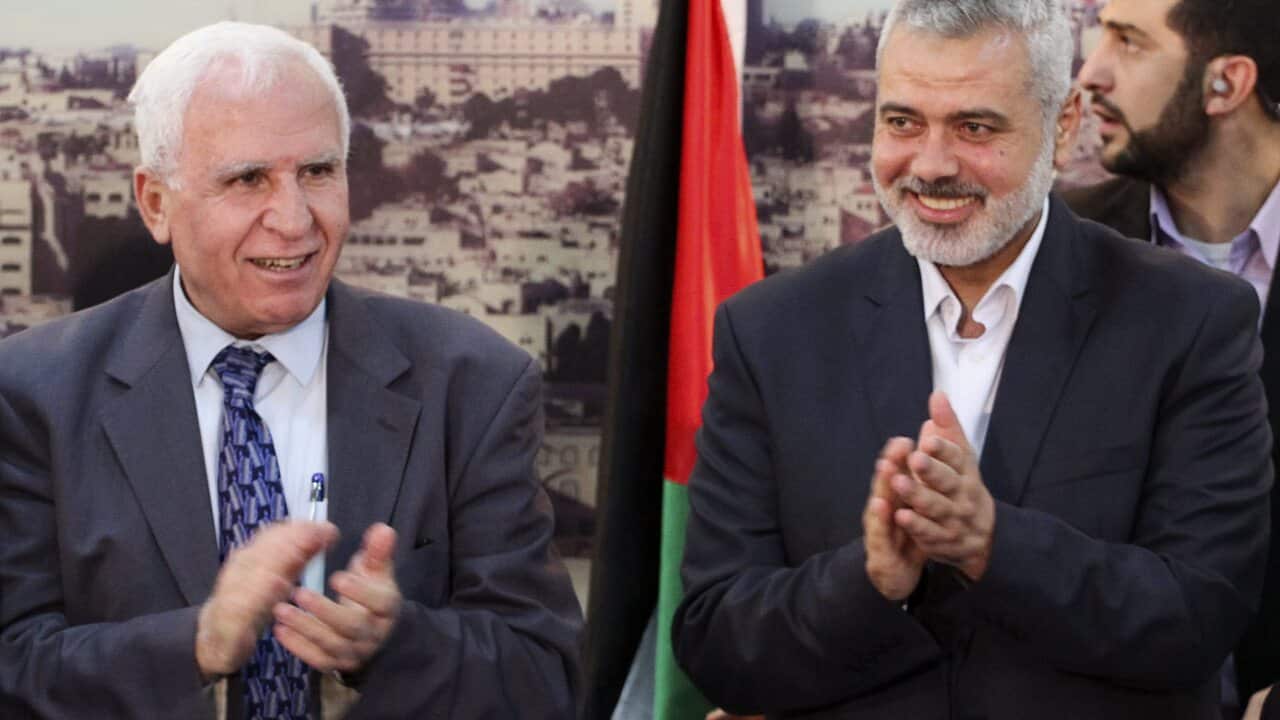
The Palestine Liberation Organisation (PLO) and Hamas have agreed to form a unity government within five weeks to end seven years of divided administration.
Israel cancelled a scheduled peace meeting with the Palestinians following the announcement.
The president of A-PAN, Bishop George Browning, says while fragile, negotiations with Israel are not dead.
He say he awaits the fine detail of the unity pact.
"We're pleased in the hope that the Palestine leadership can be unified," he told SBS. "That's got to be a good thing for Palestine and for Palestinians. And it's got to be a good thing for the Middle East."
News that makes sense
Your trusted source for staying up-to-date with the world around you. Get free daily news updates and analysis, straight to your inbox.
Washington has warned that the accord could seriously hamper American efforts to forge Israeli-Palestinian peace.
Israel's Prime Minister Benjamin Netanyahu slammed Palestinian president Mahmud Abbas for choosing "Hamas, not peace", and a Netanyahu aide said he had called off a peace meeting with the Palestinians scheduled for Wednesday evening.
However, chief Palestinian negotiator Saeb Erakat told AFP that no meeting had been planned for Wednesday.
He said the Palestinians would meet bilaterally with US peace envoy Martin Indyk in Ramallah on Thursday.
Under the rapprochement between the Palestine Liberation Organisation (PLO), internationally recognised as the sole representative of the Palestinian people, and the Islamist Hamas which rules Gaza, the sides agreed to form a "national consensus" government within weeks.
"An agreement has been reached on the formation within five weeks of an independent government headed by president Mahmud Abbas," said a joint statement read by Hamas's Gaza premier Ismail Haniya in front of a visiting PLO delegation.
The new interim Palestinian administration would be charged with holding parliamentary and presidential elections within six months of taking office.
The news brought thousands of people on to Gaza's streets in celebration.
It was not the first time the Palestinian rivals have announced a deal to end seven years of separate administrations in the West Bank and Gaza.
But the latest reconciliation attempt by the West Bank-based Palestinian leadership drew an angry reaction from Netanyahu.
"This evening... Abu Mazen chose Hamas, not peace," a statement from Netanyahu's office quoted him as saying, using the name by which Abbas is familiarly known.
"Whoever chooses Hamas does not want peace."
Abbas denied the charge, saying in a statement: "There is no incompatibility between reconciliation and the talks, especially since we are committed to a just peace on the basis of a two-state solution in accordance with the resolutions of international law."
Later on Wednesday, the Israeli military said Palestinians fired three rockets from the Gaza Strip at southern Israel, one of which hit a compound adjacent to the Erez border crossing.
It later said that it was investigating if that rocket fell on the Israel or Gaza side.
There were no reports of casualties.
Palestinian unity: Timeline
Rival Palestinian leaders from the West Bank and Gaza Strip have vowed to form a government of national unity, officials said on Wednesday.
Here is a chronology of relations between the two Palestinian national movements since Hamas forcibly seized power in Gaza in June 2007, routing forces from Fatah, the main component of the Palestine Liberation Organisation (PLO)
June 15, 2007: The Islamist movement Hamas completes its seizure of the Gaza Strip after routing Fatah forces loyal to Palestinian president Mahmud Abbas, who fires the Hamas-dominated unity government led by Ismail Haniya.
March 23, 2008: The factions agree to resume dialogue in a document signed in Yemen, but the initiative makes no progress because of differences over its interpretation.
January 19, 2009: Abbas proposes a government of national unity a day after a ceasefire announced in Gaza by Israel and Hamas after a more than three-week blitz by Israel on the territory in which 1,400 Palestinians and 13 Israelis are killed.
April 27, 2011: Fatah and Hamas say they have reached an "understanding" to set up an interim government of independents to prepare for presidential and legislative elections within a year. Most of the clauses are unapplied with deadlines regularly put back.
January 7, 2012: Hamas and Fatah agree on a prisoner swap.
February 6, 2012: The rivals agree that Abbas will head an interim national consensus government to supervise the run-up to presidential and legislative elections. The decision, contested within Hamas, is not applied.
January 4, 2013: Hundreds of thousands of Fatah supporters stage a mass demonstration in Gaza, their first since Hamas seized the territory.
January 10, 2013: Abbas and exiled Hamas chief Khaled Meshaal hold their first meeting since February 2012 and pledge to resume the reconciliation process.
A climate favourable to reconciliation is created after an Israeli November military offensive in Gaza and the UN votes to recognise Palestine as a non-member state, following an Abbas initiative supported by Meshaal.
July 29, 2013: In Washington, Israelis and Palestinians resume direct peace talks for the first time in three years. The talks have since remained deadlocked.
April 23, 2014: The PLO and Hamas agree to form a unity government within five weeks to end seven years of divided administration.
An Israeli warplane attacks the northern Gaza Strip and Israel cancels a meeting it says was scheduled with the Palestinians.