Palestinian president Mahmud Abbas made history in his people's long quest for statehood Friday as he formally asked the United Nations to admit Palestine as a member state.
Prompting an angry response from Israel and dismissal by the United States, Abbas handed over the request in a white folder emblazoned with the Palestinian crest to UN chief Ban Ki-moon.
More than 120 nations have already recognized a Palestinian state and Abbas triggered wild applause and a standing ovation from some delegates when he later stepped up to address the UN General Assembly, vowing the Palestinians were ready to return to peace talks if Israeli settlement activities cease.
News that makes sense
Your trusted source for staying up-to-date with the world around you. Get free daily news updates and analysis, straight to your inbox.
Waving a copy of the request over the UN podium, Abbas said he had submitted an "application for the admission of Palestine on the basis of the June 4, 1967 borders" with Jerusalem as its capital.
Explaining why he had pressed the Palestinian bid despite the opposition, Abbas said all previous peace efforts "were repeatedly smashed against the rocks of the positions of the Israeli government."
But the Palestinian leader stressed the Palestinians did not want to "isolate or de-legitimize" Israel.
The Palestinians only wanted to end Israel's settlement policy which he said will "destroy chances" of a two-state solution to the decades-only conflict.
"This settlement policy threatens to also undermine the structure of the Palestinian National Authority and even end its existence," he said.
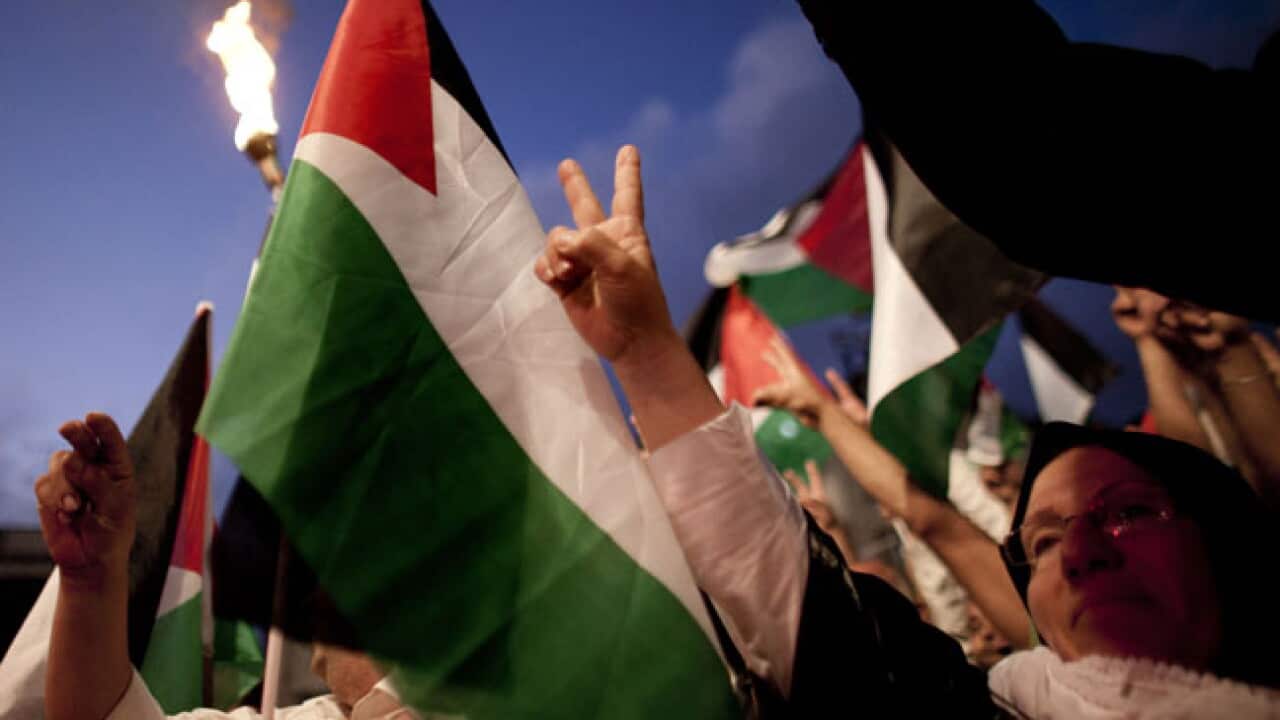
Crowds of tens of thousands of Palestinians cheered across the West Bank where they watched the speech on giant TV screens.
But Israel was scathing.
In his own address to the UN, Prime Minister Benjamin Netanyahu said: "The truth is that we cannot reach peace through UN resolutions but through negotiations. The truth is that so far the Palestinians have refused to negotiate."
Ultra-nationalist Foreign Minister Avigdor Lieberman said in a television interview that Abbas's move "proves that the Palestinians have no intention of negotiating with Israel," while Netanyahu ally Gideon Saar, the education minister, called the Palestinian's speech "venomous."
The United States, which is Israel's main backer, also cold-shouldered Abbas. The US ambassador to the United Nations, Susan Rice, sat stony-faced during Abbas's speech and wrote in a Twitter message that "shortcuts" were no way to achieve Israeli-Palestinian peace.
Amid a new bout of intense diplomatic maneuvering, the Mideast Quartet -- the United States, Russia, European Union and United Nations -- met after Abbas' speech and issued a statement calling for a peace deal by the end of 2012.
Palestinians were seized by the historic moment, which comes more than six decades after the creation of Israel in 1948.
Crowds in Ramallah and across the West Bank roared their approval, AFP reporters said.
"With our souls, with our blood, we will defend Palestine!" they roared as widescreen televisions relayed live footage of Abbas holding up a copy of the membership demand he had personally handed to UN chief Ban Ki-moon.
But fearing violence, some 22,000 Israeli police and border police were on high alert with forces deployed along the Green Line between Israel and the West Bank, in annexed east Jerusalem, and around Arab Israeli towns.
A Palestinian was shot dead in clashes with Israeli troops that erupted after settlers attacked a village near Nablus on the West Bank.
Israeli officials have warned of harsh retaliatory measures if the Palestinians succeed in their bid, including a halt to funding for the Palestinian Authority. Right-wing members of the government have gone so far as to call for annexation of the West Bank.
Besides dealing a blow to Israel's position in future peace negotiations, some believe UN recognition of a Palestinian state could allow Palestinians to sue Israel over alleged human rights abuses.
Frantic attempts led by the United States to persuade the Palestinians to renounce their membership bid went on until the last moment.
The United States has vowed to veto the bid at the UN Security Council, where the Palestinians in any case need to win the backing of nine of the 15 council members.
If that bid fails, they may well seek to be admitted as a non-member observer state by the General Assembly.
A French suggestion that Palestine be given an intermediate status as a United Nations observer nation remained on the table, Foreign Minister Alain Juppe's spokesman said Friday despite what he said were "Israeli reservations".
Abbas was to leave New York after giving his UN speech to return to the Palestinian territories for consultations on the next step forward
How do you feel about the Palestinian Authority's bid for statehood? Have your say here.







