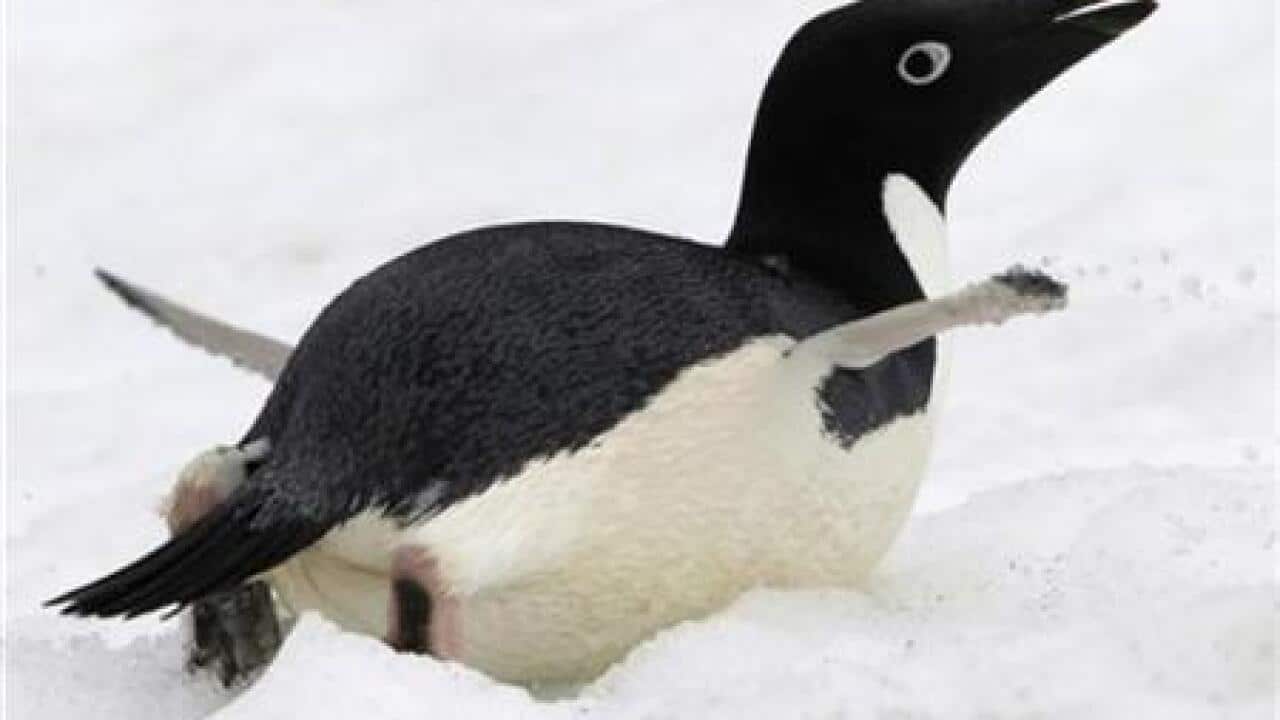
Fossil feathers reveal that penguins donned their trademark black and white late in their evolution – and may have become faster swimmers when they did. Until then, the giant ancestors of today's penguins were grey and reddish-brown.
These findings come from a remarkably complete 36-million-year-old fossil discovered in the Paracas National Reservation in Peru. It belongs to a species new to science, Inkayacu paracasensis. At 1.5 metres tall and weighing 55 to 60 kilograms, Inkayacu is among the largest specimens in the penguin lineage.
At first glance, the fossil looks very much like a modern penguin. But when Julia Clarke of the University of Texas, Austin, and her colleagues inspected the melanin-rich grains called melanosomes that are embedded in the feathers, they found a surprising difference.
News that makes sense
Your trusted source for staying up-to-date with the world around you. Get free daily news updates and analysis, straight to your inbox.
But in Inkayacu they were either long and thin or short and round – the same shape and size as those that colour many modern bird feathers reddish-brown or grey.
Clarke's team conclude that the ancient giant wore a grey coat on its back, with a similarly coloured leading edge to its wings and reddish-brown on its front and the trailing edge of its wings.
Apart from the melanosomes, the feathers resembled those of modern penguins: they are highly modified to enable the birds to "fly" through water without too much drag. Together with its heavy bones, that means Inkayacu lived much like modern penguins.
Why the colour change? It may have given the ancient birds a turbo boost, Clarke speculates, pointing out that melanosomes help strengthen feathers. She thinks the shape and grape-like clustering of the larger ones may have affected packing of the feathers and further streamlined the birds, giving them a slight edge when seals – a major predator of penguins – evolved some 20 million years ago.







