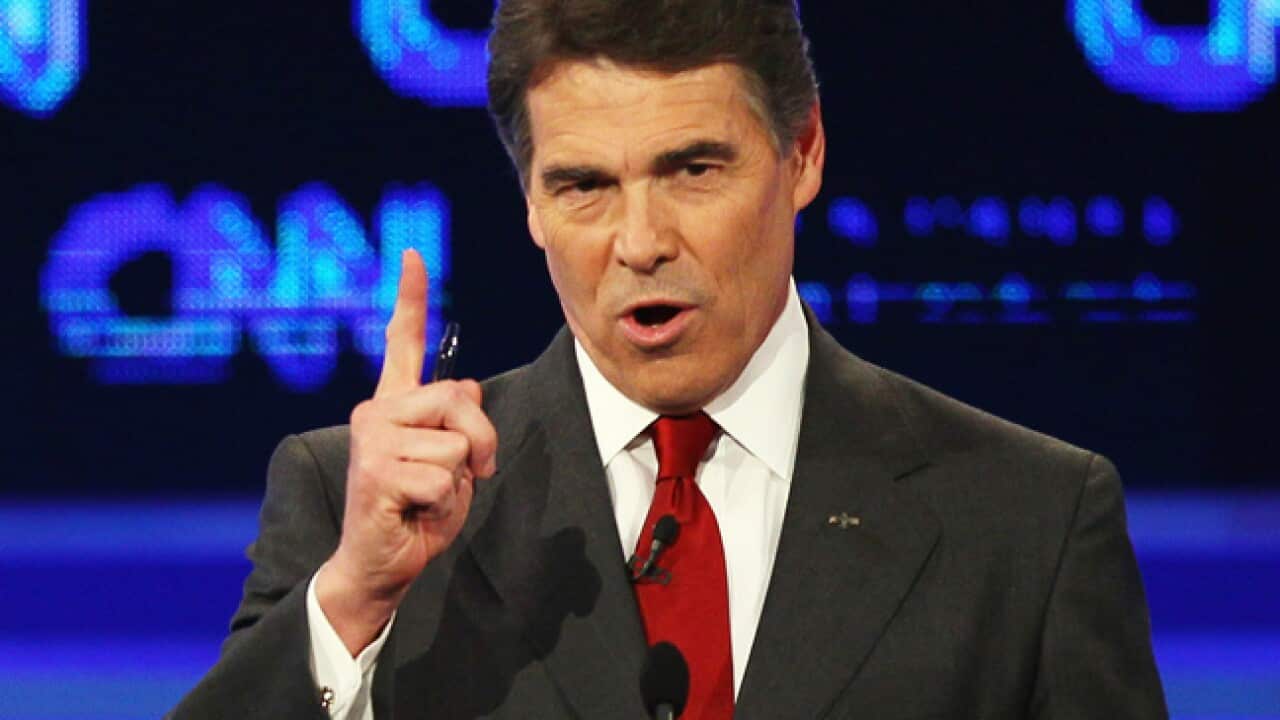
With just two months until Republican voters in Iowa cast the first vote in the Republican primary campaign, the Texas governor wrestled for nearly a minute to complete a list of three government departments he would eliminate if elected president.
"It's three agencies of government when I get there that are gone, Commerce, Education and the, err, what's the third one there..." Perry began, amid prompts from his seven rivals and gentle laughter from the audience.
News that makes sense
Your trusted source for staying up-to-date with the world around you. Get free daily news updates and analysis, straight to your inbox.
"The third one, I can't, I'm sorry, I can't. Oops," he concluded.
In the hyper-polished culture of US political debating, the moment stood out sharply.
For most of rest of the nearly two hour discussion Republicans jousted cautiously, sticking firmly to popular party principles of lower taxes and less government.
Candidates had reprised their plans for "flatter" taxes that would lower rates for the richest Americans and for corporations, while echoing talking points on the stump that slammed the Obama administration.
Perry eventually offered that the missing government agency was the Department of Energy, but not before scores of pundits had chimed in about his perceived "gaffe."
After the debate Perry spokesman Ray Sullivan tried to limit the damage, telling hosts CNBC that although "he stepped in it," it was a "error of style not substance."
Via Twitter Democratic strategist Paul Begala opined: "Perry's tiny brain freezes when he tries to name the 3 agencies he'd close. Mental midget shrinks even more."
Debating the economy on a day when the Dow Jones Industrial Average fell nearly 400 points amid fears that Italy -- the world's eighth largest economy -- saw its cost of borrowing rocket, candidates began by insisting nothing is now "too big to fail."
The front runner, Mitt Romney, soundly rejected the idea that the United States would stump up more cash to stem Europe's debt crisis, even if it threatened to engulf the US financial sector.
"Europe is able to take care of their own problems. We don't want to step in and try to bail out their banks and governments," said Romney who is the current front runner for the nomination.
"There will be some that say here, banks in the US that have Italian debt, we ought to help those as well. My view is no, no, no, we do not need to step in to bail out banks in Europe or banks here in the US that may have Italian debt."
Other candidates similarly sought to tap into popular angst at mass US bank bailouts -- launched by Republican president George W. Bush and continued by Barack Obama.
For the most part candidates ignored the single issue that has dominated the political debate for more than a week: allegations that Herman Cain sexually harassed at least four women.
"The American people deserve better than someone being tried in the court of public opinion based on unfounded accusations," Cain said over audience boos that followed the moderator's question that raised the subject for the first time.
"For every one person that comes forward with a false accusation, there are probably -- are thousands who would none of that sort of activity ever came from Herman Cain," the candidate said, using a third person reference that is quickly becoming hallmark of his oratory.
Romney, who is running neck-and-neck with Cain in some polls, batted off the opportunity to attack.
"Look, look, Herman Cain is the person to respond to these questions. He just did. The people in this room and across the country can make their own assessment."
Mitt Romney, facing allegations his policies switch with the prevailing winds of popular opinion, defended his record as "a man of steadiness and constancy."
"I don't think you are going the find somebody who has more of those attributes than do I."
"I have been married to the same woman... for 42 years. I have been in the same church my entire life."







