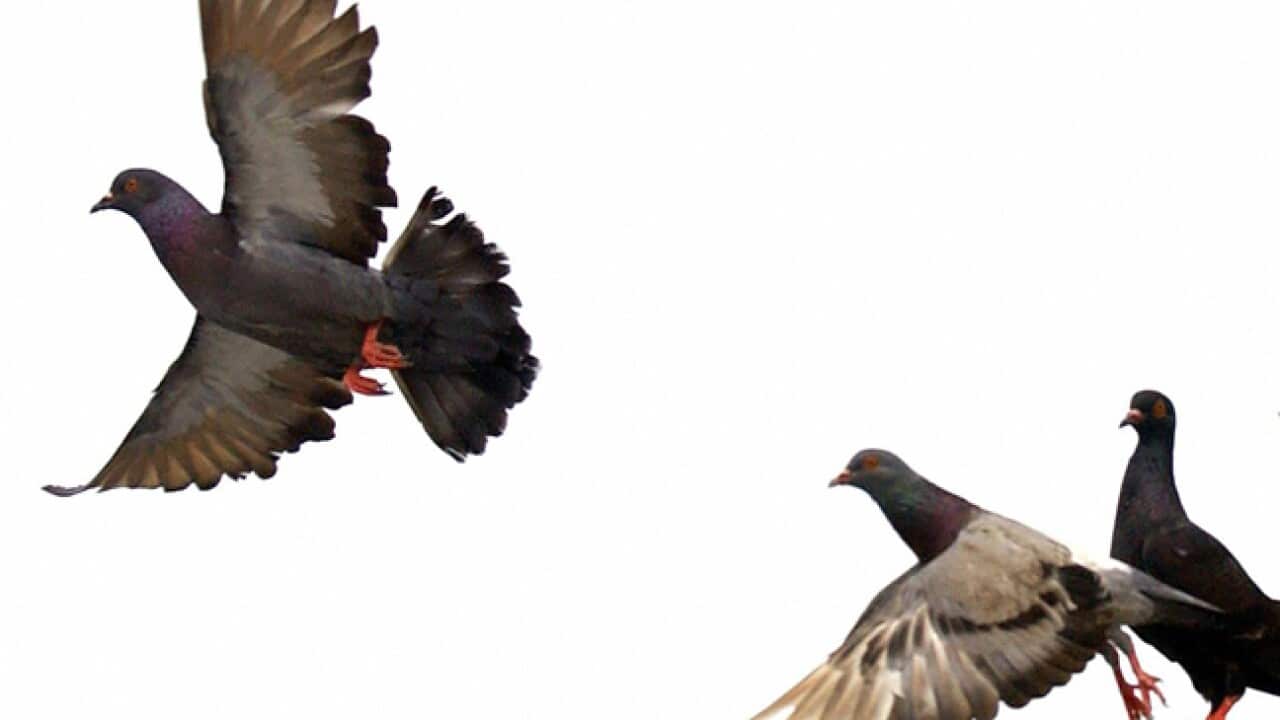
The humble pigeon can redirect its flight path with the agility of a helicopter and can stealthily navigate enclosed spaces, The New Scientist's Catherine de Lange reports.
Ivo Ros of Harvard University and colleagues let three pigeons loose in a corridor that incorporated a sharp 90-degree turn. They placed 16 markers on each pigeon's body and set up nine synchronised high-speed cameras along the corridor to track the birds' position as they flew around the bend.
The experiment revealed that when pigeons fly they produce forces in a surprisingly consistent direction relative to their bodies, which means that when a pigeon wants to turn it has to roll and rotate its body.
News that makes sense
Your trusted source for staying up-to-date with the world around you. Get free daily news updates and analysis, straight to your inbox.
"We didn't expect the forces to change direction relative to the body this little – as little as is observed in helicopters," says Ros. It's not clear yet whether the same applies to all flying animals or just to pigeons, he adds.
Adrian Thomas at the University of Oxford, who was not involved in the study, says that the information could help in the design of surveillance drones for flying inside buildings. Using pigeons as a model instead of choppers might offer a way to avoid dealing with the complex gyroscopic forces real helicopters face, he suggests.







