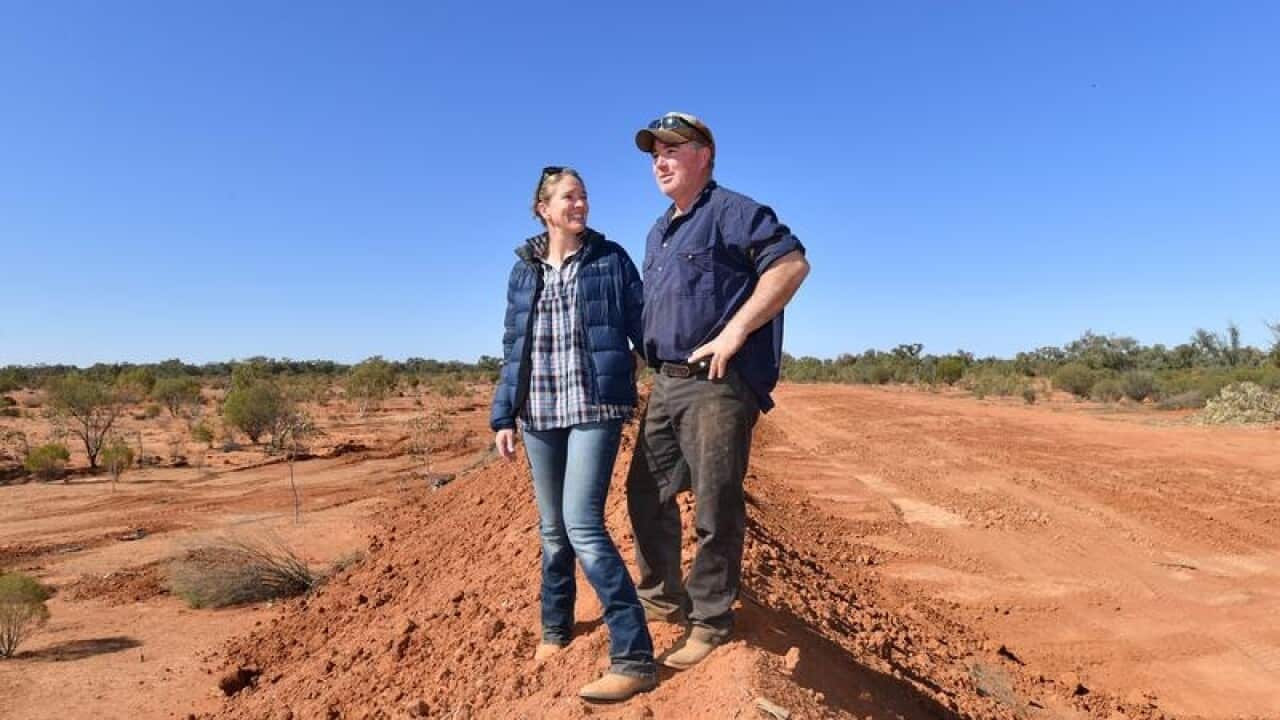
With western NSW in the grip of a devastating drought, one family is working on an ambitious plan to revive a once-thriving wetland that covered their sprawling sheep station.
Along with her husband Zane, an environmental scientist and executive officer of Western Landcare NSW, Louise Turner, is excited about not only what she can do for their own land but what similar projects could achieve across the region.
The Turners talk about "ripping" the ground, producing "champagne banks", "spillage areas", "ponding banks" and "check banks".
What it looks like is a series of major earthworks - one bank is several metres high and runs for more than the length of a football field - that look extremely impressive in their scale and complexity from the air. They are designed to direct the next big rain where it's needed to reduce damage and to keep that water on the property longer.
"We're basically rehabilitating a wetland that was here 100 years ago and it's just going to take lots of time and effort," Ms Turner said.
News that makes sense
Your trusted source for staying up-to-date with the world around you. Get free daily news updates and analysis, straight to your inbox.
"We're looking at the lay of the land and trying to work out the best option for each area and then fitting it all together like a jigsaw puzzle to get the overall effect."
When the drought breaks the Turners are hoping to see the water slow down and stay longer on the property to improve long-term soil moisture and grow more native plants.
Ordinarily, heavy rain would simply scour the landscape and while the local creeks would flood and roar, it would only last for a few hours before reducing to little more than a trickle.
"When you get a big rain the degradation to the land can be quite horrific," Ms Turner said.
"It scalds and scours, your topsoil washes away and it can be quite tragic."
But the aim is not to stop the flow of water.
"And we're not trying to stop anybody else from getting water," Ms Turner said.
"But we want it to slow and sink into the ground and improve soil moisture to start growing more plants and last for a lot longer period."
The strategy has proved successful in other regions, including some areas of South Australia and Western Australia along with parts of Africa.
Ms Turner said their strategy would not entirely drought-proof their 37,000-hectare station but should greatly improve its sustainability.
"This is a long-term plan," she said.
"We need to do things to this place so that if our kids want to be here we can enable that.
"We want to lead by example."







