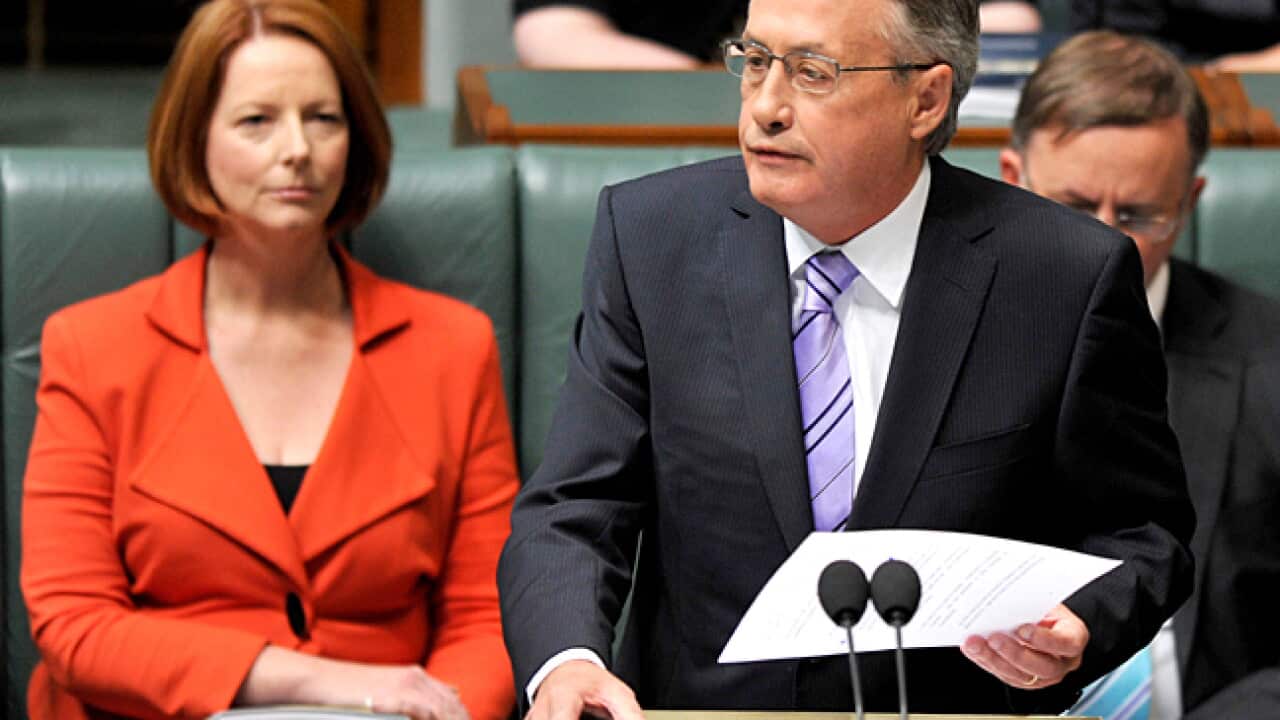
"What you've got to do is make some choices ... making room for the big investments, the wise investments that our nation needs, including education," Ms Gillard told Sky News on Wednesday.
The prime minister again pointed to the "big hit" suffered by the Australian economy in the face of a high dollar which led to tax collections that failed to meet forecasts.
"The big hit has been from the revenue writedown," she said.
News that makes sense
Your trusted source for staying up-to-date with the world around you. Get free daily news updates and analysis, straight to your inbox.
"Any prime minister sitting in this chair would have to deal with that."
INTERACTIVE: The budget in a nutshell
With less than four months to go until the federal election, Ms Gillard said Tuesday's budget, which posted a $19.4 billion deficit for 2012/13, underpinned Labor's bid for re-election.
"Voters will make their decision on September 14. This budget is right for the nation."
Asked if she was locking future governments into a spending pattern, Ms Gillard said it was always her intention to make significant long-term investments.
"I said to the nation that I wanted to make new, big, structural spends, things that will be in the budget every year," she said, citing more money for schools and supporting people with disabilities.
"And I said to the nation very clearly in order to make those new big spends, I'd be asking the nation to make some big structural saves."
Treasurer Wayne Swan's sixth budget, released on Tuesday, included abolishing the baby bonus, making a forecast $1.1 billion saving over five years.
"I am prepared to stand and argue that getting rid of the baby bonus, making changes in family benefits, making changes in business tax is the right way of supporting children's education at the highest possible standard."
Criticism of Mr Swan and the Treasury for failing to forecast shortfalls in revenue were misdirected, the prime minister said.
"People are criticising the treasurer and the Treasury for not foreseeing an event that had never happened in our economic history before over such a period of time," she said.
Ms Gillard noted there had been three quarters where nominal gross domestic product (GDP) growth was less than real GDP growth.
"I think it's a bit rough, just common sense, to say `gee, bad forecasting' for not foreseeing something that's never happened before."
The prime minister called on the opposition to lay out its alternatives to Labor's budget.
VOTERS HAVE TO WAIT: ABBOTT
Voters will have to wait until the election campaign to see a full list of 'spends and saves' from the coalition, says Tony Abbott.
Opposition Leader Tony Abbott says his official budget reply won't be a complete list of the coalition's "spends and saves" but will paint a big economic picture.
Mr Abbott will get his chance to respond to Tuesday's federal budget on Thursday when he delivers his budget-in-reply speech.
Mr Abbott told AAP in Canberra on Wednesday the budget was lacking "hope, reward and opportunity".
"There was really no hope in the budget last night, no credible hope of a surplus, no credible hope of new programs being competently and honestly delivered," he said.
"I want to demonstrate to the Australian people tomorrow night that there is a better way, that they can have government which is honest and competent and straight with people.
"That's the challenge I've set for myself, and I will be judged on that."
Asked whether the coalition would accept the axing of the baby bonus and other spending cuts, Mr Abbott said: "People will have to wait until after the Pre-election Economic and Fiscal Outlook for a full list of our spends and saves."
Mr Abbott said the coalition had already announced the axing of the SchoolKids Bonus and more measures would be "steadily" announced before the September 14 election.
"People will be much more in the picture about where they are going after tomorrow night than they were after listening to the treasurer," he said of Thursday's speech.
The opposition leader earlier told the Seven Network he could not put a timeline on a coalition government getting the budget back into the black, but it would be "as quickly as possible".
He said the government's argument that revenues were sharply falling was false, given that the budget papers revealed revenues would rise by seven per cent.
SWAN BLAMES 'CHALLENGING GLOBAL CONDITIONS'
The government says it has delayed the return to surplus so it can support jobs and growth, and set the funding course for the national disability care scheme and schools funding programs.
Mr Swan blamed challenging global conditions, lower business profits and the high Australian dollar for a "savage" $60 billion hit to tax receipts over four years while trumpeting $43 billion worth of savings.
"We have a choice - you can decide to cut to the bone or have a more gradual pathway back to surplus," Mr Swan said.
Labor's big spending includes $14.3 billion for DisabilityCare Australia, which by 2018/19 will support 460,000 people with severe and permanent disabilities and draw some of its funds from Medicare levy rise to two per cent.
There will also be $9.8 billion for new school funding, $24 billion extra for road and rail projects over 10 years, while health funding will rise to a record $64.6 billion despite some tinkering with Medicare to save $1.7 billion.
Labor wants to push the budget to a slim surplus of $800 million in 2015/16 and deliver a $6.6 billion in surplus the following year.
Among the savings is a $2.4 billion plan to axe the baby bonus from March 1 next year and replace it with a $2000 Family Benefit Part A payment for the first child, or $1000 for the second or subsequent child.
A crackdown on company tax loopholes will reap $4.2 billion.
Other initiatives include allowing Newstart recipients to earn more than $1000 more a year and a pilot program to allow pensioners to downsize their home without losing money.
Smokers will cough up an extra seven cents a pack from early 2014 and face steeper automatic rises in coming years.
Shadow treasurer Joe Hockey said while the budget was described as being about "jobs and growth" it actually projected a worse jobless figure (5.75 per cent) and lower growth (2.75 per cent).
Mr Hockey did not commit to keeping any of the cuts and dismissed Mr Swans' surplus forecasts, arguing the deficit challenge was "substantially larger".
Key Independent MP Tony Windsor said while he was uncomfortable with some measures - such as cuts to university funding and foreign aid - voters had to be realistic.
"You can't just keep demanding more without paying more and it's got to be sustainable long term," he said.
Australian Chamber of Commerce and Industry chief Peter Anderson said the government's problem was not revenues, which were expected to rise by $25 billion over the next four years, but failing to boost productivity and competitiveness.
Read more: Indigenous and migrant reaction to the federal budget
Watch: NITV political correspondent Jeremy Geia with a breakdown of some of the funding allocated to Indigenous Australians in the federal budget.







