

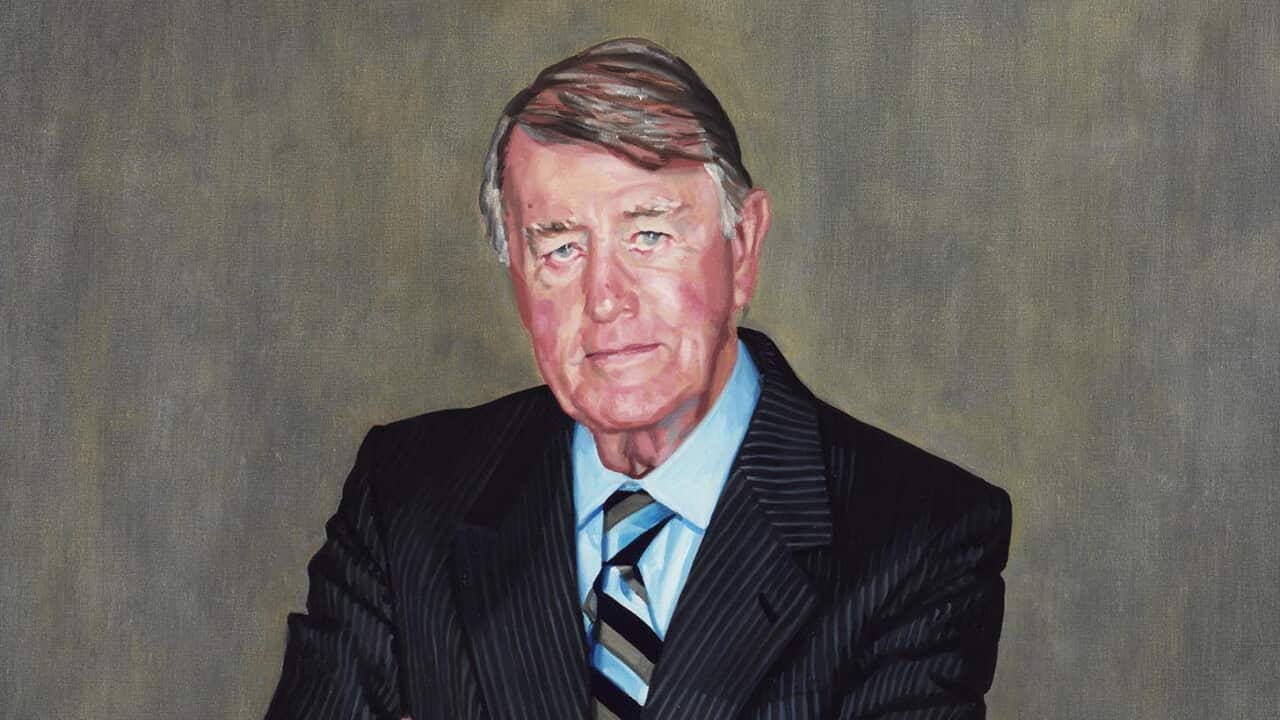
(Transcript from World News Radio)
With the death of former New South Wales Premier Neville Wran, the Australian Labor Party has lost a man described as a "giant".
Mr Wran, who'd been suffering from dementia, died aged 87.
News that makes sense
Your trusted source for staying up-to-date with the world around you. Get free daily news updates and analysis, straight to your inbox.
Murray Silby reports.
"Whilst it is an ego thing, it is terribly important to believe in the objectives and the ideals of the party which you represent."
Neville Wran speaking to the ABC in 1984.
Mr Wran died with his family by his bedside just before 6 pm on Sunday at the Lulworth House nursing home in Sydney's eastern suburbs, where he'd been in care for the past two years.
He was a successful lawyer before entering parliament in the Legislative Council in 1970.
He moved to the Lower House in 1973 before becoming Labor leader.
In 1976, he led Labor to government in a tight election, forming government after a 10-day wait, with the support of an independent.
Another former Labor Premier of New South Wales and a protege of Mr Wran, Bob Carr, has told the ABC one of the secrets of his mentor's longevity was that he never lost touch with the common people.
"He had an x-ray grasp of public opinion. He said to me once, he said, 'It's all very well', I was Leader of the Opposition at the time, he said, 'It's all very well to be bringing down this minister, to be talking up this scandal, but the bloke in a fibro cottage, with a gaping hole in one side and a wife who has got cancer, he's late getting home, his wife's thrown his dinner away', he said, 'You've got to have something to say to him,' he said, 'Otherwise you're going nowhere. You've got to have something to say to him'."
Mr Wran led the Labor government in New South Wales from May 1976 to July 1986, before dramatically announcing his resignation to a shocked Labor conference.
Bob Carr, who surpassed Mr Wran's record for the longest continuous service as New South Wales Premier, said Mr Wran set a template for successful Labor leaders, including Prime Ministers Bob Hawke and Paul Keating.
"He edged new issues onto the political agenda, I suppose to some extent indebted to the model of Don Dunstan in South Australia. Modernising the public service, anti-discrimination laws, land rights, elevating the role, or recognition of ethnic communities, heritage protection, a strong government involvement with the arts, and I think above all, environment protection with his landmark achievement being the saving of the rainforests of New South Wales, but he did all these things, all these things while never losing a thematic, a thematic focus, a thematic focus on jobs, jobs, jobs."
New South Wales Opposition and current state Labor Leader John Robertson described Mr Wran as a giant of Labor and one of the great leaders of his party and the state.
Federal Opposition Leader Bill Shorten also said the Australian Labor Party had lost a giant and that few have been made as tough, smart and honourable as Mr Wran.
There were tributes for Mr Wran from the Liberal side of politics as well.
In a statement, Prime Minister Tony Abbott noted Mr Wran's achievements as Premier included orchestrating the redevelopment of Darling Harbour and building the Sydney Entertainment Centre.
Mike Baird, who became New South Wales Premier just last week, said he was deeply saddened by Mr Wran's death, describing him as a towering figure in the state Labor Party and in the state during the 1970s and 80s.
And Federal Communications Minister Malcolm Turnbull has told Sky News Mr Wran was a dear friend, a great business partner and a mentor.
"He was not a do nothing political leader who was successful at managing the media and the spin. He was able to do that, but he was also a great activist and really, I think while people will take different views on the political merits of what he did from time to time, just as they did in those days, his activism and his dynamism is what I think all of us should learn from.
Mr Wran and his government did not avoid scandal though.
In 1983, he stepped aside while a Royal Commission examined allegations he'd tried to influence a magistrate over a misappropriation hearing against rugby league boss Kevin Humphreys.
He was cleared.
Prisons minister Rex Jackson was jailed for selling early releases, Chief Magistrate Murray Farquhar was jailed for perverting the course of justice and senior police were caught up in corruption scandals.
Mr Wran was fined $25,000 for contempt of court after declaring his belief in the innocence of his old friend Lionel Murphy, the High Court judge facing a charge of attempting to pervert the course of justice.
After politics, Mr Wran had success in the business world, including running a merchant bank with current Federal Communications Minister Malcolm Turnbull, who remains one of his strongest defenders.
"He was completely vindicated. Neville Wran was a very straight man and a very honest man in all of my experience with him. You know he was genuinely persecuted while he was in politics for some time. Now having said that, he was a tough political player and he gave as good as he got so I'm not suggesting anyone should be overwhelmed with sympathy for him in that regard. He was a hard political player, but he was cruelly defamed over a period of time there."
Neville Wran's wife, Jill Hickson, said death had come as a blessed release for her husband, who she described as a great man and a true political hero.
"I think politics is a desensitising process and it's very important to ensure that your values don't become so stereotyped and so moulded to reactive influences, whether they're ideological, political, emotional or otherwise, that you remain some sort of a human being."







