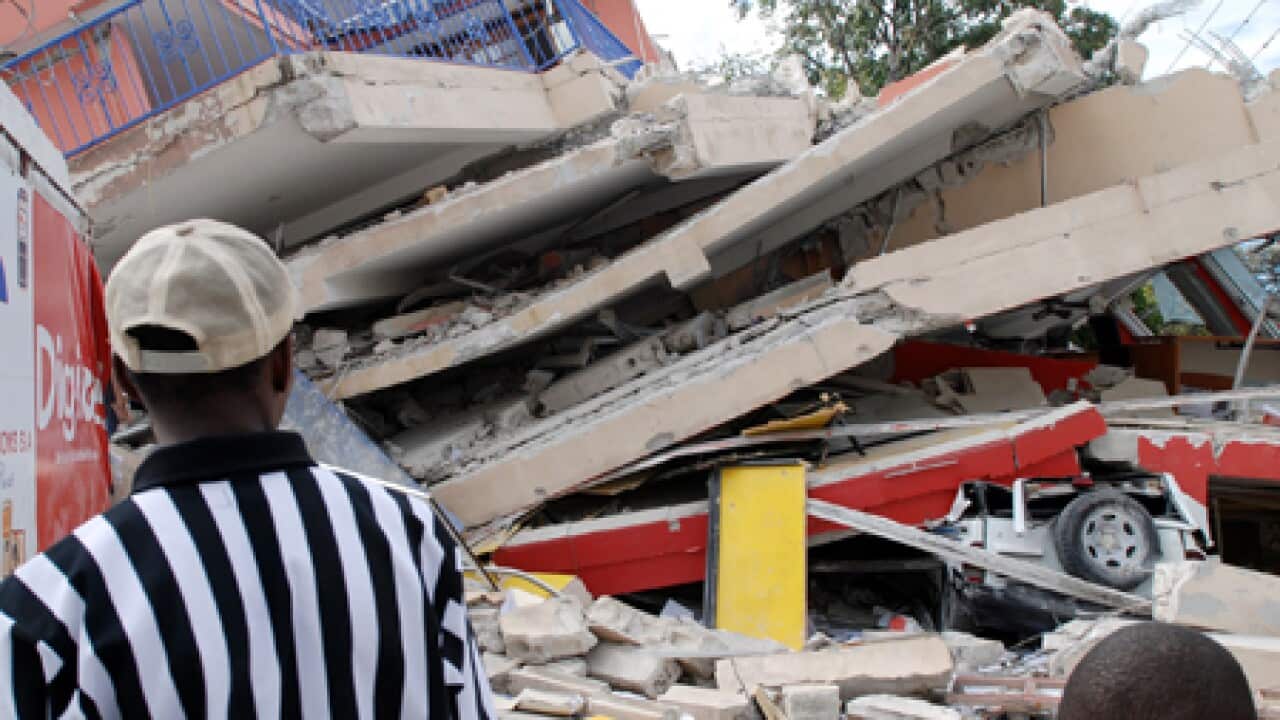
US engineers have blamed lax building standards for the devastation in Haiti, where a powerful earthquake brought buildings crumbling to the ground, trapping thousands beneath rubble.
"The quality of construction in Haiti, even in buildings that are supposedly engineered construction, is not good at all," said Farzad Naeim, president of the board of directors of the Earthquake Engineering Research Institute (EERI).
"There's no question that the lack of quality control and not using engineering knowledge that is widely available had something to do with the massive devastation we're seeing," said Naeim, who edited the Seismic Design Handbook and is vice president of a structural engineering firm in California.
From photographs he has seen of the devastation in Haiti, Naeim said many of the larger buildings were built using nonductile concrete - described in a report presented at the World Conference on Earthquake Engineering in Beijing in 2008 as "arguably... the greatest seismic life safety hazard in many urban centers worldwide because of the collapse potential."
Construction codes in the United States today require that buildings have ductility - "a property that allows them to distort like a coat hanger without breaking" - according to EERI, but many buildings were built with nonductile concrete, including in the United States, up to the mid-1970s.
News that makes sense
Your trusted source for staying up-to-date with the world around you. Get free daily news updates and analysis, straight to your inbox.
Many of the buildings that collapsed in Haiti "have been there for ages and generally older buildings are not up to the task.
And the money is not there to bring them up to the task." Ron Hamburger of the National Council of Structural Engineers Associations said the wreckage in Port-au-Prince was worsened by the fact that the powerful quake had its epicentre just a few miles outside the Haitian capital.
"A magnitude seven earthquake located 10 miles from the city is a very, very serious event," Hamburger said. "Surviving an earthquake like that takes very rigorous design rules and building code and enforcement that things are actually constructed in accordance with the code.
"I have heard that Haiti does not have strict building code enforcement, and so it's likely even the things that people believed to be reinforced were not constructed or designed to an adequate standard," he said.
Haitian Prime Minister Jean-Max Bellerive said more than 100,000 people were feared dead in his country after Tuesday's 7.0-magnitude quake.







