By Tanya Hill, Museum Victoria
But the sunspot that produced both flares, designated AR2158, was directly facing Earth when the latest flare was emitted so there’s likely to be some wild solar weather impacting Earth over the coming days.

The Solar Dynamics Observatory captured the bright solar flare in ultraviolet light. NASA/SDO
Solar flares are ranked into three categories of intensity: X-class flares are the strongest; M-class are moderate; and C-class are the mildest. Today’s solar flare is ranked as an X1.6 class flare, the ‘1.6’ denoting that it is on the low end of the X-class category.
News that makes sense
Your trusted source for staying up-to-date with the world around you. Get free daily news updates and analysis, straight to your inbox.
Such flares can trigger major events for Earth such geomagnetic storms, solar radiation storms and radio blackouts. And spaceweather.com has reported that some high-frequency radio blackouts and other communication disturbances have already occurred as a result of this flare.

The sunspot AR2158 is the large dark region towards the centre of the Sun. NASA/SDO
Eruptions from the sun
A solar flare is just one kind of eruption from the sun. It releases intense light, along with some radiation consisting of protons and other charged particles.
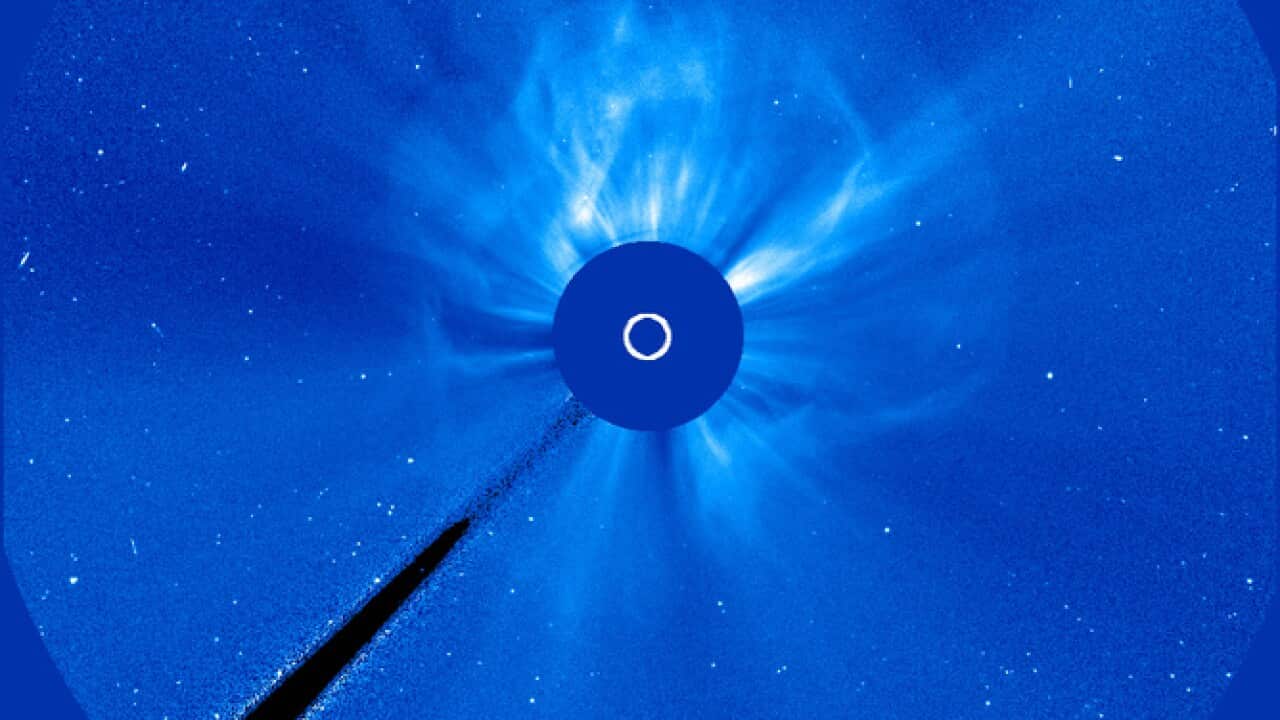
Often associated with flares is an even bigger eruption known as a coronal mass ejection (CME). In this case, as well as radiation, a gigantic bubble of gas is also blown off the sun.
The Solar and Heliospheric Observatory (SOHO) has captured CMEs released by both solar flares.
Tuesday’s flare, which was classified as an M4-flare, produced a bright CME which was caught streaming out of the sun at nearly 1,000 km/s. While today’s flare was incredibly fast moving, speeding along by as much as 3,750 km/s.
Storms of a different kind
The radiation released by the solar flare and corresponding CME flows down towards Earth to produce a solar radiation storm.
Fortunately, the Earth’s magnetic field and atmosphere blocks this radiation, so it doesn’t make its way down to us or affect airplane passengers.
Even the astronauts on board the ISS are safely inside the Earth’s magnetosphere and just in case, there are protected areas on the spacecraft where astronauts can ride out the storm.
NASA captured a mid-level solar flare on 24 August 2014
But solar radiation storms can affect satellites outside of the magnetosphere, causing damage to their electronics, memory and imaging systems.
For us on Earth, all this solar activity could bring with it beautiful aurora generated by geomagnetic storm activity.
The CME released by Tuesday’s flare was not directed right at Earth, so only a fraction of it will reach us. But even so, there’s predicted to be a high chance of aurora over the Earth’s polar regions in the next 24 hours or so.
But with today’s flare and CME pointed right at Earth, the aurora activity could be even more wide-spread and be seen down to lower altitudes.

A magnificent aurora over North America captured on August 20 by astronaut Reid Wiseman onboard the International Space Station. NASA
Geomagnetic storms can also disrupt communications with GPS and have been known to cause power outages. However, today’s solar activity is no where near as strong as the infamous flare that caused a widespread blackout across Quebec, Canada, 25 years ago.
In fact, the sun has been showing unusual low activity in the past year of so, considering that the peak of the sun’s 11-year cycle was supposed to have occurred in 2013.
Instead the sun has been very quiet and even last July, there was almost a week where the Sun had no sunspots. So it’s exciting to see things heating up.

Tanya Hill does not work for, consult to, own shares in or receive funding from any company or organisation that would benefit from this article, and has no relevant affiliations.







