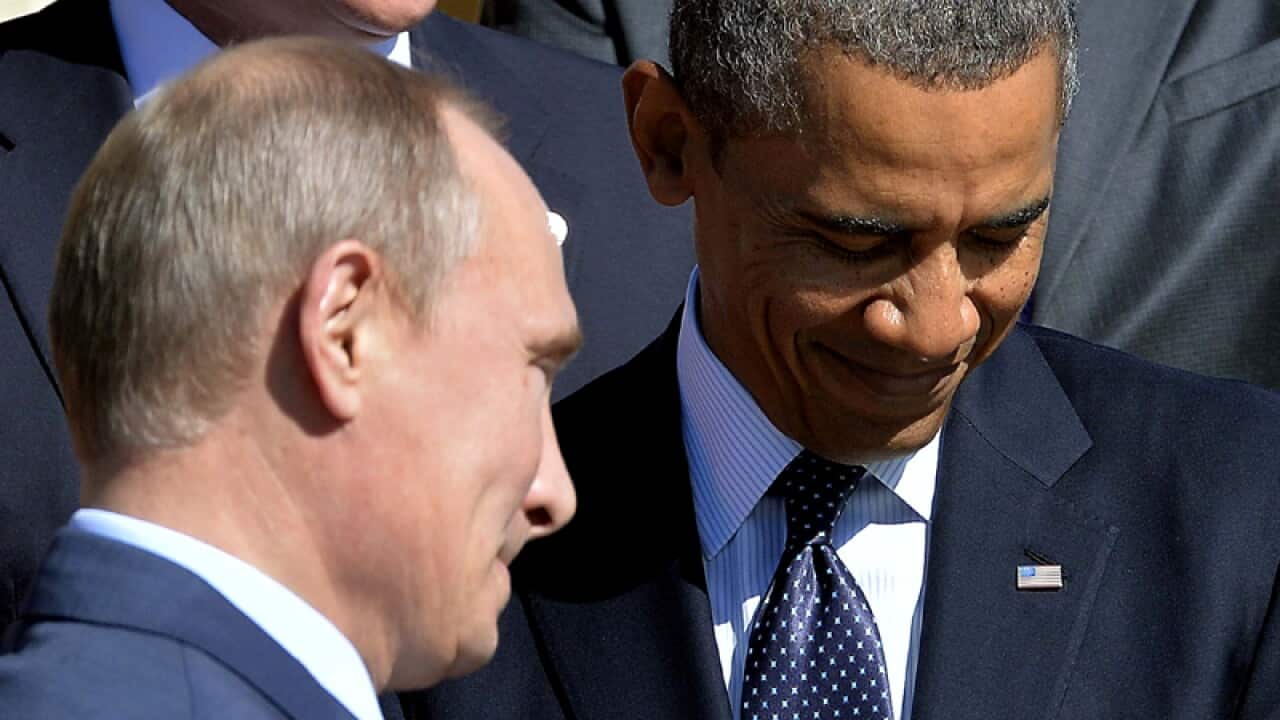
US President Barack Obama and Russian counterpart Vladimir Putin have failed to end their bitter dispute over US plans for military action in Syria, as half of the G20 called for a "strong" response to a chemical weapons attack blamed on the regime.
The United States signalled on Friday that it had given up on securing Moscow's support at the UN on the crisis, as Putin reiterated a warning that it would be "outside the law" to attack without the UN's blessing.
"We spoke sitting down... it was a constructive, meaningful, cordial conversation," Putin said after his previously unscheduled talks with Obama.
"Each of us kept with our own opinion," he said.
The split among leaders of the world's top emerging and developed countries over the issue was symbolised in a statement supported by 11 states at the G20 calling for a "strong international response" to the chemical attack.
News that makes sense
Your trusted source for staying up-to-date with the world around you. Get free daily news updates and analysis, straight to your inbox.
Without specifying military action, it said the response would "send a clear message that this kind of atrocity can never be repeated".
The signatories included US allies Britain, France, Australia and Saudi Arabia.
Obama argued at the end of the G20 summit in Russia that the world cannot "stand idly by" after the chemical weapons attack outside Damascus last month which the US claims was launched by President Bashar al-Assad's regime.
Washington prepared the ground for possible strikes, evacuating non-essential embassy staff from Beirut and urging Americans to avoid all travel to Lebanon as well as southern Turkey.
The Russian foreign ministry meanwhile on Friday strongly warned the United States against targeting Syria's chemical arsenal in any attacks.
Putin has emerged as one of the most implacable critics of military intervention against the regime of Assad over an alleged chemical weapons attack on August 21.
He and Obama spoke for about half an hour on the sidelines of the summit, but neither managed to change the other's mind on Syria.
"He (Obama) disagrees with my arguments, I disagree with his arguments, but we do hear, and we try to analyse," he said.
Obama also called the discussion "candid and constructive", adding that it "characterises my relationship with him".
On Friday, the United States said it has come to terms with the fact that no deal could emerge despite repeated attempts at persuading Syria's key ally Russia, and signalled that it would take punitive action against Assad's regime without the UN Security Council's backing.
Obama expressed appreciation for France, saying that he very much valued President Francois Hollande's "commitment to a strong international response for these grievous acts".
He said he would prefer to have an international mandate for the strikes, but that Washington should not be paralysed by a refusal on the part of some countries to act.
Obama, who will address the US nation on Tuesday, is now seeking support from Congress for military action, a process he admitted he always knew was going to be a "heavy lift".
Russia and China - both veto-wielding permanent members of the Security Council - have on three occasions voted down resolutions that would have put pressure on Assad.
UN chief Ban Ki-moon Friday also warned that military strikes could spark further sectarian violence in the country which he said is suffering from a humanitarian crisis "unprecedented" in recent history.
"I must warn that ill-considered military action could cause serious and tragic consequences, and with an increased threat of further sectarian violence," Ban said.
French President Francois Hollande said Paris would await the UN inspectors' report on the chemical attack before any Syria strike.
Several Western states share Putin's opposition to military action and after the British parliament voted against strikes, France is the only power to have vowed it will join American intervention.
According to US intelligence, more than 1400 people living in rebel-held suburbs of Damascus were killed in the August 21 chemical weapons attack, which involved the use of sarin nerve gas.







