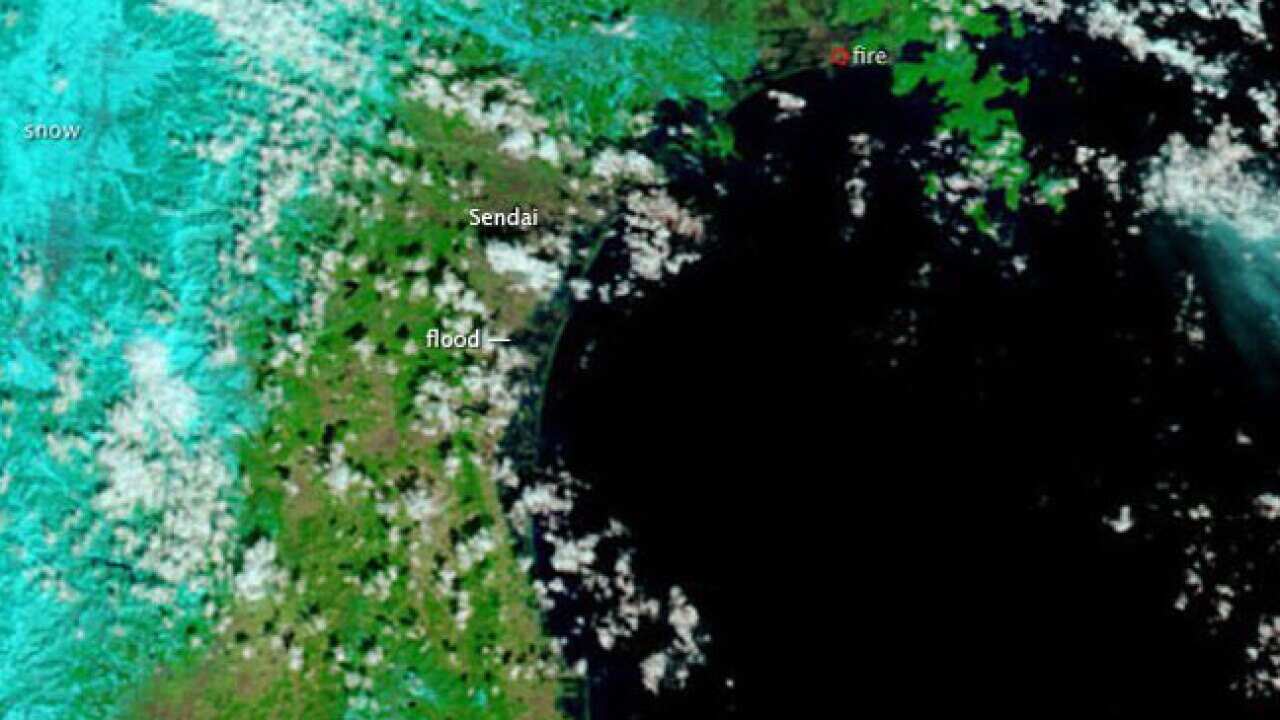
Japan's recent massive earthquake, one of the largest ever recorded, appears to have moved the island by about eight feet (2.4 metres), the US Geological Survey said Saturday.
"That's a reasonable number," USGS seismologist Paul Earle told AFP. "Eight feet, that's certainly going to be in the ballpark."
Friday's 8.9 magnitude quake unleashed a terrifying tsunami that engulfed towns and cities on Japan's northeastern coast, destroying everything in its path in what Prime Minister Naoto Kan said was an "unprecedented national disaster."
The quake and its tectonic shift resulted from "thrust faulting" along the boundary of the Pacific and North America plates, according to the USGS.
The Pacific plate pushes under a far western wedge of the North America plate at the rate of about 3.3 inches (83 millimeters) per year, but a colossal earthquake can provide enough of a jolt to dramatically move the plates, with catastrophic consequences.
News that makes sense
Your trusted source for staying up-to-date with the world around you. Get free daily news updates and analysis, straight to your inbox.
"With an earthquake this large, you can get these huge ground shifts," Earle said. "On the actual fault you can get 20 metres (65 feet) of relative movement, on the two sides of the fault."
He said similar movements would have been seen for Chile and Indonesia.
In December 2004, a 9.1 magnitude quake off Sumatra caused a tsunami that killed an estimated 228,000 people. An 8.8 quake off the coast of Chile in February 2010 killed more than 500.
There was not a similar ground shift in the 7.0 earthquake that devastated Haiti in February 2010, Earle said.
"A magnitude 7.0 is much smaller than the earthquake that just happened in Japan," he said. "We've had aftershocks (in Japan) larger than the Haiti earthquake."
Kenneth Hudnut, a USGS geophysicist, said experts read data including from global positioning systems to determine the extend of the shift.
"We know that one GPS station moved (eight feet), and we have seen a map from GSI (Geospatial Information Authority) in Japan showing the pattern of shift over a large area is consistent with about that much shift of the land mass," he told CNN.







