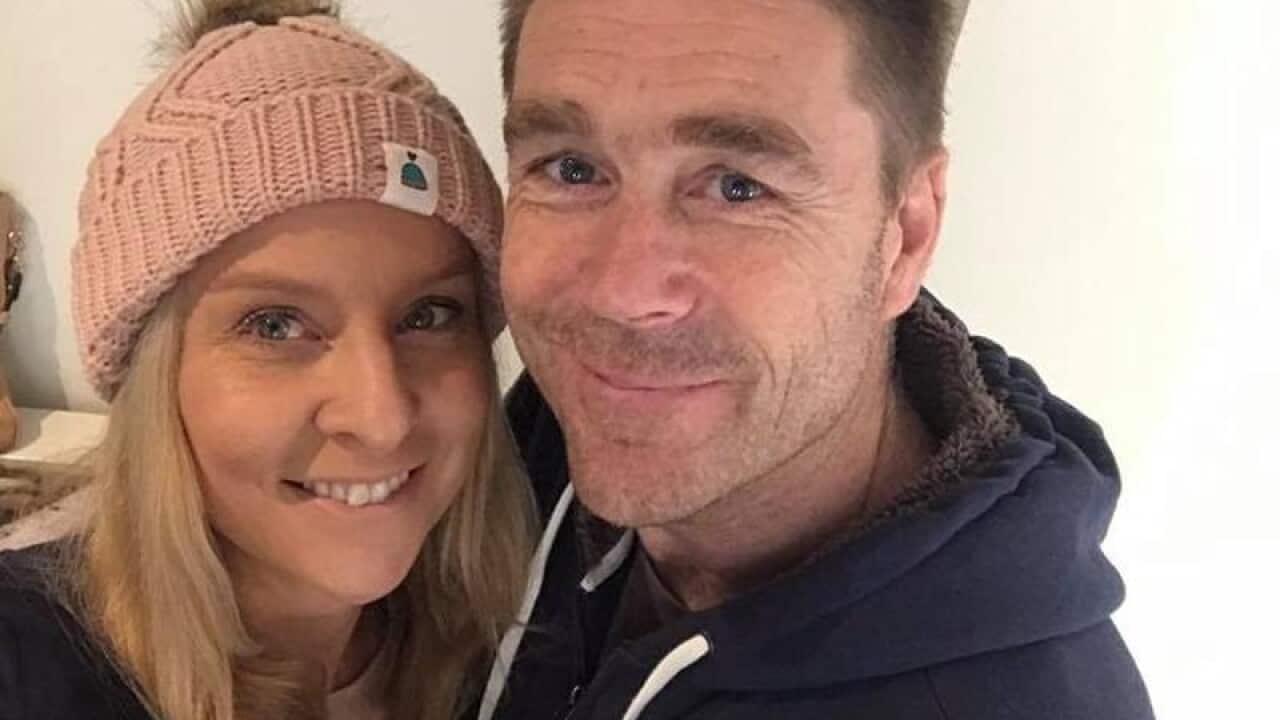
It's been almost four months since Christine Thornton lay beside her husband and whispered into his ear as he died in a Swiss euthanasia clinic.
It was a good death, the kind the couple had so desperately wanted. Peaceful. Dignified. Full of love.
Christine knew that Troy would still be able to hear her for about two minutes after the drugs began flooding his body.
"To me, that was peace of mind and I just made sure I said everything I could possibly think of to say," the Victorian office manager and mother-of-two told AAP this week.
"I told him how much I loved him, and how I would make sure the kids would never forget him, that they would know how special they were to him."
News that makes sense
Your trusted source for staying up-to-date with the world around you. Get free daily news updates and analysis, straight to your inbox.
Staff had been asked to gently touch Christie on the head when they were certain Troy was gone but when that moment arrived, she knew instinctively.
"You can feel the difference. I felt it. He was no longer there. It was the shell."
Soon afterwards, Christine was on a plane with Troy's ashes, bound for their home state of Victoria and a sad reunion with their children Jack, 17 and Laura, 14.
Months down the track, Christine is frank about the aftermath of euthanasia and says it's perhaps not what some might imagine.
She says there's been no second guessing Troy's decision to die. But there has been a profound sense of comfort in the end of his suffering and the good nature of his death.
"I'm not questioning myself about whether it was the right thing. I know exactly how he was feeling," Christine tells AAP this week.
"He was scared of what was coming (from his disease), and it was coming over the hill very quickly.
"I'm at peace that I was able to fulfil Troy's wishes. We had so many conversations about it, over so long. His whole thing was having the right to chose a good death over a bad one. To have dignity. He got that."
Troy, a veteran Victorian firefighter, was just 54 when he opted to die quickly, by lethal injection, rather than slowly from multiple system atrophy, an incurable and untreatable disease.
If the disease is allowed to run its course, sufferers are reduced to a vegetative state, and can often die choking on their own mucous as crucial functions like swallowing become impossible.
Christine says she and her children are grateful that Troy was able to avoid a death like that.
"They are doing okay. Again, I think it's the peace that comes with knowing their dad's not suffering anymore.
"We had so many conversations leading up to this, we had family holidays, we spent so much time together and we were very open - always talking about it, checking in with each other to make sure we were all okay."
Troy's decision to die was driven by fear about the end stages of his disease. But Christine says it was also about his role as as family protector.
"The kids, they've seen and experienced things that kids shouldn't have to."
In the days before they flew to Switzerland, Troy choked to the point of unconsciousness, with his family around him.
"He stopped breathing for two minutes. He was worried that if that had happened when we were not home, we could have found him choked to death.
"He just said I know I'm doing the right thing. I can't be found like this."
Christine says Troy would be happy that Victoria, on Wednesday, will become the first jurisdiction in Australia to allow euthanasia in more than two decades.
The laws were too narrow to help him, because he could not find two doctors who would say with certainty that his degenerative disease would kill him within 12 months.
But Christine is adamant that the Victorian legislation must be the start, and not the end, of a public conversation about the lack of end-of-life choices in Australia.
"Troy never thought the first laws would help everyone, but it's a start," she says.
"People who don't believe in euthanasia will never have to choose it. But shouldn't that option be there for people who do want a choice, who do want a good death."







