US President Barack Obama's Democrats are bracing for an elections rout, fueled by deep voter anger at the sour economy, that could hand Republicans control of at least the House of Representatives.
Obama, fearing a ballot-box repudiation just two years into his campaign for change, planned a wave of radio interviews and telephone calls to Democratic volunteers tasked with getting party faithful to the polls on Tuesday, aides said.
The president was notably targeting voters in the critical battlegrounds of Florida, Minnesota, Ohio and Pennsylvania - all key to his 2012 reelection bid - as well as his birth state of Hawaii, the White House said.
News that makes sense
Your trusted source for staying up-to-date with the world around you. Get free daily news updates and analysis, straight to your inbox.
Reps hold commanding lead
Feeding Democratic worries, the respected Gallup polling organization's final pre-vote survey of likely voters nationwide found Republicans held the most commanding mid-term lead either party has held in a generation.
Republicans led Democrats by a 55-40 percent margin, the widest such gap since 1974, when Democrats romped to victory amid public outrage at the Watergate scandal that forced disgraced president Richard Nixon from office.
The poll lent weight to analyst predictions that Republicans would retake the House of Representatives and slice deep into the Democratic Senate majority, though experts forecast the upper chamber would not change hands.
"I think we don't get the majority back, but we've come awfully close, and we finish the job in 2012," Republican Senator John Cornyn, his party's senate campaign field marshal, told NBC television.
Obama's soaring White House win of 2008 seemed an age away as voters went to pick 37 of 100 Senate slots, 37 of 50 governorships and all 435 House seats in a glum climate heavy with the cares of nearly 10 percent unemployment.
Republicans, electrified by the ultra-conservative "Tea Party" movement, vowed to reverse Obama's sweeping health care reforms and promised a budget crunch and tax cuts they said would slash the deficit, ignite growth, and create jobs.
"We just can't afford another two years like the past two," Republican House Minority Leader John Boehner, who would all but certainly replace Democrat Nancy Pelosi as House Speaker, said in an op-ed in USA Today on Monday.
In a sign of Democratic angst, party chairman Tim Kaine told ABC television that Obama would set about making "some adjustments and corrections" over the next few weeks in the face of a reenergized Republican opposition.
Top Republicans, however, have vowed "no compromise" with the White House on key issues and the party's leader in the Senate candidly declared last week that their number one goal would be to defeat Obama in 2012.
Obama tries to deflect anger
Obama has pleaded with voters to recall that Republican George W. Bush was in the driver's seat in 2008 when the US economy hurtled into a "ditch," and said his own polices staved off a second Great Depression and have put the United States back on course to prosperity.
He also charged Republicans would hand power back to predatory health insurance companies and credit card and finance barons by repealing health care and Wall Street reforms that add up to an already full presidential legacy.
Polls and forecasters predicted Republicans will pick up anywhere between 45 and 70 seats in the House, more than the 39 they need to gain a majority, in a reversal of the huge losses they suffered in 2006 and 2008.
Control of the House would allow Republicans to thwart Obama's ambitious plans to tackle global warming and overhaul US immigration, and to control committees that could launch damaging probes into the administration.
In close Senate races, Democrats worked desperately to hold back the Republican tide in California, Colorado, Ohio, Pennsylvania, Wisconsin and Obama's old senate seat in Illinois.
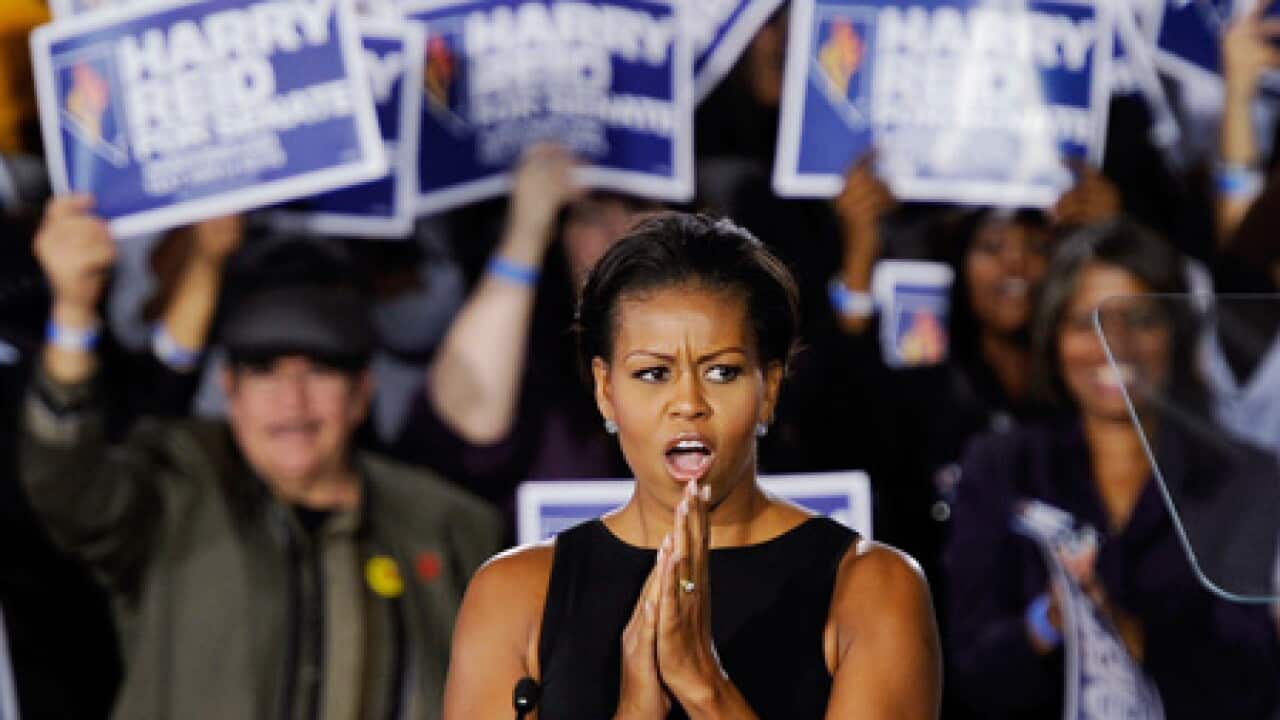
The list of endangered Senate Democrats included Majority Leader Harry Reid, who was locked in a too-close-to-call battle with Republican and "Tea Party" favorite Sharron Angle in Nevada, home to the country's highest unemployment and home foreclosure rates.
But voters seem more inclined to punish the party in power, rather than to have suddenly fallen for Republicans, who remain broadly unpopular.
And despite a grim two years fighting economic malaise, Obama remained the most popular, active senior US political leader - though his approval ratings now in the mid-40s have declined from their stratospheric heights.
Historically, sitting US presidents have seen their party lose seats in elections halfway through their first term, though Bush defied that trend in 2002.







