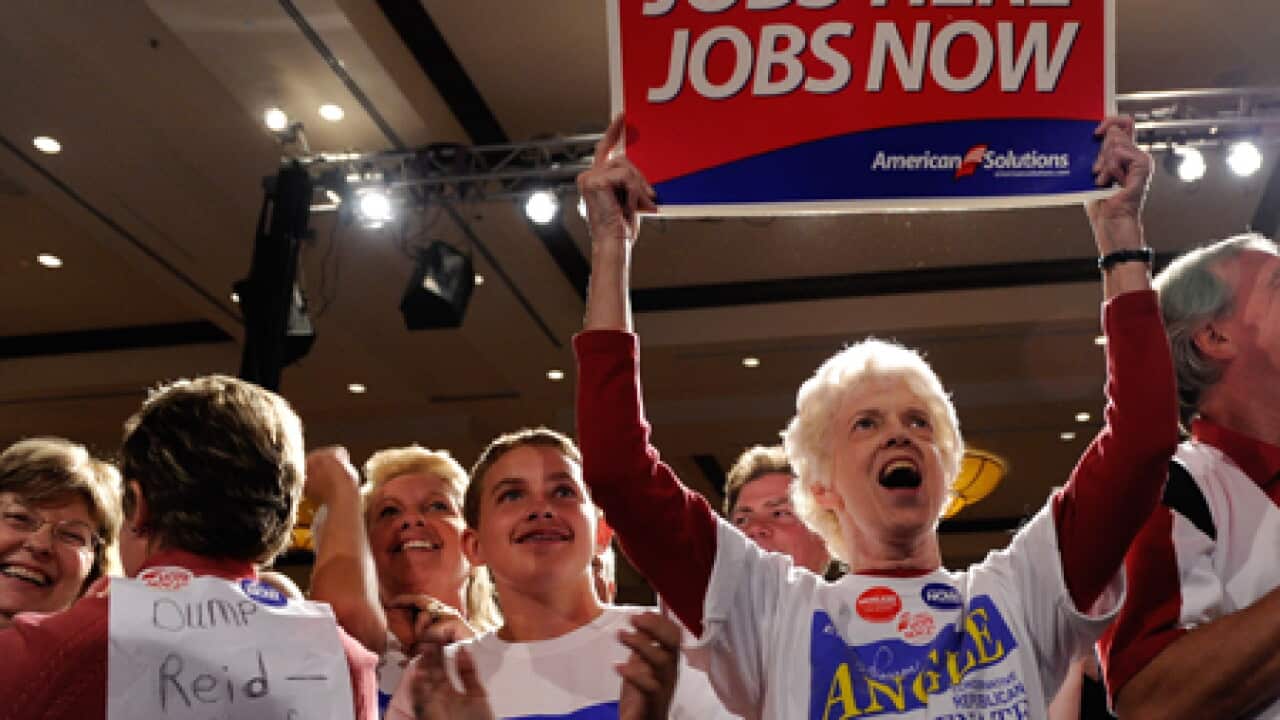
One week before US elections, President Barack Obama's fired-up Republican foes seemed on track Tuesday to ride a wave of voter anger at the sour economy to big gains in Congress.
Analysts predicted Republicans would retake the House of Representatives and cut deeply into the Democrats' Senate majority, winning a solid base to assail Obama's agenda two years before his 2012 reelection bid.
Democrats hoped their get-out-the-vote efforts would make the difference in scores of nail-biter races and help contain a Republican tide that was also expected to give the president's opponents control of key governorships.
News that makes sense
Your trusted source for staying up-to-date with the world around you. Get free daily news updates and analysis, straight to your inbox.
Obama, who warned supporters in Rhode Island late Monday to "run scared" of losing their congressional majorities, planned to mount an 11th-hour coast-to-coast blitz through crucial battlegrounds.
"I've got to have you come out in droves and vote in this election. You've got to come out and vote. And, look, if everybody who voted in 2008 votes in 2010, we are confident we will win this election," he said.
But a USA Today poll gave Republicans an unprecedented 63 percent-37 percent edge over Democrats among supporters who said they were more excited than usual about casting a ballot on November 2.
In 1994, Republicans held a nine-point advantage in the same poll and went on to swamp Democrats in a historic rout -- something they hope to do again in an election that will shape the fate of the president's agenda.
The survey, carried out by the respected Gallup organization, had an error margin of plus or minus four percentage points. It seemed to buttress repeated US media reports of a potentially devastating "enthusiasm gap" for Democrats.
Historically, a sitting US president's party loses seats in his first mid-term elections, though such contests have not been good predictors of chances for a second term.
Democrats, aiming to capitalize on rules that allow early voting, enlisted First Lady Michelle Obama to urge party faithful in an online video not to wait until election day because "our president needs our help, we need your votes!"
All 435 House of Representatives seats, 37 of 100 Senate seats, and 37 governorships are up for grabs in the election, which came amid stubbornly high unemployment of nearly 10 percent.
Analysts predicted Republicans stood a solid chance of netting the 39 seats needed to retake the House and seizing key governorships but would fall just short of the 10 new seats required to recapture the Senate.
Taking control of even one chamber of Congress would give Republicans broad control over the legislative agenda in Washington and new power to investigate the Obama administration and probe government programs.
And winning over governorships and state legislatures would give Republicans an edge in once-per-decade re-drawing of political maps, a process often bent to partisan aims in a bid to maximize a party's presence in Congress.
Among the high profile races: California was picking a successor to action star turned Governor Arnold Schwarzenegger, and Democratic Senate Majority Leader Harry Reid was fighting for his political life in Nevada.
Whatever happens on Tuesday, Republicans must make it their top goal to defeat Obama in 2012, Republican Senate Minority Leader Mitch McConnell told National Journal, which focuses on US politics and policy.
In an interview published Monday, McConnell underlined that Republicans must be "smarter" than they were after retaking the Congress in 1994 -- only to see then-president Bill Clinton coast to reelection in 1996.
"Our single biggest political goal is to give our nominee for president the maximum opportunity to be successful," he told the magazine.
McConnell also warned the arch-conservative "Tea Party" movement -- which has vowed to turn Washington upside down -- not to expect sweeping changes as long as Obama "holds the veto pen."
The movement -- which has harnessed voter anger at government spending in response to the worst downturn in 80 years -- has set its sights on ousting Democrats, including Reid.
Obama, meanwhile, planned to stay at the White House for election night, staying "in fairly regular communication" with his top advisers and receiving a steady stream of written or email updates, his spokesman Robert Gibbs said.
Gibbs noted the president was "not usually one to sit by the TV and watch over and over and over again" the early returns and commentary.







