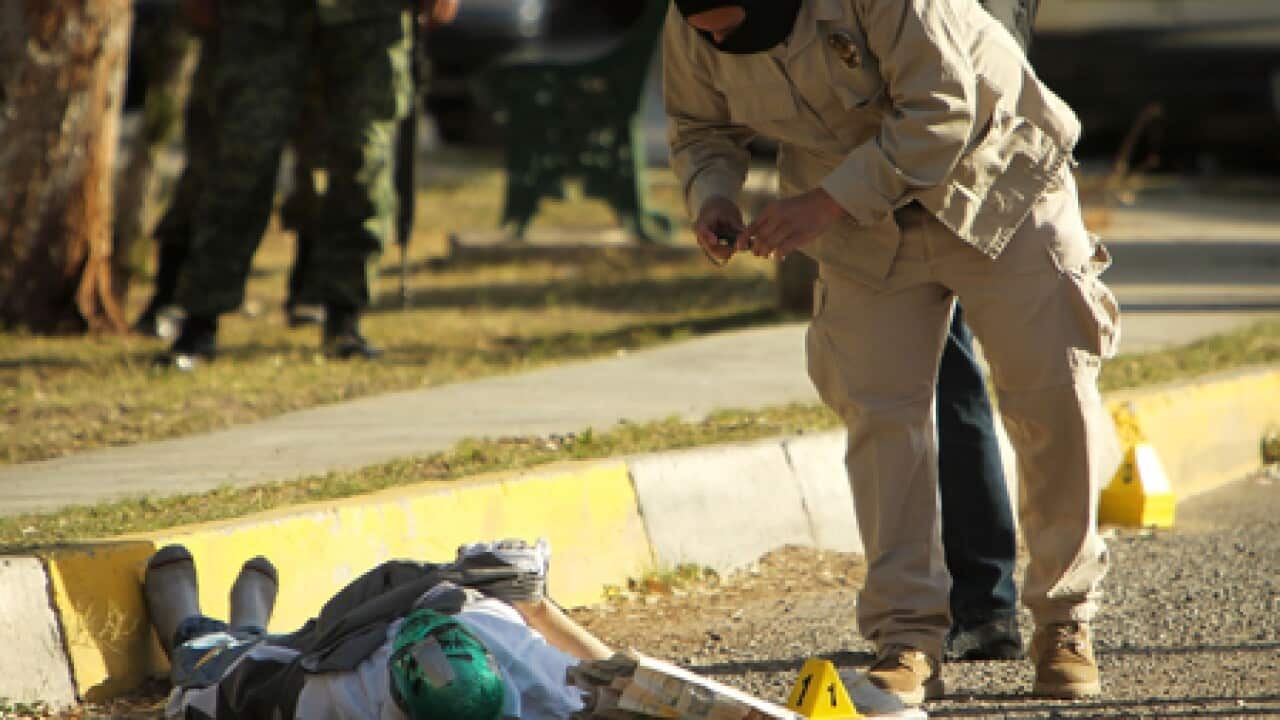
Thirteen retirees were shot and killed late on Sunday in an execution-style massacre at a Mexican drug rehabilitation centre near the border city of Tijuana, a police official told AFP.
The exact reason for the killing was not immediately known but it was apparently linked to a brutal drug war that has claimed thousands of Mexican lives this year.
"There were 13 people killed. They were all recuperating drug addicts," said the police official who spoke on condition of anonymity.
News that makes sense
Your trusted source for staying up-to-date with the world around you. Get free daily news updates and analysis, straight to your inbox.
According to a witness, gunmen lined up their victims against a wall and executed them in cold blood. There were no wounded.
As many as 105 tonnes of marijuana were seized in Tijuana last week in the largest drug bust in Mexican history, and some law enforcement officials suggested Sunday's killings might have been connected to this event.
The rehabilitation centre is located in the same neighbourhood where the drugs were seized and destroyed.
The narcotics had a value of over $US335 million ($A340.55 million) on the Mexican street, but their worth could double or triple if sold in the United States, which the traffickers had been attempting to enter, officials said.
Killings follow shootout
The massive haul came after a shootout between Tijuana municipal police officers and gunmen in a convoy of seven vehicles. The army and state police sent reinforcements and 11 people were arrested. Some of the drugs were found aboard the trucks.
Confessions from the detainees led security forces to more of the illegal substance at a local ranch, a home and an apartment.
On the US side of the border, Californians are due to vote on November 2 in a referendum over whether to legalize marijuana for recreational use.
Mexico's border regions, especially the major towns directly on the US frontier, have witnessed the brunt of the conflict with notable spikes in particularly gruesome violence in Tijuana and Ciudad Juarez, which borders Texas further to the east.
Murder at house party
The Tijuana attack follows the killing of 14 people during a celebration this past weekend in Ciudad Juarez, another Mexican border city, where warring Mexican drug cartels have unleashed a wave of violence.
At that city, gunmen stormed a home and shot indiscriminately at partygoers, including many teenagers.
The attack, which began at pre-dawn hours on Saturday, was the third such massacre this year in Ciudad Juarez, Mexico's most violent city, and it bore the chilling hallmarks of a drug cartel attack.
"The victims were in the back yard of the house having a party when hooded men, in dark uniforms and with rifles, arrived in several vans, broke in and began shooting indiscriminately at those inside," said a police official in this troubled metropolis.
The young gunmen screamed insults as they opened fired on the crowd, according to witnesses, who told the police the hail of bullets went on for five minutes.
Ciudad Juarez, with a population of 1.2 million people across the Rio Grande from El Paso, Texas, is at the epicentre of a ferocious drug war between two major drug cartels battling for control of lucrative trafficking routes into the United States.
The latest attack occurred in the Horizontes del Sur neighborhood, about 2km from the site of an eerily similar blood bath in January, when heavily armed gunmen killed 16 youths at a party.
On June 11, 19 people were gunned down in a Ciudad Juarez drug rehabilitation centre.
Drug violence has claimed more than 7,000 lives nationwide in 2010, making it the deadliest year since President Felipe Calderon launched a war on drug cartels in 2006.







