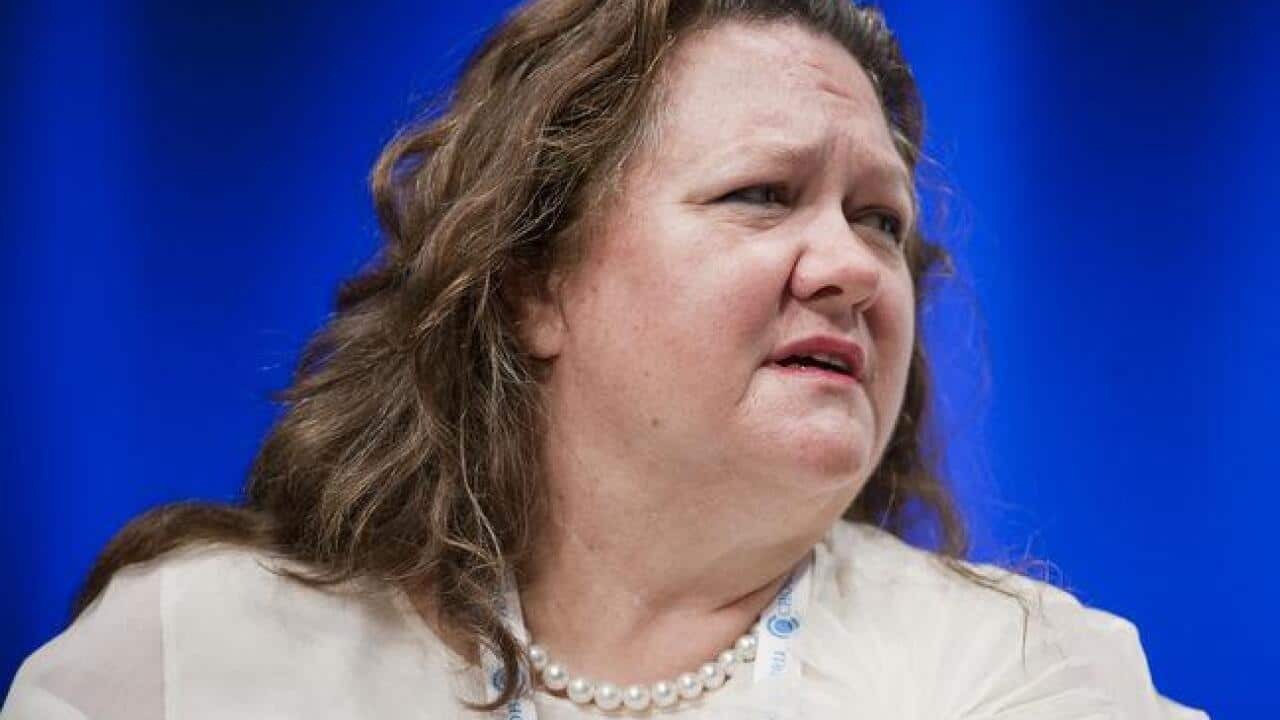
Australia's richest woman, Gina Rinehart, has become the largest shareholder in newspaper publisher Fairfax Media in what one analyst told SBS is likely a play for control of the 181-year-old company.
Ms Rinehart, a mining industry billionaire, had acquired 12.8 per cent of the nation's second-largest newspaper company by late Wednesday.
This puts her ahead of Commonwealth Bank's 12.4 per cent, according to IG Markets analyst Chris Weston.
News that makes sense
Your trusted source for staying up-to-date with the world around you. Get free daily news updates and analysis, straight to your inbox.
The news pushed Fairfax shares up 7.5 cents, or 10.14 per cent, to a three-month high at 81.5 cents.
POWER PLAY
Media analayst Roger Coleman from CCZ equities told SBS Ms Rinehart may increase her share at the permitted 3 per cent every six months, increasing her share to twenty per cent as fast as possible.
Ms Rinehart made her $192 million play at 81.77 cents a share - a 10.5 per cent premium to Tuesday's close - which has increased her stake from 4.9 per cent to just under the 15 per cent ownership limit currently legally permitted.
"'She would have control of the company at around 22 to 26 per cent of capital...at that point she's got the company", Mr Coleman said.
The Communications Minister Stephen Conroy says there should be a debate about applying a stronger public interest case to the media, amidst concerns Ms Rinehart will seek to take control and direct the editorial lines of Fairfax papers, with her mining operations driving the company's line.
Fairfax publishes The Age, The Sydney Morning Herald and The Australian Financial Review and owns a string of radio stations.
"Just one newspaper group in a complex, competitive market can change election outcomes. If she's out for that aim, it's achievable given her wealth", Mr Coleman said.
"That's the last left-wing operation in Australia outside Crikey.com...if she can get that, she can change the agenda."
Mr Coleman said newspaper companies work better with a proprietor, and were Ms Rinehart to be it, the direction for Fairfax was obvious.
"It's economically logical to go back to a right-wing agenda", because that's where the paying audience is...and Rinehart will ensure it happens."
Mr Coleman also said Ms Rinehart would not be overly concerned at predicted revenue falls of minus five to ten per cent per annum for the next decade.
"She'll make a couple of billion dollars eliminating the mineral resource rental tax: that's it."
While neither Ms Rinehart nor Fairfax would comment on Wednesday, the move has been met by concern elsewhere.
Media analyst Peter Cox agreed there was no way Ms Rinehart was buying into Fairfax as a major shareholder just for a financial investment.
"This has to be driven by her view on politics in Australia," Mr Cox said.
"What's the point of spending that money on it if you're not going to have influence?
Ms Rinehart's late father, Lang Hancock, was an investor in Western Australian newspapers The Sunday Independent and the National Miner.
Ms Rinehart, who chairs her privately owned mining company Hancock Prospecting, has been a vocal critic of the Gillard government's mineral resources rent tax (MRRT) and Labor's plan to put a price on carbon pollution.
Shortly after Ms Rinehart picked up a board seat at Ten Network Holdings, the conservative commentator Andrew Bolt was given a TV talk show on Sunday mornings.
JOURNALISTS' CONCERN
However the secretary of the journalists' union the MEAA, Chris Warren, said journalists should be reassured that the Fairfax board was committed to its charter of editorial independence.
No individual shareholder or proprietor could seek to influence editorial decisions, he said.
OptionsXpress market analyst Ben Le Brun said he was surprised Ms Rinehart would buy into Fairfax, given its debt, falling advertising revenue and a decision to sell down its stake in the profitable Trade Me online business.
EL&C Baillieu Stockbroking media analyst Ivor Ries said Ms Rinehart's move on Fairfax was high risk, given he doubted she could influence the board and he doubted that the company would ever return to its profitable heyday.
"She could just be being opportunistic ... she's enjoying the up cycle of mining, media is in a down cycle and she's buying it at the bottom to flip them out in 18 months to two years' time when the media cycle turns better," he said.
Ms Rinehart's personal wealth is believed to have recently doubled to about $20 billion through the sale of a 15 per cent stake in the Roy Hill iron ore project in Western Australia to South Korean corporate giant Posco.
That would mean her investment in Fairfax represents less than one per cent of her fortune, with Fairfax's complete market value only $1.7 billion.
Coalition politicians have spent the day dismissing concerns, after the Greens expressed concern at people using the media as a mouthpiece.
Opposition treasury spokesman Joe Hockey said it "arguably does not matter" who owns Fairfax, due to its strong board and editorial independence.
"It comes down to the quality of the paper, the quality of the editorial," Mr Hockey said on ABC Radio.







