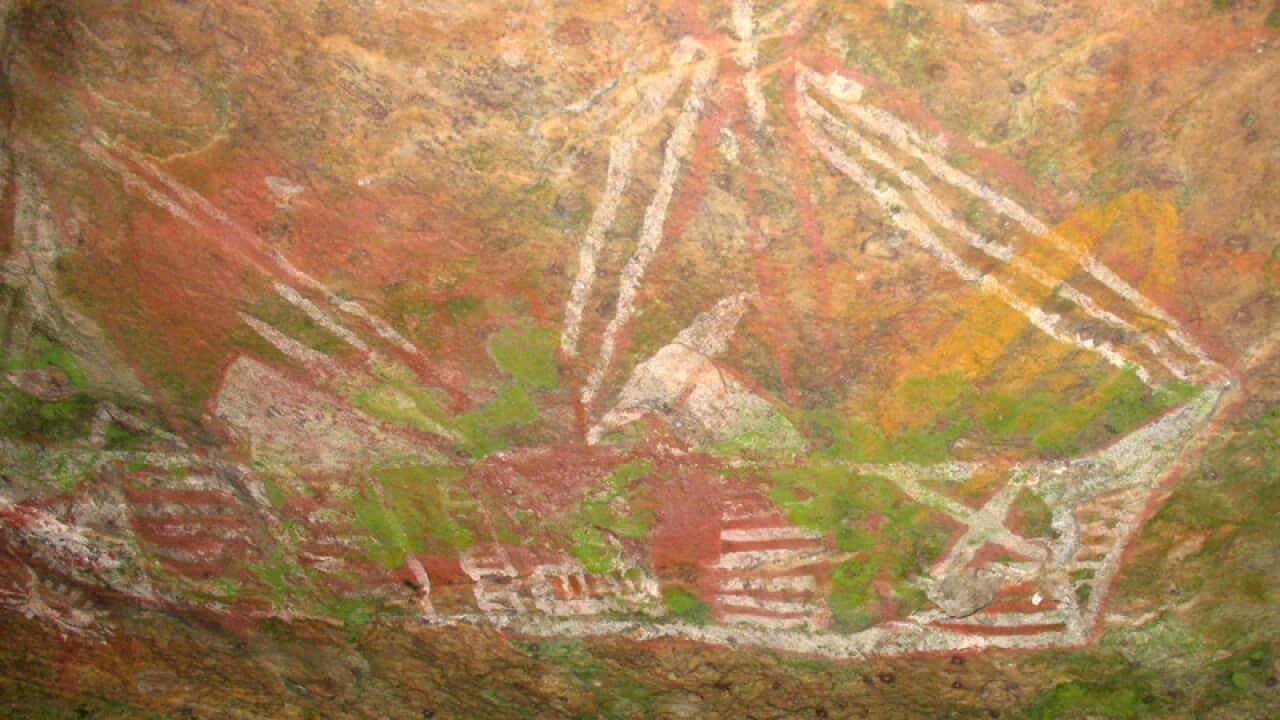
An expedition to a remote Northern Territory island in search of clues for ancient coins has discovered rare indigenous rock art that could depict the first seafarers to reach Australian shores.
The art work shows vessels which could pre-date the arrival of Dutch explorers in the 17th century.
Five 1000-year-old African copper coins were initially found on the Wessel Islands, an uninhabited group of islands off Australia's north coast, when troops were stationed there during World War II.
A 10-day expedition last month to look for clues around the discovery site did not find any more coins but instead unearthed Aboriginal rock art that depicts the ancient sailing ships and sailors.
The expedition team led by Australian scientist Ian McIntosh, currently Professor of Anthropology at Indiana University in the US, searched the entire island.
News that makes sense
Your trusted source for staying up-to-date with the world around you. Get free daily news updates and analysis, straight to your inbox.
His team had to crawl partly on their backs through thick bush to discover several caves filled with the Aboriginal rock paintings.
"We combed every square metre," Professor McIntosh said.
Among whales, snakes and fish, the ancient but as yet un-dated art shows white men with long pants and guns, ships of different sizes with sails and rigging that were used in different periods of seafaring.
The discovery was met with enthusiasm by the Aboriginal owners of the land, the Warramiri-Golpa clan, who supported the venture with an oral history.
The rock paintings, together with the five coins from the ancient African kingdom of Kilwa, have led to speculation that the northern parts of Australia may have been visited by European, Arabian, African and Indonesian seafarers before 1606 - when Dutch explorer Willem Janszoon became the first known European to reach Australian shores, followed a few years later by compatriot Dirk Hartog.
The expedition also found a piece of timber which may have passed as driftwood but is believed to be a piece of deck support for an old sailing ship.
Despite not yet being dated it could support the theory of a shipwreck from where the coins might have washed ashore.
The coins could be from an Arab ship as "they found another Arab shipwreck off Sumatra 10 years ago," the group's geomorphologist Tim Stone said.
"Or from a Portuguese ship, as it is possible that they were making contact with Aborigines in the north and must have had Kilwa coins in their possession after destroying the African kingdom in the 1500s," he said.
Australian soldier Maurie Isenberg discovered the coins in 1944 while fishing when stationed on one of the islands to man a radar installation.
He didn't have a clue where they came from but pocketed them before putting them in a tin and forgetting about them for 35 years.
In 1979 he rediscovered them and sent the coins to a museum for identification, along with an old map showing an "X" where he found them.
Professor McIntosh's team used that map to find the location of the coin discovery.







