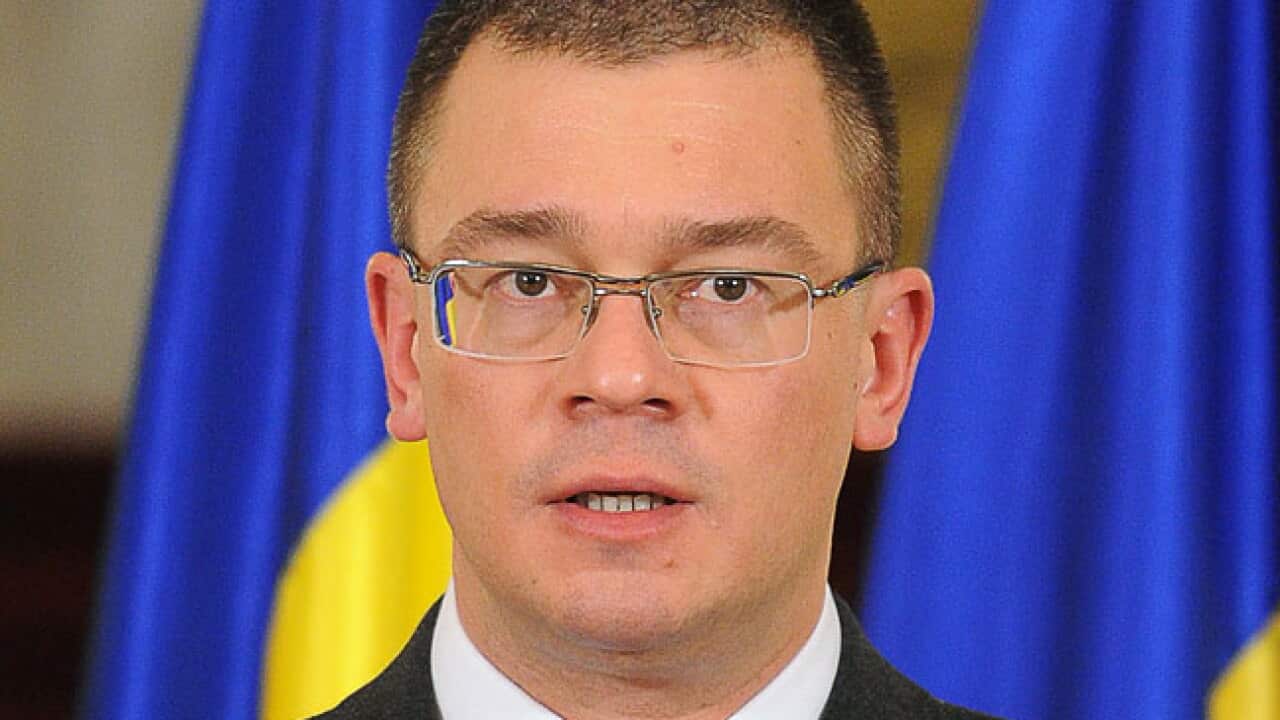
Romania's spy chief was appointed prime minister after the centre-right government resigned following wide protests over austerity cuts.
"The ruling coalition agreed to appoint Mihai Razvan Ungureanu as prime minister designate", president Traian Basescu Basescu said in a public address.
Ungureanu now has 10 days to form a government and win parliament's approval.
News that makes sense
Your trusted source for staying up-to-date with the world around you. Get free daily news updates and analysis, straight to your inbox.
"Reforms will continue. The added value that I will bring resides in my experience as a manager," Ungureanu said.
The 43-year-old, who has a master's degree from Oxford, was foreign minister between 2004 and 2007 during Basescu's first term in office.
Forced to resign following a conflict with then prime minister Calin Tariceanu, he was named chief of Romania's external intelligence service (SIE) in December 2007.
Ungureanu, who speaks fluent English, French and German, has worked as history professor at Bucharest's university.
An elegant man, with close-cropped hair, he has kept the intelligence service away from scandals that marred its reputation before he was put in charge, analysts say.
"The new government's first priority will be to restore the purchasing power of the Romanians who bore the brunt of the macroeconomic adjustment measures" adopted since 2010, Basescu said.
He stressed that the new government should do more to fight corruption, especially when government officials are implicated.
Ungureanu said that he would start talks on forming a new government with the ruling coalition parties on Tuesday morning.
He added that he would also talk to the opposition, even if its leaders have ruled out any solution short of early elections.
Prime minister Emil Boc quit Monday amid public anger at austerity measures and despite praise from the International Monetary Fund and the European Union for introducing drastic economic reforms.
"I have decided to tender the resignation of my government in order to defuse political and social tension and preserve Romania's hard-won stability," Boc told
Boc, 45, had been prime minister since 2008, when the Balkan country plunged into severe recession after years of solid growth.
His government was forced to call on the IMF and the EU for a 20-billion euro ($26 billion) lifeline in 2009. In exchange for the loan, Boc's government took drastic measures to curb public spending, cutting public wages by 25 percent and freezing pensions in 2010.
Tens of thousands of jobs were axed in the public sector.
Last year, Romania concluded a second, precautionary-type agreement with the IMF and EU for a five billion euro credit line, to be drawn on only in case of emergency.
After two years of recession, Romania registered economic growth in 2011 while the public deficit was expected to have remained under three percent of GDP.







