(Transcript from World News Radio)
Tensions remain high between Russia and Ukraine's interim government as both exchange accusations.
Russia's Federal Security Service has arrested 25 Ukrainians who it says planned attacks in Russia at around the time of last month's Crimean referendum.
News that makes sense
Your trusted source for staying up-to-date with the world around you. Get free daily news updates and analysis, straight to your inbox.
While Ukraine's leadership says more than 30 Russian security agents had been involved in planning operations against anti-government protesters in Kiev.
Greg Dyett reports.
(Click on audio tab to listen to this item)
Russia's Federal Security Service, the FSB, says members of ultra-nationalist movements had been planning attacks on Russian soil for between March the 14th and 17th.
The services says it's detained 25 Ukrainians, including three members of the Ukrainian nationalist group Right Sector.
Ukraine's Security Service has dismissed as nonsense Russian media reports that it gave orders for the attacks.
The claim comes at the same time as Ukraine's interim government accuses the ousted pro-Russian president, Viktor Yanukovych, of responsibility for attacking anti-government protesters in Kiev.
They say Mr Yanukovych issued orders to shoot the protesters, while Russian agents helped plan and carry out the shootings, which took place over three days in February.
Ukraine's interim Prime Minister, Arseniy Yatsenyuk, has told the BBC Mr Yanukovych is to blame for the deaths.
"It's crystal clear that President Yanukovych and his close allies are personally responsible for these killings."
In other developments, Russia has increased the gas price it charges Ukraine for the second time in just three days, pushing the price up by 80 per cent.
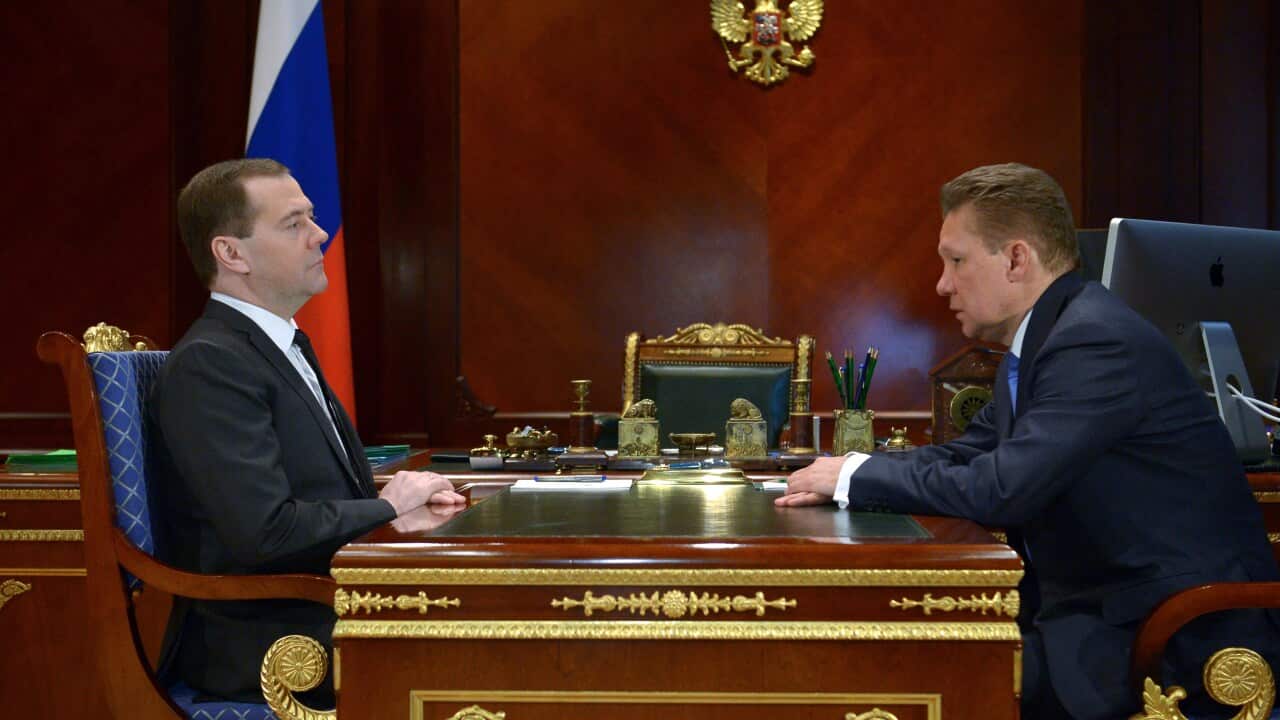
Russia's Prime Minister, Dmitry Medvedev, held a face-to-face meeting with the head of the state-owned gas company, telling Gazprom to increase the price of gas and insist that past bills are paid.
(translated) "I have made a decision to cancel the government's decree number 291 from April 30, 2010. This decision entails direct consequences for Gazprom's future relations with our Ukrainian partners, consumers, you should follow the general rate for gas without any reductions or special tariffs." (Medvedev ends)
Ukraine needs Russian supplies for 50 per cent of its demand for gas and says this increase is politically motivated.
Russia has also accused the NATO alliance of violating international law by enhancing its military presence in Eastern Europe.
NATO has reinforced defences in eastern Europe to carry out what it calls a collective defence of its member states.
Secretary General Anders Fogh Rasmussen says NATO has not violated any of its commitments to Russia.
"This is just another piece of Russian propaganda and disinformation and it's based on a baseless interpretation of the NATO Russia Founding Act which we agreed with Russia in 1997."
Meanwhile, the way this conflict is being covered by the Australian media has left a community group of Russian Australians saying that if feels besieged.
The Russian Ethnic Representative Council of Victoria says the Australian media's coverage has been biased, reviving Cold War rhetoric to portray Russian actions in a negative light.
Council President Alex Ilyin says the depiction of Russians is unfair.
"Russia's being portrayed as an invader, as a country that offends, takes over and so forth and so forth. Well we know in the case of Crimea that they ran the referendum and it was the will of the people. We know for a fact that there is a 17 per cent population of Tatars, 20 per cent of Ukrainians, the rest are predominantly Russian and Russian-speaking people."